Dealing with hazards
As a driver, you will constantly face hazards on the road. A hazard is any object or situation that could be dangerous.
Hazards include:
- Intersections
- Curves or bends in the road
- Pedestrian crossings
- The position or movement of other road users, such as other vehicles, cyclists or pedestrians
- Changes in weather and road conditions
To deal with hazards safely, you should get into the habit of using the hazard action plan and system of car control described in this section.
The hazard action plan
When you’re driving you should always be:
- Identifying potential hazards that could affect you
- Predicting how the hazard might develop and endanger your safety
- Deciding what action to take to negotiate the hazard
- Acting upon your decision by using the system of car control
The system of car control
This system is a safe and simple method of driving that will help you deal with hazards safely. It ensures you are always positioned in the right place on the road, and travelling at the right speed and in the right gear.
Use this system when you approach any type of hazard.
Course of action: when you see a hazard, decide on the best way to deal with it. For example, if there are children playing near the kerb, the best thing to do may be to move as far away from the children as possible, while still keeping on your side of the road.
Mirrors: check your mirrors frequently to see the position of all other traffic around you.
Signal: always signal if you intend to change your position on the road.
Brake: use the brakes to reduce your speed.
Gear: select the correct gear for the speed you have chosen.
Accelerate: accelerate safely to leave the hazard.
Multiple hazards
It is rare to come across only one hazard at a time when driving. Most of the time you will have to deal with several hazards at once.
This means you will need to stay aware of all the hazards, but give most attention to the hazard that is most likely to develop into a dangerous situation and require you to take urgent action.
Identifying the ‘main’ hazard
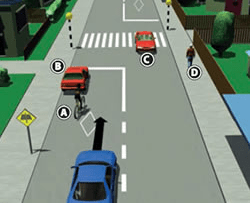
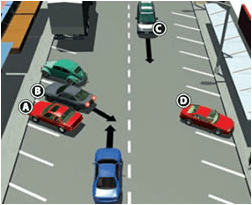
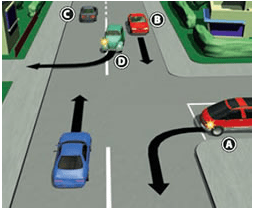
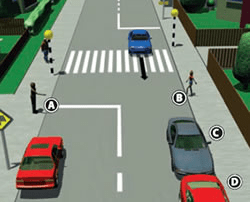
The following illustrations show scenes involving multiple hazards for the driver of the blue car. Remember, the main hazard is the one that is most likely to require you to take urgent action.
Safe driving tips
Extend your vision
One of the most important things you can do to be a safer driver is to look well ahead of you when you’re driving, so you can pick up potentially dangerous situations before it’s too late.
The earlier you spot a potential hazard, the more time you will have to take evasive action.
Rather than looking only as far as the vehicle in front of you when driving, you should actually be scanning the road in front to a distance of at least 12 seconds ahead of where your car is – that is, the place you will be after driving for 12 seconds.
As a rough guide, 12 seconds is approximately six cars ahead.
Keep your eyes moving
Many people only look ahead of them when driving. This means they’re not getting the full picture of what’s happening on the road.
As well as looking ahead, you should also use your mirrors to look to the sides and behind every few seconds while you drive. This will help you spot potentially dangerous situations that could be forming around or behind you.
Moving your eyes regularly and concentrating on what’s going on around you will also help you to stay alert on long journeys.
Create a safety cushion
You should create a ‘cushion’ of safety around your whole vehicle by making sure there is a safe distance in all directions between you, other vehicles and potential hazards.
This will give you and other road users more time and space to avoid any hazards.
- Create a cushion of safety ahead of you by maintaining a safe following distance. Use the two-second rule or the four-second rule when appropriate.
- Create a cushion of safety behind you by maintaining a safe distance between you and any following vehicles. If a vehicle is following you too closely, slow down, move over and let it pass as soon as you can do so safely.
- Create a safety cushion to your sides by keeping a safe distance from any hazards on your sides, such as driveways, parked vehicles, cyclists or children playing on the footpath.
Important
The cheapest insurance you can have is space around your vehicle. The more space you have the safer you will be.
Don’t get distracted
It’s easy to get distracted when you’re driving. Things like music, talking passengers, passing scenery and roadside advertising can all divert your attention from your driving and the road.
You must learn to ignore distractions and concentrate on your driving when you’re behind the wheel. If, for any reason, you must look away from the road, follow the pointers below:
- Check well ahead and behind for any potential hazards. Don’t look away if you can see potential hazards.
- Remember if you do look away from the road make sure you don’t go off course.
- Never take your eyes off the road for more than a few seconds.
Identify escape routes
Following the tips above will help you avoid many potentially dangerous crashes. However, despite all your best efforts, there may still be occasions when you find yourself on a direct collision course with another vehicle or other hazard.
For this reason, it is wise to identify possible escape routes all the time while you’re driving. That way, if you find yourself in danger of a crash, you’ll be ready to take quick evasive action.
Most escape routes will be to your left, so take note of what’s on the left-hand side of the road as you drive. Ask yourself questions like:
- ‘Is there a wide shoulder I could steer onto?’
- ‘Can I steer off the road safely if I need to?’
If there are no safe escape routes, reduce your speed and increase your following distance so you can stop in plenty of time if a crash situation develops.
Furthering your driver education
As a driver, you never stop learning. You should always be looking for ways to improve your safe driving skills.
Practice, combined with the right attitude, will help you refine your skills, but there are also courses you can take to help you become a safer driver.
Tips for handling driving emergencies
Sometimes, no matter how carefully you drive, you may still find yourself in an emergency situation. This section describes how to handle emergencies if they develop.
Skids
Skids don’t happen without reason. They are usually caused by:
- Heavy acceleration
- Heavy braking
- Changing direction suddenly
- Driving too fast on wet or unsealed roads
Different kinds of skids require you to take different corrective action. You should know what to do if your car goes into a skid.
Note: the following guidelines relate only to vehicles with conventional brakes and not vehicles with ABS brakes.
If your vehicle has ABS brakes, never pump the brakes in an emergency. Keep the pedal pressed down hard and steer out of trouble.
Four-wheel skid
In a four-wheel skid, all four wheels lock under heavy braking.
You should:
- Pump your brakes gently so the wheels turn and grip the road again
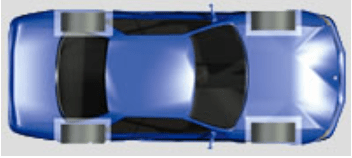
Front-wheel skid (understeer)
In a front-wheel skid, the vehicle goes in a straight line instead of following the direction your front wheels are turned in.
In this kind of skid you shouldn’t brake.
You should:
- Push in the clutch (if driving a manual vehicle)
- Take your foot off the accelerator
- Turn the steering wheel in the direction that the vehicle is heading
- Once you’ve regained control, let the clutch out

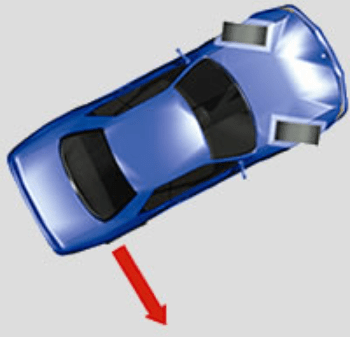
Rear-wheel skid (oversteer)
In a rear-wheel skid, the rear of the vehicle swings out.
In this kind of skid you shouldn’t brake.
You should:
- Push in the clutch (if driving a manual vehicle)
- Take your foot off the accelerator
- Turn the steering wheel in the direction that the rear wheels are sliding
- Once you’ve regained control, let the clutch out
Tyre blowouts
Tyre blowouts can be dangerous, especially if you are driving fast, because they can cause your vehicle to lose control.
A front-tyre blowout will usually cause the vehicle to ‘pull’ towards the side with the blowout. A rear-tyre blowout will usually cause the vehicle to sway from side to side.
You can try to avoid having a blowout by checking your tyres regularly. It’s important to have correct tyre pressure. If a tyre has a large cut or bulge, or is very worn, it needs to be replaced.
If you do have a blowout while driving, you should:
- Grip the steering wheel tightly
- Ease off the accelerator
- Try to keep the vehicle on its path
- Signal and steer to the side of the road once you’ve reduced speed
Engine failure
If your engine cuts out suddenly while driving, you must try to get the vehicle to the side of the road as quickly and safely as possible.
You should:
- Signal and steer towards the side of the road
- Put the gears into neutral – this will help you roll further
- Put your hazard lights on once you’ve stopped
If your vehicle has power steering, it will be difficult to steer once the engine is dead. Try not to be alarmed by the reduced control. Grip the wheel tightly and steer as best as you can.
Jammed accelerator
An instinctive response of many drivers to a jammed accelerator is to turn the engine off. This isn’t a good idea, particularly if your vehicle has power steering and braking, as this will make it much harder to steer and the brakes will be less effective.
You should:
- Try to lift the accelerator up with your toes
- Leave the vehicle in gear
- Brake – the brakes will be strong enough to stop the vehicle, even with the engine going
- Keep steering and look for a spot where you can safely pull of the road
Shattered windscreen
Shattered windscreens are becoming less common these days because modern vehicles are fitted with laminated windscreens, which crack but don’t shatter. Stone chips can turn into cracks which weaken the screen. Always repair chips before they turn into cracks.
If you are driving an older model vehicle and your windscreen shatters, you should:
- Steer by looking through the side window if you can’t see through the shattered windscreen. If you have been concentrating on the road ahead by using the ’12-second rule’ you should have a good mental picture of the road, which will help you steer
- Avoid pushing a hole in the shattered glass unless absolutely necessary. You will probably cut your hand and pieces of broken glass will be blown into your eyes
- Pull over and stop as soon as possible
- Once you have stopped, punch out the shattered glass using a jack or another tool. If no tools are available, wrap your hand in thick cloth (such as a jersey or towel) and carefully knock out the glass
- Drive at a reduced speed to the nearest windscreen repairer
Vehicle fire
If you think your vehicle is on fire, you will need to act immediately. You should:
- Signal and pull over to the side of the road
- Get yourself and any passengers out of the vehicle as quickly as possible
- Keep everyone clear of the vehicle and try to warn oncoming traffic
- Phone the fire service
Don’t try to put out the fire yourself, as you could inhale toxic fumes and there is also a danger the vehicle could explode.
Earthquake
In a severe earthquake driving can be very difficult because the road may be shaking or moving up and down beneath you.
If you think that an earthquake is happening while you’re driving, you should:
- Pull over and stop
- Stay inside your vehicle until the shaking stops. Your vehicle will provide you with some protection against falling objects
After the earthquake:
- If power lines have fallen onto your vehicle, stay inside it until help arrives
- If you continue driving straight after the earthquake, be on the lookout for slips or other road damage and obstacles
- Turn on your radio and listen for news about possible road closures and other information.
Submerged vehicle
New Zealand has a high number of coastal and riverside roads and sometimes vehicles can end up underwater.
Knowing what to do if you’re ever in this situation can mean the difference between life and death.
- If possible, get out of the vehicle while it’s still afloat. It will normally sink within a matter of minutes.
- Escape by winding down the window. The weight of water against doors will usually make them too hard to open.
- Once submerged, water will gradually seep into the vehicle. Escape through the windows. If this isn’t possible, wait until the vehicle is filled almost to head height with water. The doors will be easier to open then as the pressure inside the vehicle will be almost the same as it is outside.
- Before leaving the vehicle, turn the lights on so rescuers can find it more easily.
- Form a human chain with any other passengers as you leave the vehicle. This will make sure you all stay together.
Bonnet flying up
You can try to avoid having your bonnet fly up by:
- Remembering to re-fasten your vehicle’s bonnet securely whenever you open it
- Pulling over to the side of the road immediately if you notice the bonnet flexing or coming loose while you are driving
If the bonnet flies up while you are driving you should:
- Steer by looking through the gap under the hinge of the bonnet or out the side window
- Brake smoothly, indicate and move over to the left-hand side of the road
If your vehicle’s brakes fail, it will be an alarming experience.
Brake failure
You can try to avoid this happening by checking your brakes regularly. Always replace worn brake pads immediately and top up the brake fluid levels whenever necessary.
If your brakes do fail while driving:
- Change to a lower gear – automatic vehicles included – to help slow the vehicle down
- Pump the brakes hard and quickly to make use of any capacity still left in the hydraulic brake system
- Gradually pull up on the handbrake – don’t pull too hard or you may cause the rear wheels to lock
- Warn other road users by switching on your headlights and hazard lights and sounding your horn
- Look for an ‘escape route’, such as a wide shoulder of the road, a flat field or an uphill road
- If you are travelling downhill and the vehicle is starting to lose control, try to scrape against something on the side of the road, such as a safety rail, a bank or the kerb
Headlight failure
It’s uncommon for both headlights to fail while you are driving, but it can happen.
If your headlights do fail while you’re driving, you should:
- Slow down
- Move off the road gradually and stop somewhere safe
- Turn your hazard lights on
Avoiding a head-on crash
A head-on crash is probably the most dangerous type of crash you can be involved in. This is because when two vehicles collide head-on the force of the impact is usually twice as much as it is when a vehicle hits a non-moving object.
If you find yourself heading towards a head-on crash, there are some things you can do to try and avoid the crash or limit its damage:
- Brake hard. Every kilometre of speed that you slow down by will lessen the impact of a crash if it happens.
- Flash your headlights and blow your horn to attract the attention of the other driver.
- Look for an escape route to your left, even if it means driving off the road. A roll-over accident is likely to be less dangerous than a head-on crash.
- Don’t swerve to your right. The other driver is mostly likely to respond by swerving to their left and you would be likely to crash into each other.
 Apperture Labs