Speed limits
Excessive speed is one of the biggest killers on our roads. On average, 170 people die every year in New Zealand in speed-related crashes.
Remember, the faster you go, the more likely you are to be killed or seriously injured if you crash.
Safe speed guidelines
You can drive at any speed under or equal to the limit, provided:
- Your speed is safe for the traffic conditions (for example, slow down if you are on a busy road, or if there are pedestrians or cyclists around)
- Your speed is safe for the road conditions (for example, slow down if the road is winding, bumpy, narrow, wet or icy)
- Your speed is safe for the weather conditions (for example, slow down if it is raining, windy or foggy)
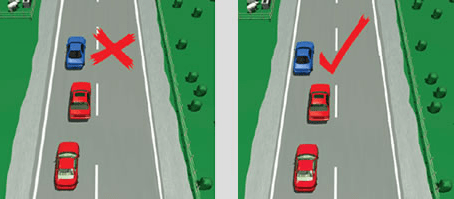
- You can stop suddenly behind a vehicle that you’re following – if a vehicle ahead of you stops suddenly and you run into the back of it, you will be legally responsible
- You can stop in half the length of clear road you can see in front of you on a road with no centre line or lanes (for example, a narrow country road where vehicles may meet head-on)
- You can stop in the length of a clear lane you can see in front of you on a road with a centre line or lanes
Slow drivers
If you are travelling slower than the speed limit and there are vehicles following you, you must:
- Keep as close to the left side of the road as possible
- Pull over as soon as it is safe to let following vehicles pass
Don’t speed up on straight stretches of road to prevent following vehicles from passing you.
Compulsory speed signs
A speed limit is the maximum legal speed that you can travel on the road under good conditions.
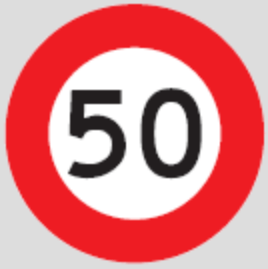
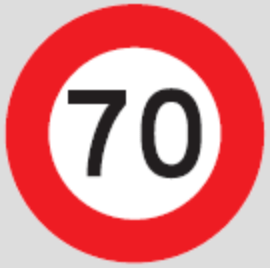
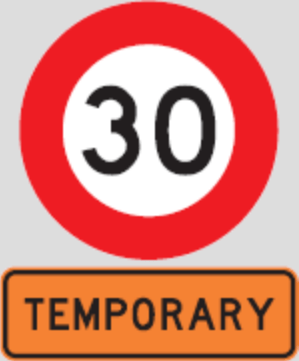
Signs showing the speed limit are displayed beside the road. These signs usually have a red border, which means that the sign is compulsory.
You may drive slower than the speed limit shown, but you must be considerate towards any vehicles behind you.
You must drive slower than the limit if:
- Conditions make the speed limit shown unsafe, or
- You are driving a vehicle that requires you to drive at a lower speed (such as heavy vehicles, which have a lower speed limit than cars – see table below)
Some examples of speed signs are shown below.
Important
Speed limit changes take effect at the sign post.
Before reaching the speed-limit sign make sure you:
- Reduce your speed, if the sign indicates a lower speed
- Do not increase your speed until you pass the sign, if the sign indicates a higher speed
Open road speed limits
The signs below mean that the maximum speed that you can travel at is 100 km/h.
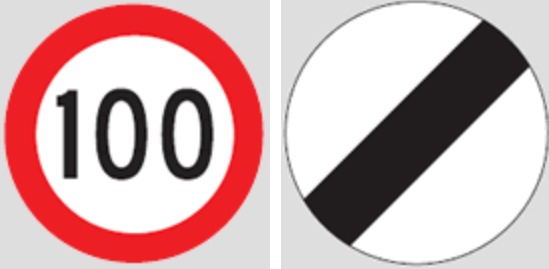
The vehicles listed in the table below have a lower maximum speed limit.
When following other vehicles, remember that some vehicles have lower speed limits and you may have to adjust your speed.
| Vehicle type | Maximum open road speed limit |
|---|---|
| Heavy motor vehicles (vehicles with a gross vehicle mass* of over 3500 kg) and heavy motor vehicles towing trailers | 90 km/h |
| Vehicles with a gross vehicle mass* of over 2000 kg and displaying school bus signs | 80 km/h |
| Light vehicles towing trailers | 90 km/h |
| Motorcycles, when ridden by riders who have a learner licence | 70 km/h |
| Special-type heavy motor vehicles without springs or other effective suspension systems, with pneumatic tyres | 45 km/h |
* Gross vehicle mass (GVM) is the greater of:
- The mass specified as the GVM of a particular vehicle by the vehicle’s manufacturer
- The mass specified as the GVM of a particular vehicle (or a vehicle of its kind) by the NZTA
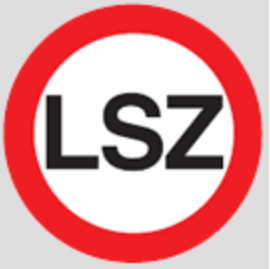
Limited speed zone sign
The sign below means that you can drive at the open road speed limit, provided it is safe to do so. However, you must not exceed 50 km/h if conditions are hazardous because:
- The weather is bad
- Visibility is poor
- There are people, animals, cyclists or lots of vehicles on the road
- The road is in poor condition
Important
If a driver exceeds a permanent posted speed limit by more than 40 km/h, there is an automatic 28-day licence suspension.
If a driver exceeds a temporary speed limit by more than 50 km/h, there is an automatic 28-day licence suspension.
Other signs that mean you must adjust your speed
Accident sign
The signs below mean that you are coming up to a crash site. Slow down and drive at 20 km/h or less until you have passed the crash site.

School bus signs
The signs below will be displayed on school buses. If a school bus has stopped to let children on or off, you must slow down and drive at 20 km/h or less until you are well past the bus, no matter what direction you are coming from.
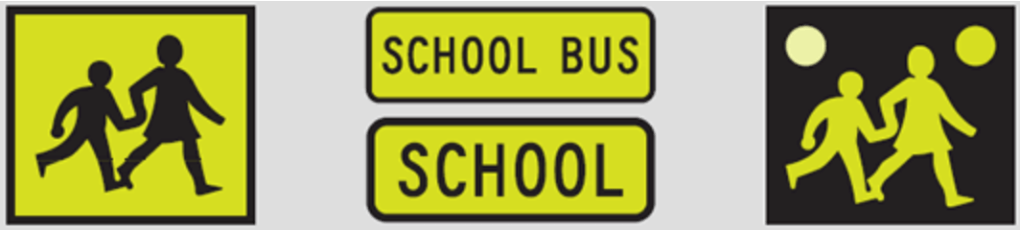
Note: you may also see ‘Kura’, the Māori word for school, on a bus.
Curve warning signs
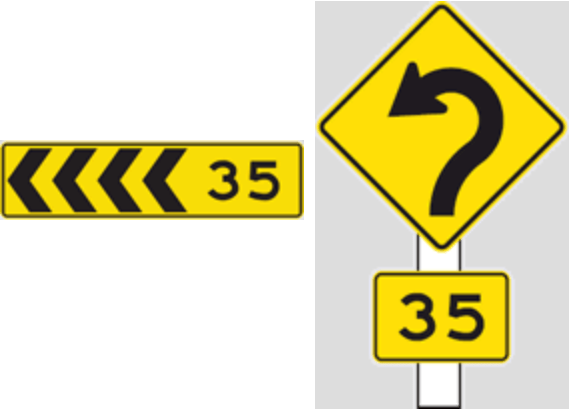
The signs below warn you that you are coming up to a tight curve or bend in the road. The number recommends a safe and comfortable speed to drive at around the curve – in this example the recommended speed is 35 km/h. The arrows show which direction the curve goes.
Alcohol and drugs limits
Alcohol and drugs, including some drugs given to you by a doctor, can seriously affect your driving. They can slow your reaction times and affect your senses.
You risk causing death and serious injury to yourself and other people if you drive under the influence of alcohol or drugs.
Legal alcohol limits for driving
The law says you must not drive if the amount of alcohol in your blood or breath exceeds certain age-related limits. These limits are shown below.
Under twenty
The legal alcohol limit, if you are under 20, is 150 micrograms per litre of breath or 30 milligrams per 100 millilitres of blood. This is effectively a zero limit consuming just one drink will mean you can be charged with drink-driving.
Twenty or over
You must not drive if you have consumed more than the legal alcohol limit, which is 400 micrograms per litre of breath or 80 milligrams per 100 millilitres of blood.
It is difficult to say how many alcoholic drinks you can have before you reach these limits. It depends on many factors, including:
- Whether you are male or female
- Your size
- How much food you have eaten
Because of this, and because even small amounts of alcohol can affect your driving, the best advice is: if you drink at all, don’t drive.
If you’ve been drinking, call a taxi, take a bus or get someone who hasn’t been drinking, such as a friend or ‘dial-a-driver’, to drive you home.
Drugs and driving
The law also says you must not drive if you have taken any type of drug that may affect your driving ability. If you are prescribed drugs by a doctor, always ask if they will have any effect on your driving.
Testing for alcohol and drugs
You can be stopped by the Police and breath-tested at any time. The Police can use the following tests to see if you have been drinking or taking drugs.
Passive breath test
The officer will place a hand-held device in front of your mouth and ask you to talk into it. This will show if you have recently drunk any alcohol. If any alcohol is detected, a breath screening test will be required.
Breath screening test
The police officer will give you either a tube of crystals with a bag on the end or a small electronic device, and will ask you to blow into it. If your alcohol level is high, you will be asked to take an evidential breath test or have a blood test.
Evidential breath test
This is an electronic device you blow into, which gives a reading that can be used in court as evidence of your breath–alcohol concentration.
Blood test
If you have a blood test, a medical doctor or other approved person will take a sample of your blood to be tested for alcohol or drugs.
When are the tests carried out?
A police officer can ask you to take a passive breath test or breath screening test if:
- You are suspected of drinking and driving
- You are signalled to stop at a Police alcohol check point
You must wait with the officer for the result of the test.
If the test shows you have been drinking, you must:
- Take a further test – this will be either an evidential breath test or a blood test
- Hand over the keys to your vehicle, if asked by a police officer
- Go with a police officer, if required
- Agree to a blood test, if asked by a police officer, medical doctor or other approved person
If you don’t, you may be arrested.
What are your rights?
You may:
- Choose not to take a breath screening or evidential breath test – however, if you:
- Refuse a breath screening test, you will be asked to take an evidential breath test
- Refuse an evidential breath test, you must undergo a blood test
- Choose to give blood if an evidential breath test suggests you are over the legal limit
- Talk to a lawyer (if you wish to) after a positive breath screening test and before an evidential breath or blood test – a telephone will be made available to you for this purpose
If your blood test shows you are over the legal limit, you will be given a copy of the blood test certificate.
You may ask for your blood sample to be tested by an independent analyst. If you want this to happen, it’s important that you talk to a lawyer as soon as possible.
What are the penalties?
The following table shows some of the penalties for driving offences related to alcohol and drugs.
Court-imposed penalties for alcohol/drugs offences
| Offence | Amount of alcohol | Penalty | ||||
|---|---|---|---|---|---|---|
| Blood | Breath | Prison | Fine | Disqualification or suspension of licence | ||
| You kill or injure someone when driving after drinking too much or taking drugs | More than 80 mg per 100 ml | More than 400 mcg per litre | Up to five years | Up to $20,000 | First or second offence one year or more, third or subsequent offence more than one year | |
| You drive, or try to drive, after drinking too much or taking drugs and you are aged 20 years or over | More than 80 mg per 100 ml | More than 400 mcg per litre | First and second offences | |||
| Up to three months | Up to $4,500 | Six months or more | ||||
| Third and subsequent offences | ||||||
| Up to two years | Up to $6,000 | More than one year | ||||
| You drive, or try to drive, after drinking too much or taking drugs and you are aged under 20 years | More than 30 mg per 100 ml | More than 150 mcg per litre | Up to three months | Up to $2,250 | Three months or more | |
| You refuse to give blood when asked by a police officer, doctor or approved person | First and second offence | |||||
| Up to three months | Up to $4,500 | Six months or more | ||||
| Third and subsequent offences | ||||||
| Up to two years | Up to $6,000 | More than one year | ||||
| You refuse to go with a police officer for an evidential breath test or blood test | Up to $4,500 | As decided by the court | ||||
| You are in charge of a vehicle after drinking too much or taking drugs and you do not hand over the keys when asked by a police officer | Up to $10,000 | |||||
On-the-spot (roadside) licence suspension
Your licence will be suspended on the spot if you refuse to have a blood test or if, following an evidential breath or blood test, you are found to have:
- More than 130* milligrams of alcohol per 100 millilitres of blood, or
- More than 650* micrograms of alcohol per litre of breath
* A lower threshold of 80 milligrams or 400 micrograms will apply if, in the previous four years, you have been convicted of:
- Driving or attempting to drive under the influence of alcohol or drugs, or
- Driving or attempting to drive with excess breath or blood alcohol, or
- Failing or refusing to allow a blood sample to be taken, or
- Causing death or injury while in charge of a motor vehicle and under the influence of alcohol or drugs, or with excess breath or blood alcohol
Your licence will be suspended for 28 days and you will still have to face court-imposed penalties.
Repeat offences
The penalties described above may be increased substantially for repeat offences.
In addition, if you commit two alcohol-related offences within a five-year period and one of those offences involves:
- Refusing to go with a police officer
- Refusing to give a breath or blood sample
- Driving under the influence of alcohol or drugs
- Having a breath–alcohol level above 1000 micrograms
- Having a blood–alcohol level above 200 milligrams per 100 millilitres
then you will be:
- Disqualified from driving for an indefinite period, and
- Required to attend an approved alcohol assessment centre
Applying for removal of an indefinite disqualification
You can apply for the removal of an alcohol-related indefinite disqualification if:
- You have served at least one year and one day of the disqualification, and
- You receive a satisfactory report from an assessment centre
The disqualification can only be removed by the NZTA, and you must resit and pass your driver licence tests before you can drive again.
Driver fatigue
Many fatal crashes are caused by people driving when they are tired. If you feel tired, don’t drive. Don’t risk your life or those of other road users.
Tips to help you avoid driver fatigue
- Get a good night’s sleep before driving, preferably eight hours.
- Avoid driving during the hours when you are normally sleeping. For most people, this will be between 10 pm and 6 am.
- If you normally have a mid-afternoon nap, then you should avoid driving at that time.
- Make sure that following a period of sleep you are fully awake before driving.
- Don’t drink even small amounts of alcohol. It will make the effects of fatigue much worse.
- When taking long trips, plan your journey to include rest breaks.
- Share the driving if possible.
- Snack on light, fresh foods. Avoid consuming fatty, sugary or carbohydrate-filled foods, which can make you tired.
Recognise the warning signs
Some warning signs are:
- Having trouble focusing, keeping your eyes open or holding your head up
- Daydreaming, wandering or disconnected thoughts, loss of memory
- Yawning or rubbing your eyes repeatedly
- Drifting from your lane, tailgating and missing signs or exits
- Feeling restless and irritable
Stop to revive, then drive
During long trips, take rest breaks about every two hours or every 100 kilometres.
If you start feeling sleepy:
- Don’t keep driving – pull over immediately in a safe place (as far off the road as possible)
- Move to the passenger seat and take a 15–20 minute power nap. A short sleep is very refreshing – try not to nap for a period longer than 40 minutes otherwise you may feel groggy and disoriented when you wake up and for quite some time afterwards (this is called sleep inertia)
- Wait at least 10 minutes to make sure that you are completely awake before you start driving again
If you still feel sleepy don’t drive, find a place to sleep for an extended period or for the night.
 Apperture Labs