Ownership responsibilities
If you own a motor vehicle, you are responsible for making sure that the following requirements are met.
Warrant of fitness or certificate of fitness
All vehicles driven on New Zealand roads must have a current warrant of fitness (WoF) or certificate of fitness (CoF).
Registration
All vehicles driven on New Zealand roads must be registered. When you register a vehicle, it is added to the Motor Vehicles Register. Once a vehicle is registered, it is issued with registration plates and a current vehicle licence. A certificate of registration is also sent to the person registered as the owner.
Before a vehicle can be registered, it must have been given a vehicle identification number (VIN) and been approved for registration by an approved vehicle inspector. Vehicle inspectors can be found at participating offices of the Automobile Association (AA), Vehicle Testing New Zealand (VTNZ), and Vehicle Inspection New Zealand (VINZ).
Relicensing
Relicensing is sometimes confused with registration. Relicensing is the payment of a fee to use a vehicle on the road. All vehicles used on the road must be relicensed regularly and must display a current licence label on the windscreen.
To get a vehicle licence, you must:
- Make sure your vehicle has a current WoF or CoF
- Fill out the relicensing notice (MR1) that you should receive in the post, or fill out an Application to licence a motor vehicle (MR1B), which is available from any NZTA agent
- Pay the appropriate fee
You can also relicense online at the NZTA’s Transaction Centre.
A vehicle licence is valid for up to 12 months. Most vehicles must be licensed continuously. This means that the licence fees must be paid from the expiry date of the previous licence (that is, if you renew your licence after the expiry date of the previous licence, the licence fees will be backdated and you must pay these).
You can apply for an exemption from continuous licensing if you won’t be using your vehicle for a period of three months or more. An exemption means that when your licence expires, the licence fees won’t be backdated next time you relicence your vehicle. An exemption does not mean that you can use your vehicle on the road without a current licence. Talk to an NZTA agent for more information.
If you don’t:
- Relicense your vehicle, or
- Apply for an exemption from continuous licensing
and the vehicle remains unlicensed for more than 12 months, its registration will lapse.
You will still have to pay any backdated licence fees and, if the vehicle is to be used on a road again, it must be re-registered with new plates and registration papers. Your vehicle may also need to be certified by an approved vehicle inspector.
Road user charges
You must pay road user charges (RUC) and obtain a RUC licence for your vehicle if:
- It’s powered by diesel, or any other fuel that doesn’t include government tax in its purchase price (regardless of the vehicle’s weight), or
- It has a manufacturer’s gross laden weight of more than 3.5 tonnes (3500 kg)
This is because diesel, unlike petrol, CNG and LPG, doesn’t contain government tax in its purchase price. This tax contributes towards the upkeep of New Zealand’s roads.
RUC licences can be purchased from an NZTA agent or online from NZTA’s transaction centre. You’ll be given a RUC licence label, which must be displayed on the inside of the windscreen.
When buying or selling a vehicle that requires a RUC licence, the licence should be sold with the vehicle. The new owner will become responsible for paying any outstanding charges if the vehicle is sold without a current RUC licence.
Buying a motor vehicle
Before you purchase a vehicle, an NZTA agent can check to see whether it is registered and licensed, or has been reported stolen. It’s a good idea to do this before you buy the vehicle, because once you have bought it:
- You will be liable for any outstanding fees owing on the vehicle
- You may lose the vehicle if it has been stolen
Once you’ve bought a motor vehicle, you need to notify the NZTA within seven days of the sale. The seller may want to confirm that you’ve done this before they hand over the vehicle. You need to do the following:
- Obtain the vehicle’s Certificate of registration from the seller. The form for changing the ownership is printed on the back of the certificate. If the seller has lost the certificate, you will need a buyer’s change of ownership form (MR13B), available from an NZTA agent.
- Complete the change of ownership form and give it to an NZTA agent with the appropriate fee.
- Show the agent your New Zealand driver licence as evidence of identification. If you don’t have your driver licence, you’ll need to show other identification that includes your full name, signature and date of birth.
- Ask the agent to give you a transfer receipt. Take this to the seller when you pick up the vehicle – it shows you have changed the vehicle’s registration into your name.
You can also complete this transaction online at the NZTA’s transaction centre.
A new Certificate of registration, showing that you are registered as the owner, will be sent to you once you have completed the change of ownership. The Certificate of registration isn’t legal title for the vehicle – it is simply a record of who is responsible for the vehicle.
Selling a motor vehicle
If you are selling a motor vehicle:
- Complete the bottom, tear-off portion of your Certificate of registration with the new owner’s details and post it to the Transport Registry Centre, Private Bag, Palmerston North (no stamp required). If you’ve lost the Certificate of registration, you can still notify your part of the change of ownership process by completing a Notice by person selling/disposing of motor vehicle (form MR13A), available from NZTA agents.
- Give the remaining portion of the Certificate of registration to the buyer so they can notify their part of the change of ownership.
- Make sure you and the new owner complete change of ownership forms within seven days of the sale. If you don’t, you could be liable for the new owner’s speed camera tickets, licensing fees and any fines they may receive for not displaying a current WoF or a current licence. Ask them to show you one of the following documents as evidence they’ve changed the vehicle into their name:
- A change of ownership transfer receipt
- An email confirmation page (if they have completed their transaction online)
- A receipted Notice of change of ownership of motor vehicle (form MR13B)
- If you sell your car through a registered motor vehicle trader they should notify the change of ownership for you, but it is wise to check that they have done this.
You can also complete this transaction online at the NZTA’s transaction centre.
Call the motor vehicle registration contact centre if you have any questions about:
- Your ownership responsibilities
- Where to obtain any of the forms, or
- Where to find an NZTA agent
This service is available between 8 am and 6 pm, Monday to Friday (except public holidays).
Responsible driving
Responsible driving means driving with the safety and convenience of all road users in mind. Following the information in this section will help you to become a safe and responsible road user.
Important driver responsibilities
Operation of a vehicle
A driver must not operate a vehicle in a condition or manner that could cause:
- Injury to any person or animal
- Annoyance to any person
- Damage to any property
- Distraction to the driver
Unsafe vehicle or load
You must not drive:
- An unsafe vehicle
- A vehicle with an unsafe load, which:
- Is not tied down
- Could fall from the vehicle
- Is dragging on the ground
Dangerous riding
You must not ride in (or on) a vehicle in a way that might result in injury. If you are the driver you must not let your passengers ride in (or on) the vehicle in an unsafe way.
Carrying people or packages
Holding a package, person or animal in your lap or arms when driving is dangerous. Ideally, put packages in a secure place such as the boot. If this isn’t possible, put them in a place inside the vehicle where they won’t hurt anyone if the vehicle stops suddenly.
Children and pets
Children and pets can be noisy or need your help when you are driving. If you have to deal with the needs of children or pets, pull over to the side of the road and park your vehicle first.
Lighting
A driver or passenger must not use any vehicle lighting equipment in a way that will dazzle, confuse or distract other road users.
Noisy and smoky vehicles
You must not drive a vehicle that:
- Makes a lot of noise, inside or outside the vehicle, due to:
- The way in which the vehicle is being driven
- The condition of the vehicle
- Any other means (such as a car stereo)
- Makes noise that is likely to cause annoyance to any person
- Makes smoke for 10 seconds or more
Make sure your vehicle’s exhaust system and silencer are in good working order. This will prevent gases and excessive noise entering the car.
Making the wheels of a motor vehicle lose traction and spin on the road surface may make unnecessary noise or smoke and could be a traffic offence.
Using the horn
The horn should only be used as a reasonable traffic warning. It should not make an unnecessary or unreasonably loud, harsh or shrill noise.
Opening and closing doors
You must not open or close the door of a motor vehicle if it is likely to:
- Cause a hazard to any road user (including pedestrians, cyclists or other users of a footpath), or
- Hurt anyone
Music
Don’t play music in your car so loudly that you can’t hear:
- The sounds your car is making
- Emergency sirens
- The sound of warning bells or trains when you’re coming up to a railway level crossing
Uphill and downhill traffic
On steep, narrow roads, it is easier for vehicles moving downhill to give way to vehicles moving uphill.
Funeral processions
If you are driving in a funeral procession, you should drive with your vehicle’s headlights on dip. That way, other drivers will know you are part of the procession.
Animals on the road
Farmers often use country roads to move stock between paddocks. If there are animals on the road:
- Slow down or pull over to the side of the road
- Don’t sound your horn or make a noise that could frighten the animals
- Follow any advice the farmer may give you
Broken glass and other debris on the road
You are responsible for removing the following things if they fall or escape from your vehicle onto the road:
- Any slippery substance
- Any piercing or dangerous substance
- Glass
- Any other substance of any kind that, because of its size or nature, constitutes or could constitute a danger to road users
If the substance or glass can be removed quickly and safely, you must immediately remove it or ensure it is removed.
If the substance or glass cannot be removed quickly and safely, and there is likelihood of harm being caused to the public or any person, you must warn the public or report the occurrence immediately to the nearest police station or to a member of the police.
If you are physically incapacitated and unable to remove the substance or glass or warn the public or report the occurrence, the person removing the vehicle from the scene must do those things as required.
Firearms (guns)
You must not carry a firearm in your vehicle unless you hold a firearm licence. You must never carry a loaded firearm in a vehicle. (This also means you must not carry ammunition in the chamber or attached magazine of the gun.)
Space-saver wheels
Some cars have a space-saver wheel as the spare wheel. Space-saver wheels are much smaller than the vehicle’s other wheels so they take up less storage room.
Space-saver wheels are for emergency use only and are not designed to be used over long distances. If you get a flat tyre and replace a wheel with a space-saver wheel, you should only use it to get directly home or to a place where the flat tyre can be repaired or replaced.
The vehicle is likely to handle differently with a space-saver wheel. Drive carefully and don’t drive faster than 80 km/h. If the space-saver wheel has a sticker showing a lower speed, then that speed applies.
Space-saver wheels must have a safety label that states that the tyre is for temporary use only, what the maximum safe speed is for the tyre and what the correct pressure is. Make sure you read and follow the label.
Note: make sure the space-saver tyre is inflated to the correct pressure. This is much higher than normal tyre pressure.
Cellphones
It is recommended that you don’t make or receive phone calls or text messages while you’re driving. Instead, pull over and stop in a safe place at the side of the road before using a cellphone.
Driver distractions
Anything that takes a driver’s attention away from the road can be a potential hazard.
You should avoid or minimise the following distractions when you are driving:
- Looking at things on the roadside
- Looking at scenery
- Talking or texting on a cellphone
- Talking to passengers
- Noisy children
- Pets
- Eating food
- Lighting a cigarette
- Adjusting radio or climate controls
- Daydreaming
- Tiredness
- Reading maps
- Objects moving in the vehicle
- Electronic gadgets
- Reaching for items in the glovebox
- Cleaning the inside of the windscreen
Work time and logbook requirements
If you are driving a taxi or if your vehicle weighs more than 3500 kg (for example, a truck), you may be subject to restrictions on how long you can drive and the amount of rest you must have. You may also need to keep a logbook of your work time.
Safety belts and child restraints
Safety belts and child restraints protect people by holding them in their seats when there is a crash or when the vehicle stops suddenly. If you don’t wear a safety belt and you’re involved in a crash, you could be thrown out of your vehicle.
Always remember to fasten your safety belt before you drive off.
Responsibility
The driver is responsible for making sure children aged under 15 years wear safety belts or are in approved child restraints.
All passengers 15 years and over are responsible for making sure that they are wearing their own safety belts.
How to wear a safety belt
Most safety belts are retractable. This means they stretch automatically to the correct length when you fasten them and lock only if the vehicle stops suddenly.
If your vehicle has a non-retractable safety belt, you will need to adjust its length before you fasten it. There should be just enough room to slide the palm of your hand between the belt and your chest.
Never put an adult and a child together in the same safety belt.
Special exemptions
You don’t have to wear a safety belt if you:
- Hold a doctor’s certificate that says you don’t have to wear a safety belt for medical reasons
- Are driving and you’re unable to reach the controls (for example, brake, signals, dip switch) with a safety belt on
- Are a taxi driver plying for hire (your passengers, however, must wear safety belts)
- Are a driver or passenger who is getting in and out of the vehicle often to read meters, deliver goods, etc. In these situations you must not travel faster than 50 km/h
- Are reversing and it is difficult to see while wearing a safety belt
Child restraints
Under fives
Children under five years old must be properly restrained in an approved child restraint.
The only exception to this rule is when the children are travelling in a taxi that doesn’t have an approved child restraint. In this case, the children must sit in the back seat.
Five to seven year olds
Children aged between five and seven years old must use a child restraint if available.
If no child restraint is available, they must use a safety belt. f no safety belt is available, they must sit in the back seat.
Crashes
Unfortunately, crashes do happen on our roads. As a responsible driver, you need to know the signs that show you are coming up to the scene of a crash and what your responsibilities are if you’re involved in a crash or if you come across a crash.
Crash warning signs
At a crash site the Police may use signs, flashing lights and flares to warn approaching drivers.
When coming up to a crash site, slow down and drive carefully. The road may be blocked and there could be injured people lying on it.
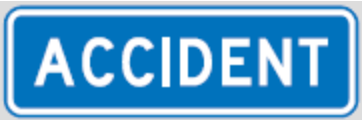
The sign shown above is placed by Police near a crash site. It means you must drive at 20 km/h or less until you pass the crash site. Watch out for emergency workers and injured people.
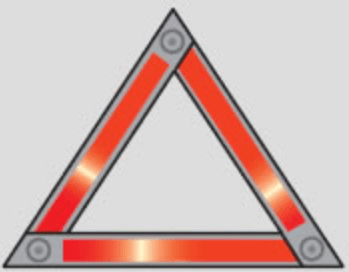
The triangle shown above is a warning triangle. It means there is a breakdown or crash ahead. Anyone can put a warning triangle on the side of the road to warn other road users.
Reporting a crash
If you are involved in a crash while driving, and you are not badly injured, the first thing you must do is stop and check to see if anyone is hurt, and provide assistance.
If someone is hurt, you must tell a police officer as soon as possible and no later than 24 hours after the crash.
If no one is hurt, you must give your name, address and vehicle registration (and, if asked, the name and address of the owner of the vehicle you are driving, if it isn’t your vehicle) as soon as possible but no later than 48 hours after the crash to:
- The owner or driver of any other vehicle that has been damaged
- The owner of any property that has been damaged
If you can’t find these people, you must tell a police officer as soon as possible and no later than 60 hours after the crash.
If your vehicle is insured, tell your insurance company as soon as possible after the crash.
Tips for dealing with crashes
If you are first on the scene of a crash, your actions could help save the lives of the people involved in the crash and make it safer for other drivers coming upon the crash scene.
Here are some things you can do to help make the crash scene safer:
- Park your car in a safe spot, away from the crash area. Leave plenty of space for emergency vehicles to come and go, and for emergency workers to work in.
- Switch on your car’s hazard warning lights.
- If possible, post other people or warning triangles on all approaches to the crash site to warn oncoming drivers. The people or triangles should be about 200 metres from the crash site to give approaching drivers time to slow down.
- If people are injured, call an ambulance as soon as possible.
- Following a crash, some airbags may not be deployed. If you need to enter a crashed vehicle, don’t place yourself between any undeployed airbag and injured or trapped person. Undeployed airbags can deploy with force some minutes after a crash and could injure both the rescuer and injured/trapped person.
- If it is safe to do so, turn off the ignition of all vehicles involved in the crash.
- If any vehicle involved in the crash has a dangerous goods placard, follow the instructions below on crashes involving dangerous goods.
If people have been injured in the crash, you should call an ambulance as soon as you can. Before the ambulance comes, there are some things you may be able to do to help them and some things you should be aware of, which are outlined in this section.
Important
Dial 111 for emergency services. Dial *555 to report traffic incidents.
Basic first aid
Ideally, you should enrol in a recognised first aid course so you can learn techniques such as cardio-pulmonary resuscitation (CPR) and mouth-to-mouth resuscitation under proper supervision. This will make you more confident and more capable of using first aid if you have to.
Try not to move injured people
If a victim has spinal injuries, moving them may only worsen their injuries. You should never move a crash victim unless it is absolutely necessary. The only instances where you should move someone before medical help arrives are when:
- The person is trapped in a vehicle that is on fire or in danger of catching fire
- It is necessary to move them to:
- Give CPR
- Give mouth-to-mouth resuscitation
- Stop severe bleeding
Stopping severe bleeding
If the patient is bleeding badly, you should try to stop or reduce the bleeding.
- Raise the part of the body that is bleeding. This will take some of the blood away from the wound.
- Apply pressure to the wound, preferably with thick, folded fabric, such as a towel or an item of clothing.
Crashes involving dangerous goods
If you come across a crash involving a vehicle that is carrying dangerous goods, you will need to be extremely careful. Never make a rescue attempt unless you are sure you are not endangering yourself by coming into contact with dangerous substances.
Most vehicles carrying dangerous goods display a placard that indicates the type of goods being carried. Some of the most common placards are shown below. You should familiarise yourself with these placards and what they mean.
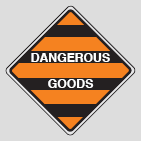 Dangerous goods | 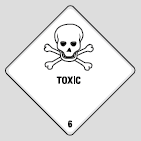 Toxic substances |
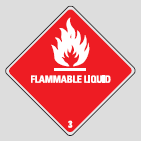 Flammable liquid | 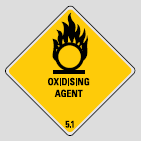 Oxidising agent |
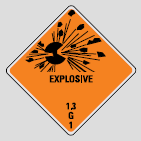 Explosives | 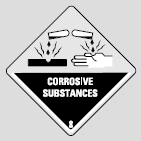 Corrosive substances |
Remember, if you’re at a crash site and you’re in any doubt about the meaning of a placard, keep your distance – especially if there’s been a spillage. Poisonous fumes may be given off by a dangerous substance.
Make a careful note of the colour and symbol on the placard and give this information to the emergency services when phoning to report a crash and when they arrive at the crash site. Keep bystanders well away from the crash scene and up wind of poisonous fumes.
Stepping over the line
Traffic laws are made to protect and ensure the safety of all road users. This section describes the penalties that you can face if you commit driving offences.
Demerit points
Demerit points are given for some traffic offences and for speeding infringements (except those recorded by a speed camera).
If you get a total of 100 or more demerit points within any two-year period, you will be suspended from driving for three months.
If you incur 50 or more demerit points, you will be sent a letter to warn you that your licence is in danger of being suspended.
If you are disqualified from driving for less than six months by the court, you may have demerit points added to any previous demerit points on your record.
If you are suspended or disqualified by the court for six months or more, any previously recorded demerit points will be cleared from your record. Demerit points will also be cancelled if you have not offended for two years.
If you are suspended for excess demerit points, you will be served with a suspension notice.
Your suspension is effective from when you are personally served with the suspension notice and you must surrender your driver licence to the person giving you the notice.
Some of the offences that incur demerit points are listed below.
| Offence | Demerit points |
|---|---|
| Exceeding speed limit by 10 km/h | 10 |
| Exceeding speed limit by 11–20 km/h | 20 |
| Driving at a speed that means you are unable to stop in half of the clear distance ahead | 20 |
| Driving in a lane at a speed that means you are unable to stop in length of lane that you can see | 20 |
| Driving at a speed that means you are unable to stop short of the vehicle ahead | 20 |
| Failing to observe Give Way signs | 20 |
| Proceeding before the way is clear at a Stop sign | 20 |
| Failing to keep as close as practicable to left edge of roadway | 20 |
| Failing to stop and remain stopped for a school patrol sign | 20 |
| Failing to observe the requirements at a school patrol crossing | 20 |
| Breaching a condition of learner licence | 25 |
| Breaching a conditions of restricted licence | 25 |
| Exceeding speed limit by 21–30 km/h | 35 |
| Passing or attempting to pass where no-passing lines are marked on the road | 35 |
| Failing to remain stopped for an enforcement officer | 35 |
| Failing to stop when followed by red and blue flashing lights | 35 |
| Carelessly or inconsiderately using a motor vehicle | 35 |
| Driving or attempting to drive when prohibited by an enforcement officer | 35 |
| Exceeding speed limit by 31–35 km/h | 40 |
| Exceeding speed limit by 36 km/h or more | 50 |
| Failing or refusing: > to wait for result of a breath screening test > to accompany a police officer when required > to remain for evidential breath test or blood test | 50 |
| Person under 20 driving or attempting to drive with excess breath or blood alcohol | 50 |
Careless, reckless and dangerous driving
The courts deal very seriously with drivers who drive carelessly, recklessly or dangerously.
Severe penalties can be imposed if you are convicted of one of these offences. The penalties will be especially severe if you hurt or kill someone, whether or not you have taken alcohol or drugs.
Penalties may include:
- A maximum fine of $20,000
- Maximum imprisonment of five years
- Disqualification of your driver licence
Not wearing a safety belt
You can be fined if you are aged 15 or over and you drive or ride in a vehicle without wearing a safety belt.
If you are the driver, you can also be fined if any passengers under the age of 15 are riding in your vehicle without wearing a safety belt or child restraint.
Mandatory suspension of driver licence
Your licence will be suspended on the spot if:
- A police officer (but not a speed camera) detects you exceeding a permanently posted speed limit by more than 40 km/h or a temporary speed limit by more than 50 km/h
- You commit one of the alcohol-related offences covered by mandatory suspension
Your licence will be suspended for 28 days and you will also have to face court-imposed penalties for your offence.
Note: there is no legal provision for the granting of a limited/work licence in these circumstances.
Impounding vehicles
A police officer will impound your vehicle on the spot if you are caught:
- Driving while disqualified
- Driving while your licence has been suspended
- Driving without a licence, or with an expired licence, and you have previously been stopped by a police officer and forbidden to drive
Your vehicle will be impounded for 28 days and you will have to face court-imposed penalties for your offence.
Powers of arrest
Some of the powers of arrest that a police officer has are listed below.
As a driver or passenger, you could be arrested if you:
- Don’t give your name or address to the officer, when requested
- Tell an officer something that is not true about the identity of the owner of the vehicle
- Don’t stop when signalled by an officer
- Assault an officer
- Refuse, or don’t go with an officer for a blood or breath test
- Don’t wait for the result of a breath screening test or an evidential breath test
- Don’t give a blood sample when required by an officer or doctor
- Don’t give your car keys to an officer when requested
- Drive when told not to by an officer
Tips on driving sustainably
By following the tips in this section, you can use less fuel and reduce the amount of emissions (CO2 and other pollutants) your vehicle produces.
Drive to save fuel and reduce emissions
Driving efficiently can reduce the amount of fuel your vehicle uses and the pollution it emits. You should:
- Drive smoothly, avoiding fast acceleration and sharp braking
- Avoid over-revving by changing up gears
- Reduce short trips (you use 20 percent more fuel when your engine is cold)
- Don’t leave your vehicle idling for long periods
- Avoid carrying unnecessary loads
Keep your vehicle maintained
Basic maintenance will cut down the fuel your vehicle uses as well as reducing pollutants produced. Make sure your vehicle is well-tuned and the tyres are correctly inflated.
Roof racks and poorly placed spoilers increase air resistance and fuel consumption.
When buying a vehicle
Try to choose a model that uses less fuel and emits fewer greenhouse gases.
Consider other ways to travel
Think about sharing rides/car pooling, taking public transport, walking or cycling.
 Apperture Labs