Sharing the road with pedestrians
On average, 40 pedestrians are killed and 1000 pedestrians are injured on New Zealand roads every year.
Many of these deaths and injuries could be prevented if drivers took more care when using our roads.
Please look out for pedestrians whenever you’re behind the wheel.
Pedestrian safety for drivers
- Always be ready to stop near schools, bus stops and pedestrian crossings.
- Be careful when driving past parked vehicles. Pedestrians may walk out without warning.
- You must slow down to 20 km/h when passing or coming towards a school bus that has stopped to let children on or off, no matter which side of the road you are on.
- Watch out for elderly people or people with disabilities.
- Take special care near roadside stalls and parked vendors. Pedestrians visiting these may forget to watch for traffic when crossing the road.
Pedestrian crossings
A pedestrian crossing is an area of road that has white stripes marked across it.
Some crossings have raised islands in the middle, creating a ‘refuge’ where pedestrians can stop. These are helpful for pedestrians crossing wide, two-way roads or multi-lane roads, because they allow them to walk across one direction of traffic at a time.
As you drive towards a pedestrian crossing, you will see pedestrian crossing signs before the crossing and black and white poles at the crossing. The poles are mounted with fluorescent orange disks, or round yellow lights that flash at night. White diamonds are generally painted on the road before the crossing, and a white limit line shows you where to stop.
When coming up to pedestrian crossings:
- Slow down and be ready to stop for any pedestrians on, or stepping onto, the crossing
- if there is no raised traffic island in the middle of the crossing, stop and give way to pedestrians on any part of the crossing
- If there is a raised traffic island in the middle of the crossing, stop and give way to pedestrians on your half of the road
- Wait until the pedestrian has crossed in front of you and is clear of your vehicle before you proceed – see give way rules
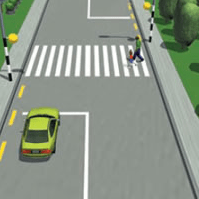

If you find yourself in a queue of traffic near a pedestrian crossing, don’t move onto the crossing if there isn’t enough room for your vehicle on the other side of the crossing.
Important
Never overtake a vehicle that is slowing down for a pedestrian crossing or has stopped to let someone cross.
Courtesy crossings
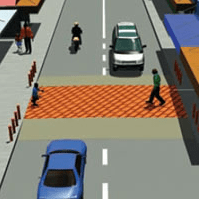
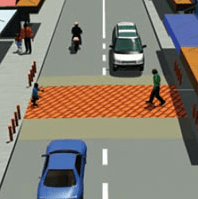
Courtesy crossings are usually made of bricks or paving and are often raised above the level of the road.
They are not official pedestrian crossings, but they do provide a place where drivers can stop safely to allow pedestrians to cross.
Please be courteous to pedestrians waiting to cross on a courtesy crossing.
Shared zone
This is a road that has been designed to slow traffic and give priority to pedestrians. Drivers give way to pedestrians who, in turn, should not impede traffic.
School crossings
School crossings, also known as kea crossings, provide a safe place for children to safely cross the road. They generally only operate before and after school.
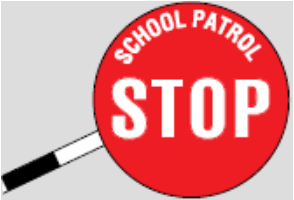
When school crossings are operating, a fluorescent orange Children sign will be displayed, along with a School Patrol Stop sign, which swings out into the road.
When the School Patrol Stop sign is out, vehicles coming from both directions must stop and stay stopped until all signs have been pulled in.
What children would like drivers to know
- Children are not little adults, so don’t expect them to act as adults do.
- Children, especially those under the age of nine, may not have the skills and abilities needed to be safe in traffic. Be very careful when driving near them.
- Young children have narrow vision. This means they may not see vehicles as easily as adults do.
- Children have trouble judging the speed of moving vehicles. They may let a slow vehicle pass and try to cross in front of a fast one.
- Children often don’t understand that it takes time for a vehicle to stop.
- Children may have difficulty working out where sounds are coming from.
- Because children are small, they often can’t see over bushes and parked vehicles. This also means they can’t be seen easily by drivers.
- Children tend to think about one thing at a time and ignore other things happening around them.
- Because children are always on the move, they may have trouble stopping at a kerb and could dart out into traffic.
- Children can freeze when they find themselves in danger, instead of taking quick action as an adult might.
Keep a lookout for children at all times. Take special care when driving during 8–9 am and 3–4 pm, when children are travelling to and from school.
Blind and vision-impaired pedestrians
People who are blind or vision-impaired often use aids such as a white cane or a guide dog. When drivers see people with these aids trying to cross the road, they should take extra care and let them cross in their own time.
When leaving and entering driveways
When you are entering or leaving a driveway that crosses a footpath, you must give way to people using the footpath.
Sharing the road with trucks and buses
Following trucks and buses
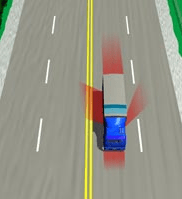
- Drivers of buses and trucks often have large blind spots behind and at the side of their vehicles, so it is a good idea to position your vehicle far enough back so it can be seen in their side mirrors. This will let the truck or bus driver know you are there.
- Remember the two-second rule; following too closely will limit your visibility, give you less time to stop, and may put you in the truck or bus driver’s blind spots.
- In wet weather, increase your following distance to four seconds. This will keep you away from any water spraying from the wheels of the bus or truck that could reduce your visibility, and will also give you more time to stop.
Important
If you can’t see the truck or bus driver in their side mirror, they can’t see you.
Overtaking trucks and buses
Because it takes several seconds longer to pass a truck or bus than it does to pass a car, it’s important to make sure you have plenty of clear road ahead to safely pass without going over the speed limit. See Passing for more information.
Oncoming trucks and buses
When driving past an oncoming truck or bus (one traveling in the opposite direction), drivers should keep firm control of the steering wheel to counter the effect of any air turbulence.
Remember, trucks and other large vehicles take up more room on the road when traveling around bends and at intersections, and may not always stay entirely in their own lane.
Sharing the road with tractors
You will sometimes see tractors and other farm or construction machinery on New Zealand roads. Because they are large and usually travel slower than other vehicles, you need to be especially careful when driving near them.
- Begin to slow down as soon as you see a tractor ahead of you and watch out for any warning beacons.
- Be patient while driving behind tractors – a few minutes of traveling at a slow speed is better than risking a crash.
- Be extremely careful when passing and only pass when it is safe and legal to do so (see Passing for more information).
- Remember that tractors often have wide or long loads, which can make passing more difficult – see Sharing the Road with over-dimension Vehicles for more information.
- Be especially careful around tractors that have just stopped, as they may actually be about to turn.
Sharing the road with over-dimension vehicles
You will sometimes see over-dimension vehicles, such as vehicles carrying buildings, on the road. Because of their size, and because they travel slower than other vehicles, you need to be especially careful when driving near them.
- You will usually have advance warnings of extremely large vehicles, as they have pilot vehicles traveling with them to warn you (see Vehicle-mounted signs for more information). Oversized vehicles will be equipped with hazard panels, beacons, and flags.
- Slow down and be prepared to do what the pilot vehicle instructs you to do.
- Be patient – a few minutes of travelling at a slow speed is better than risking an accident.
- Be extremely careful when passing and only pass when it is safe and legal to do so (see Passing for more information). Remember that wide or long loads can make passing more difficult.
Sharing the road with motorcyclists
Motorcyclists are highly mobile but less visible and therefore more vulnerable. It is important to remember to:
- Check your mirrors and blind spots before turning
- Look behind you before opening your door or changing lanes
- Be aware that most motorcycle indicators don’t automatically turn off like most other vehicles’ – don’t be fooled by an indicator that stays on
- Acknowledge motorcycles always need a whole lane. At any time a motorcyclist may suddenly swerve or slow down to avoid road hazards
Sharing the road with cyclists
Cyclists can be quite vulnerable on the road as they are less visible and less well-protected than other road users.
For these reasons, be alert for cyclists on the road and drive carefully when near them.
Safe driving around cyclists
- Hazards like parked cars, potholes, glass, litter, and opening car doors may cause cyclists to veer off-line and move into your path. Because of this, give cyclists plenty of room when passing them. Ideally, allow at least 1.5 metres between you and the cyclist.
- Wait for a clear space before passing a cyclist on a narrow road.
- At intersections, apply the same rules to cyclists that you would to any other vehicle on the road. Take care to indicate turns.
- Only drive across cycle lanes when entering or leaving side roads, driveways, or parking spaces.
- If you are crossing a cycle lane, give way to cyclists before you cross.
- Take extra care around young cyclists.
- You must not drive in a cycle lane.
Common causes of cycle collisions
Take extra care when you are carrying out the following actions.
Moving through or turning at intersections
Cyclists can be hard to see on the road. Always check carefully for cyclists before turning at, or moving through an intersection. If you are following a cyclist and want to turn left, wait until the cyclist has passed the intersection.
Opening a car door
You can injure a cyclist if you open your door into their path. Always check carefully for cyclists before you open your door.
Reversing or moving out of driveways or parking spaces
Always check the road carefully for cyclists before reversing or moving out of a driveway or parking space.
Passing groups of cyclists
Remember, don’t drive too close to cyclists. Allow them plenty of room.
What cyclists would like drivers to know
- Cycles are small and can be difficult to see, especially at night. Don’t just look for car-sized vehicles.
- Cyclists can feel threatened by inconsiderate driving. Cyclists have a right to space on the road and need extra room at intersections and roundabouts.
- Cyclists may ride away from the kerb or occupy a lane – not because they want to annoy drivers, but to:
- Avoid drains, potholes, or roadside rubbish
- Be seen as they come up to intersections with side roads
- Discourage drivers from squeezing past where it’s too narrow.
- Cyclists turning right are exposed. They need extra consideration from drivers, especially on multi-lane roads with fast-moving traffic.
- Cyclists can be forced into faster traffic by vehicles that are parked where they shouldn’t be:
- In cycle lanes
- On broken yellow lines
- Near intersections.
- Cyclists are dazzled by headlights on full beam, just like other road users – remember to dip your lights for cyclists as well as other motor vehicles.
- Cyclists can be fast movers, capable of travelling at speeds of 40 km/h or more.
- Cyclists have a right to use the roads and to travel safely and enjoyably. Please understand and respect their needs.
Sharing the road with horse riders
Please show courtesy when sharing the road with horse traffic. Horses can take fright easily, so adjust your driving as soon as you see horses on the road ahead of you.
Safe driving near horses
- Slow down and pass carefully, giving the horse and rider plenty of room.
- Don’t sound your horn, rev your engine, or pass at speed, as this could frighten the horse.
- If the horse and rider are on a bridge or narrow road, be very careful – slow down or stop.
- If the horse appears frightened, stop.
- At night, dip your vehicle’s headlights when approaching a horse.
- Two vehicles should avoid passing near a horse.
Important
Be careful around horse traffic. If you aren’t, you could be charged with careless or dangerous driving.
Information for other road users
Information for pedestrians
As a pedestrian, it’s important that you follow the road rules and guidelines shown below. They will help ensure your safety when you’re walking near roads or crossing the road.
General pedestrian guidelines
- Footpaths provide a safe place for you to walk. Where a footpath is provided, use it.
- Where there is no footpath:
- Walk on the side of the road facing oncoming traffic (except on curves, where it is best to walk on the outside edge of the curve)
- If possible, walk off the road, or as close as possible to the edge of the road
- At night, wear light-coloured or reflective clothing, or carry a torch to help you be seen.
- Be careful when crossing driveways, particularly when your visibility is restricted by buildings or fences. Remember, if a driver is coming out of their driveway, their vision will be restricted and they may not see you.
- Cross the road only when it is safe to do so. Always check all nearby roads for vehicles before you cross and quickly walk straight across the road.
- Remember, it takes time for a vehicle to stop. Be sensible and wait for a gap in the traffic before crossing the road.
- When crossing the road at an intersection, remember to check behind and in front for turning vehicles.
- When crossing the road at night, cross near a street light if you can.
- If you need to cross the road when you get off a bus, wait until the bus has moved away before checking for moving vehicles.
- If you have to cross the road between parked vehicles, move out as far as the headlight of a parked car nearest the traffic, then check for moving vehicles and wait for a gap before crossing the road.
- Young children should hold an older person’s hand.
Pedestrian crossings
If you are within 20 metres of a pedestrian crossing or traffic signals, you must use the crossing, footbridge, underpass, or pedestrian traffic signals to cross the road.
Don’t dawdle on a pedestrian crossing. Don’t step out suddenly onto a pedestrian crossing if any vehicles are so close to the crossing that they cannot stop.
Courtesy crossings
Courtesy crossings are not official pedestrian crossings. They provide a place where drivers can stop safely to allow pedestrians to cross. However, drivers are not obliged to stop at courtesy crossings, so use them with care.
Pedestrian traffic signals
At many intersections and busy roads, there are special traffic signals for pedestrians.
When a non-flashing red figure is displayed, you must not cross the road.

When a green figure is displayed, pedestrians may cross the road. A buzzer may also sound to let you know that you can cross.

When a flashing red figure is displayed, you must not start crossing the road, but you can finish crossing if you have already started.

Joggers
- It can be hard for drivers to see you when you are running. Wear bright clothes and reflective belts or bands.
- Obey the road rules for pedestrians.
- Be very careful at intersections.
Tips for Parents
- Teach your children to be safe on the roads and footpaths. Show them where it is safe to walk and how to cross the road safely.
- Show your children the safest way to school, the shops, the playground, or other places they go regularly.
- If your children are five years old or under, walk with them to school or pre-school.
Remember to watch for children when reversing into or out of driveways and garages.
Skateboards, rollerblades, and scooters should not be used on roads. They should only be used on private property or places set aside specifically for their use.
Most councils have rules that limit their use in carparks, footpaths, and other pedestrian areas. If you are unsure what these rules are, check with your local council.
Information for cyclists
As a cyclist, it is important that you follow the road rules and guidelines. They will increase your safety when you are cycling on the road.
Safety rules for cyclists
- Cyclists must wear an approved safety helmet. Always fasten it securely, by following the manufacturer’s instructions.
- It’s a good idea to wear brightly coloured or reflective clothing when cycling. That way you’ll be easier to see.
- Don’t ride your bicycle on a footpath unless you are delivering newspapers, mail or leaflets, or there is a sign indicating it is a shared pedestrian and cycle path.
- At intersections, you must:
- Follow the rules for motor vehicles, or
- Get off your cycle and walk across.
- You can only ride alongside another cyclist or moped. You must not ride alongside a car, truck or other motor vehicle.
- Always ride in single file if passing another vehicle.
- Your cycle must not be towed by another vehicle.
- Your cycle can only tow a trailer (one designed to be towed by a cycle) and must not be fitted with a sidecar.
- You must not carry a pillion passenger on your cycle unless you have a pillion seat and footrest. If you are carrying a child, the pillion seat must protect the child’s legs from the wheels.
- You must not leave a cycle blocking a footpath.
- Where there is an adequate cycle path or cycle lane, cyclists should use it.
- You must ride with lights on when it is dark (from 30 minutes after sunset until 30 minutes before sunrise).
- You must keep your cycle in good working condition.
Hand signals for cyclists
You must give a hand signal at least three seconds before stopping or turning.
Always check to make sure your hand signals have been seen and understood.
Look well behind you to make sure there is room for you to turn, pull out or pass safely.
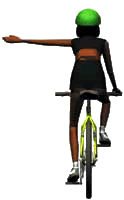
The hand signal shown below means you want to turn left.
The hand signal shown below means you are stopping or slowing down.
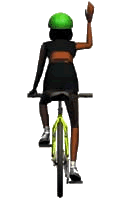
Stop hand signal
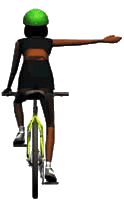
The hand signal shown below means you:
- Want to turn right
- Are going to pass a vehicle or some other object on the road
- Are pulling out from the kerb
What drivers would like cyclists to know
- Drivers expect cyclists to obey the road rules.
- Drivers usually travel faster than cyclists and therefore have less time to react to hazards. Remember this when you’re on the road.
- Sometimes cyclists’ behaviour can unsettle drivers, such as when cyclists appear hesitant or change direction suddenly.
- Drivers can feel delayed by cyclists.
- Licensed drivers and cyclists both have a right to use our roads, and both share a responsibility to understand and respect each other’s needs.
Features your cycle must have
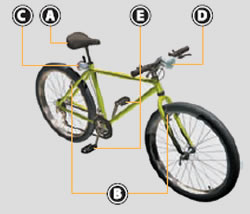
- A. A red or yellow reflector at the back.
- B. Good brakes on the front and back wheels (or, if the bike was made on or before 1 January 1988, a good brake on the back wheel).
When riding at night, cycles must have the following:
- C. A steady or flashing rear-facing red light that can be seen at night from a distance of 100 metres.
- D. One or two white or yellow headlights that can be seen at night from a distance of 100 metres (one of these lights may flash).
- E. Yellow pedal reflectors, or the rider must be wearing reflective material.
Any load you carry on your cycle must be tied on firmly and must not touch the ground.
Information for horse riders
As a horse rider, it’s important that you follow the road rules shown below. They will help ensure your safety when you are riding on the road.
Safety rules for horse riders
- Always wear a safety hat while riding. Otherwise, a fall from your horse could result in a head injury.
- Ride your horse on the left-hand side of the road and as far to the left as possible.
- Keep your horse on the side of the road whenever you can, but don’t ride on footpaths, lawns or gardens.
- Don’t ride more than two abreast.
- Don’t ride on the right of any moving vehicle.
- If you’re leading another animal while riding, always keep it on your left, away from the traffic.
- If you’re riding a horse or leading animals at night, wear reflective clothing and carry a torch.
Horse-drawn vehicles
- At night, vehicles drawn by horses must have a white light on the front right of the vehicle or load and have a red light shining to the rear. They must not have a red light on the front at night.
Information for moped riders
A moped is a motor vehicle on two or three wheels, with a power output of no more than 2 kW and a maximum speed of 50 km/h (some mopeds may have a lower maximum speed).
You are licensed to ride a moped if you have either a motorcycle (Class 6) licence or a car (Class 1) licence. When riding a moped on a Class 1 or Class 6 learner licence, you must display an L plate. If you’re on a learner or restricted licence, you must not ride the moped between 10 pm and 5 am.
Safety rules for moped riders
- A moped is a motor vehicle. Therefore, you must not ride it on the footpath or a cycle path.
- You must wear an approved motorcycle safety helmet when riding a moped.
- At intersections, you must:
- Follow the rules for motor vehicles, or
- Get off your moped and walk across.
- You may ride beside another moped or cyclist, but you must not ride beside other vehicles.
- Pass other vehicles in single file.
- A moped must not be towed by any other vehicle.
- A moped may tow a trailer, but must not be fitted with a sidecar.
- You must not carry a pillion passenger on a moped, unless you have a pillion seat and footrests. If you are carrying a child, the pillion seat must protect the child’s legs from the wheels.
- You must not park a moped on the footpath.
Features your moped must have
Your moped must have:
- A rear red light that can be seen from 100 metres away
- A headlight powerful enough to see clearly anything 30 metres in front of you
- A horn
- Good tyres, with a clear tread pattern
- A good exhaust system that isn’t excessively noisy
- Safe steering
- Mudguards
- Good brakes at the front and back
- One or two red rear stop lights (if first registered in New Zealand after 1 January 1991)
- A red rear reflector
Any load you carry on your moped must be tied on firmly and must not touch the ground.
 Apperture Labs