Car requirements
To drive your car (or other light vehicle) safely and legally on the road it must have the right equipment (in good working order) and have a current warrant of fitness (WoF). This section explains what your vehicle must have.
Warrant of fitness (WoF)
Privately operated cars, utes, vans and four-wheel drives must have a current WoF. Commercial vehicles and heavy vehicles must have a current certificate of fitness (CoF).
A current WoF shows the vehicle has been inspected by an approved WoF inspector and was roadworthy at the time of the last WoF inspection.
Important
In addition to the warrant of fitness, the vehicle must display a current licence label, a road user charges (RUC) licence if required (such as if your car runs on diesel) and a number plate on the front and back that can be clearly seen. See About driver responsibility for more information about these requirements.
The WoF label is attached to the inside of the windscreen, on the same side as the steering wheel, and must be clearly visible from outside the vehicle. The recommended position is in the top corner of the windscreen.
The WoF inspector will give you a copy of the check sheet. This is a receipt of payment for the inspection and is not a warrant of fitness. If your vehicle failed its WoF inspection, the receipt gives you 28 days to have the vehicle fixed and brought back for re-inspection without any additional payment. During that time you are only allowed to drive the vehicle to get it repaired and re-inspected.
How often do I need to get a WoF?
If your vehicle was first registered (in New Zealand or overseas) less than six years ago, it requires a WoF inspection every 12 months.
If your vehicle was first registered more than six years ago, it requires a WoF inspection every six months.
Important
You can be fined if you drive any vehicle that is not up to WoF standard on a road. A police officer can require you to stop for a roadside vehicle check at any time.
Features your car must have
To meet the WoF standard, your car must be in good condition (no rust around safety areas) and it must have the following equipment in good working order:
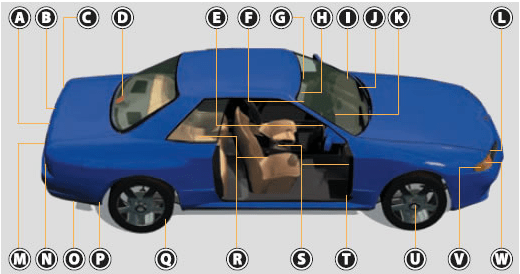
- A number plate light at the back.
- Two red reflectors at the back.
- Two red position lights at the back.
- One or two red high-mounted stop lights at the back.
- A working horn.
- A current WoF.
- A rear-view mirror that gives a clear view behind.
- A good sun visor.
- A windscreen that meets safety standards and is clean.
- One or more working windscreen wipers.
- A working speedometer.
- Two good headlights that can be dipped when another vehicle comes towards you.
- Two red stop lights at the back.
- Flashing direction indicator lights at the back.
- A good silencer and exhaust system.
- Mudguards.
- Safe tyres – the tread depth must be at least 1.5 millimetres right around the tyre.
- Working safety belts.
- Good footbrake and handbrake.
- Doors that open and close safely.
- Safe steering.
- Flashing direction indicator lights at the front.
- Two white or amber position lights at the front.
Important
Before making modifications, including the fitting of extra lights to your vehicle, check with an approved WoF inspector that the modifications are legal.
Carrying a load on your car
- Do not overload your roof rack.
- Your load must not extend more than 3 metres forward of the front edge of the front seat or 4 metres behind the rear axle.

- Your load must not extend more than 1.25 metres on either side from the centre of the vehicle.
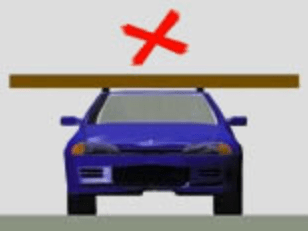
Note: if a load extends more than 1 metre beyond the back of your vehicle, you must tie on a white flag, or a red, orange or yellow fluorescent flag. The flag must be at least 40 centimetres by 30 centimetres in size. The load must be tied on firmly and must not touch the ground.
Safety belts
Approved safety belts must be fitted in all light passenger vehicles: cars, vans, utes and four-wheel drives.
The safety belts must be in good condition. You should have safety belts checked immediately if:
- The buckles are not working properly
- The belt is damaged or faded
- The belt starts to fray
They may need replacing.
Legal requirements for safety belts have changed over the years and are different depending on the age of the vehicle. The type of belt has also changed from static belts to retractor belts.
Three-point (lap and diagonal) belts must be fitted in the outer seating positions (including the driver’s seat) in most cars, vans, utes and four-wheel drives. Two-point (lap) belts are legally allowed in centre seating positions, but three-point belts provide better safety.
You must wear your safety belt when driving. Children must also be belted-in, using approved child restraints. See About driver responsibility for more information.
Light trailer requirements
If you tow a light trailer (under 3500 kg when loaded), it must have a WoF. To meet the WoF standard your trailer must be in good condition (no rust around safety areas) and it must have the following equipment in good working order:
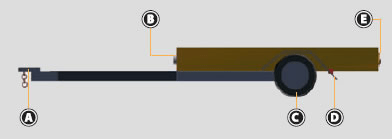
- A safe and strong coupling and a safety chain.
- If the trailer or its load is more than 2 metres wide, it must have two white lights at the front to show how wide it is.
- Safe tyres – the tread depth must be at least 1.5 millimetres right around the tyre.
- Mudguards.
- Two red reflectors at the back (one on each side).
Your trailer will also need the following features:
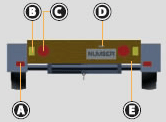
- Two red lights at the back to show how wide the trailer is.
- Direction indicators at the back.
- Two red stop lights at the back, if the driver’s signals can’t be seen.
- A number plate light at the back.
- A current trailer WoF issued by a WoF inspector. This must be renewed:
- Every 12 months for the first six years, then
- Every six months after.
Loading your trailer safely
The load on the trailer must not:
- Extend more than 4 metres behind the rear axle.
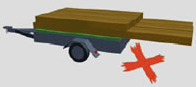
- Extend more than 1.25 metres on either side from the centre of the trailer.
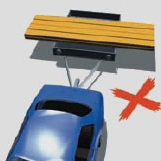
If the load extends more than 1 metre behind the trailer, you must tie on a white flag, or a red, orange or yellow fluorescent flag. The flag must be at least 40 centimetres by 30 centimetres in size. The load must be tied on firmly and must not touch the ground.
 Apperture Labs