Dealing with particular situations
Aggressive driving and road rage
Aggressive-driving behaviours, such as tailgating, speeding, failing to yield the right-of-way and cutting in front of someone too closely, may cause other drivers to become frustrated and angry and lead to a road-rage conflict between drivers. An angry driver may attempt dangerous retaliatory action. Avoid becoming angry on the road by following these tips:
- Know the warning signs of stress and combat them by getting fresh air, breathing deeply and slowly, and listening to relaxing music.
- Make a conscious decision not to take your problems with you when driving.
- If you are on a long trip, take a break from driving every few hours.
- Don’t compete with another driver, or retaliate for what you believe to be inconsiderate behaviour.
- If someone else’s driving annoys you, don’t try to “educate” the person. Leave traffic enforcement to the police.
- Don’t take other drivers’ mistakes or behaviours personally.
- Avoid honking your horn at other drivers, unless absolutely necessary. A light tap on the horn is usually sufficient.
Remember that if you drive responsibly and courteously, you are less likely to spark a road rage situation.
- Plan your route in advance. Some of the most erratic and inconsiderate driving occurs when a driver is lost.
- Drive in a courteous and considerate manner.
- Yield the right-of-way when it is courteous to do so.
- Be polite and let other drivers in front of you when they are signalling that they would like to do so.
- If you make a mistake while driving, indicate that you are sorry. An apology can greatly reduce the risk of conflict.
- Don’t return aggression. Avoid eye contact and do not gesture back. Keep away from erratic drivers.
If you are in a situation in which you feel threatened by another driver, do the following:
- Stay in your vehicle and lock the doors.
- If you have a cell phone, call police.
- Use your horn and signals to attract attention.
- If you believe you are being followed, do not drive home. Drive to a police station or a busy public place.
Street racing
Street racing is one of the most serious and reckless forms of aggressive driving. It shows a callous disregard for other drivers and road users, and it puts everyone on the road at serious risk of injury or death. Street racers run the risk of being charged under the Criminal Code of Canada.
Drowsy driving
Drowsiness has been identified as a causal factor in a growing number of collisions resulting in injury and fatality. Tired drivers can be as impaired as drunk drivers. They have a slower reaction time and are less alert.
Studies have shown that collisions involving drowsiness tend to occur during late night/early morning hours (between 2 a.m. and 6 a.m.) or late afternoon (between 2 p.m. and 4 p.m.). Studies also indicate that shift workers, people with undiagnosed or untreated sleep disorders, and commercial-vehicle operators, are at greater risk for such collisions.
Always avoid driving when you are feeling drowsy. Scientific research confirms that you can fall asleep without actually being aware of it. Here are eight important warning signs that your drowsiness is serious enough to place you at risk:
- You have difficulty keeping your eyes open.
- Your head keeps tilting forward despite your efforts to keep your eyes on the road.
- Your mind keeps wandering and you can’t seem to concentrate.
- You yawn frequently.
- You can’t remember details about the last few kilometres you have travelled.
- You are missing traffic lights and signals.
- Your vehicle drifts into the next lane and you have to jerk it back into your lane.
- You have drifted off the road and narrowly avoided a crash.
If you have one of these symptoms, you may be in danger of falling asleep. Pull off the road and park your vehicle in a safe, secure place. Use well-lit rest stops or truck stops on busy roads. Lock your doors, roll up your windows and take a nap.
Stimulants are never a substitute for sleep. Drinks containing caffeine can help you feel more alert but, if you are sleep deprived, the effects wear off quickly. The same is true of turning up the volume of your radio or CD player and opening the window. You cannot trick your body into staying awake; you need to sleep. Remember, the only safe driver is a well-rested, alert driver.
Workers on the road
Be extra careful when driving through construction zones and areas where people are working on or near the road.
When approaching a construction zone, proceed with caution and obey all warning signs, people and/or devices that are directing traffic through the area. Often, lower speed limits are posted to increase worker safety and reflect increased road hazards, such as construction vehicles in the area, uneven or gravel surfaces, narrowed lanes and so on. In the construction zone, drive carefully and adjust your driving to suit the conditions, do not change lanes, be ready for sudden stops and watch for workers and related construction vehicles and equipment on the road.
Other types of workers and vehicles may also be present on the road and pose a hazard, such as roadside assistance and disable vehicles, surveyors, road maintenance or utility workers. Always slow down and pass with caution to prevent a collision. If safe to do so, move over a lane to increase the space between your vehicle and the hazard.
Traffic-control workers direct vehicle traffic in work zones and prevent conflicts between construction activity and traffic. Whether you are driving during the day or at night, watch for traffic-control people and follow their instructions.
Treat people working on roads with respect, and be patient if traffic is delayed. Sometimes traffic in one direction must wait while vehicles from the other direction pass through a detour. If your lane is blocked and no one is directing traffic, yield to the driver coming from the opposite direction. When the way is clear, move slowly and carefully around the obstacle.
Recent changes to the Highway Traffic Act have resulted in doubled fines for speeding in a construction zone when workers are present. It is also an offence to disobey STOP or SLOW signs displayed by a traffic-control person or firefighter.
Animals on the road
Crashes involving animals (mainly moose and deer) are a growing problem. Motor vehicle/wild animal collisions increased from 8,964 in 1999 to 12,791 collisions in 2008. This represents an increase of 43 percent over a 10-year period. Many of these collisions go unreported.
You may encounter domestic, farm or wild animals on the road anywhere in Ontario. Scan the road ahead from shoulder to shoulder. If you see an animal on or near the road, slow down and pass carefully as they may suddenly bolt onto the road. Many areas of the province have animal crossing signs which warn drivers of the danger of large animals (such as moose, deer or cattle) crossing the road. Be cautious when you see these signs, especially during dusk-to-dawn hours when wild animals are most active.
To reduce your chances of hitting an animal:
- Reduce speed in darkness, rain and fog. These conditions can reduce your ability to see an animal on or near the road.
- Travel at a safe speed and stay alert. Driver inattention and speed are common factors in animal-vehicle crashes.
- Watch for shining eyes at the roadside. If you do see shining eyes, slow down and be ready to stop.
- Keep your windshield clean and headlights properly adjusted.
- Use high beams whenever possible and safe to do so, and scan both sides of the road ahead.
If you see an animal:
- Slow down and sound your horn.
- Be alert for other animals that may be with the one you’ve seen.
- Don’t try to drive around the animal. Animal movements are unpredictable.
- If you wish to watch an animal, find a safe place to pull completely off the road and park first. Do not park on the shoulder of the road, as other drivers may be distracted by the animal and hit your vehicle.
- Stay in your vehicle; getting out increases your chance of being hit by another vehicle.
- If you hit a deer or moose, report it to the local police service or the Ministry of Natural Resources. Do not try to move an injured animal.
Distracted driving
Driving is a job that requires your full attention every time you get behind the wheel, even if your vehicle has driver-assistance features. Any secondary activity will detract from your ability to drive properly and safely. You must reduce distractions and focus on your driving.
Ontario’s distracted driving laws apply to the use of hand-held communication/entertainment devices and certain display screens.
While you are driving, including when you are stopped in traffic or at a red light, it is illegal to:
- Use a phone or other hand-held wireless communication device to text or dial, except to call 911 in an emergency
- Use a hand-held electronic entertainment device, such as a tablet or portable gaming console
- View display screens unrelated to driving, such as watching a video
- Program a GPS device, except by voice commands
You are allowed to use hands-free wireless communications devices with an earpiece, lapel button or Bluetooth. You can view GPS display screens as long as they are built into your vehicle’s dashboard or securely mounted.
Other actions such as eating, drinking, grooming, smoking, reading and reaching for objects are not part of Ontario’s distracted driving law. However, you can still be charged with careless or dangerous driving.
Careless driving
You could face charges for careless driving if you endanger other people because of any kind of distraction. This includes distraction caused by both hand-held (e.g., phone) or hands-free (e.g., Bluetooth) devices.
You could even be charged with dangerous driving – a criminal offence that carries heavier penalties, including long jail terms.
Tips to avoid distracted driving
Use any of these tips to avoid distracted driving and its penalties:
- Turn off your phone or switch it to silent mode before you get in the car
- put it in the glove compartment (lock it, if you have to) or in a bag on the back seat
- Before you leave the house, record an outgoing message that tells callers you’re driving and you’ll get back to them when you’re off the road
- some apps can block incoming calls and texts, or send automatic replies to people trying to call or text you
- Ask a passenger to take a call or respond to a text for you
- if you must respond, or have to make a call or send a text, carefully pull over to a safe area
- Silence notifications that tempt you to check your phone
How dangerous is distracted driving?
About 100 people are killed and 16,000 are injured by distracted drivers every year in Ontario. About one in four of those deaths are vulnerable road users such as pedestrians and cyclists.
Research shows that young people 16-25 are more likely to drive distracted than any age group and are the most likely to be killed or injured in a distracted driving collision.
- Texting or browsing on your phone takes your eyes off the road and increases your risk of crashing by 10 times. In fact, a recent study found that drivers who were texting or changing music on their phones traveled 28 metres further (nearly half a hockey rink) before responding to a hazard than drivers who were paying attention. It can be a matter of life and death for a child who runs out on the street unexpectedly, or a family crossing at a crosswalk. For every 10-year increase in the driver’s age, drivers were 44% less likely to text, 38% less likely to use a handheld phone, and 28% less likely to use a hands-free phone.
Emergency vehicles
Emergency vehicles – police, fire, ambulance and special public-utility vehicles – are easily identified through their use of flashing red or blue lights, a siren or bell, or alternating flashes of white light from their headlamp high beams. Also, be aware that police, fire and ambulance services use many different types of vehicles, such as bicycles, snowmobiles, all-terrain vehicles, motorcycles, buses and trucks.
Reacting to an approaching emergency vehicle
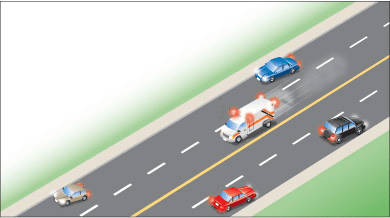
When an emergency vehicle is approaching your vehicle from any direction with its flashing red or red and blue lights, or siren or bell sounding, you are required to bring your vehicle to an immediate stop.
When bringing your vehicle to a stop, you are required to bring your vehicle as near as is practical to the right-hand curb or edge of the roadway. When on a one-way road or divided highway having more than two lanes of traffic, move to the closest curb or edge of the roadway. Your vehicle should be parallel to the roadway and clear of any intersections, including highway on/off ramps. Do not move onto or stop on the shoulder of the roadway, as emergency vehicles may be travelling along it.
Use extreme caution when stopping your vehicle because other drivers may not yet be aware of or are already reacting to the approaching emergency vehicle. Look to the front, both sides and toward the rear of your vehicle, signal your intention to pull over well in advance and begin to adjust your vehicle’s speed to merge with any traffic to the side you are pulling to. Once you have moved your vehicle to the side, brake gradually as required and bring your vehicle to a safe stop. Avoid any sudden changes in direction or excessive braking and be aware of any vehicles approaching fast to the rear of your vehicle.
If you are in an intersection and preparing to make a turn when an emergency vehicle is approaching, you should abandon the turn and clear the intersection by proceeding straight when safe to do so, then pull to the right and stop. This will clear the intersection and minimize the possibility of a collision with the emergency vehicle should it be passing you on the side you intended to turn towards.
When the emergency vehicle has passed, check to make sure the way is clear and signal before merging back into traffic. Remain vigilant for additional emergency vehicles, and remember it is illegal to follow within 150 metres of a fire vehicle responding to an alarm.
Note: Some firefighters and volunteer medical responders may display a flashing green light when using their own vehicles to respond to a fire or medical emergency. Please yield the right-of-way to help them respond to an emergency call quickly and safely.
Police or other enforcement officers may require you to pull over and bring your vehicle to an immediate stop. Typically, the officer may signal this requirement by driving their vehicle with its emergency lights flashing and/or siren on behind your vehicle or by using hand gestures from the side of the road. When stopping your vehicle, follow the previous procedures, except that you should bring your vehicle to a stop outside of traffic lanes and onto the shoulder of the roadway where possible, or turn and stop on a side street with less traffic if in the immediate vicinity. If the officer gives direction as to where to stop, follow the officer’s directions.
Stay alert
When you see an approaching emergency vehicle with its lights or siren on, prepare to clear the way.
- React quickly but calmly. Don’t slam on the brakes or pull over suddenly. Use your signals to alert other drivers you intend to pull over.
- Check your rearview mirrors. Look in front and on both sides of your vehicle. Allow other vehicles to also pull over. Pull to the right and gradually come to a stop.
- Wait for the emergency vehicle to pass and watch for other emergency vehicles that may be responding to the same call. Check to make sure the way is clear and signal before merging back into traffic.
- Don’t drive on or block the shoulder on freeways. Emergency vehicles will use the shoulder of the road if all lanes are blocked.
Reacting to a stopped emergency vehicle or tow truck
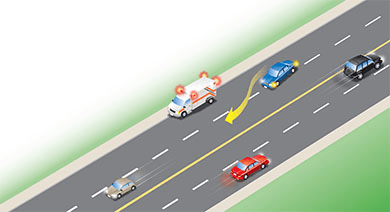
When approaching any emergency vehicle that is stopped with its red, or red and blue, lights flashing or a tow truck with its amber lights flashing in the same direction of your travel, you are required to reduce the speed of your vehicle and proceed with caution. When reducing your speed, you are required to assess the speed of the surrounding traffic and the condition of the roadway (such as fog, rain, snow). To ensure safety, brake early and gradually to allow surrounding traffic to better adjust to a reduced speed and to ensure you have full control of your vehicle when braking.
If your vehicle has a manual transmission, it is recommended that you use your brakes, versus shifting down to a lower gear, in order to activate your rear brake lights and indicate to other drivers that you are slowing down.
When the roadway has two or more lanes of traffic in the same direction of your travel, you are required to move into a lane away from the emergency vehicle or tow truck, if safe to do so, in addition to reducing the speed of your vehicle and proceeding with caution. Similar to the procedures noted above, when slowing down and moving over, look in front and on both sides of your vehicle, and check your rearview mirrors, to determine the speed of the traffic around you and condition of the roadway. Proceed to decrease your speed similar to surrounding traffic speed, use your turn signal prior to making the lane change, and double check your rearview mirrors and shoulder check your blind spots to ensure no other vehicles are moving into or approaching that lane too fast. When safe to do so, change lanes well in advance of an emergency vehicle or a stopped tow truck with its flashing amber lights. Once in the lane, brake gradually and continue to reduce the speed of your vehicle when safe to do so. Be aware of any vehicles approaching fast to the rear of your vehicle.
Tips to remember
- Stay alert. Avoid distractions. Keep the noise level down in your vehicle.
- Remain calm, and do not make sudden lane changes or brake excessively.
- Before changing direction or speed, consider road conditions, check surrounding traffic, use your mirrors, look to blind spots, and signal and brake early.
- Keep roadway shoulders, intersections and highway ramps clear for emergency-vehicle use.
- If your vehicle is being pulled over, in this instance, bring it to a safe stop on the shoulder of the roadway, away from traffic, following any directions from the officer.
Failing to respond to an emergency vehicle
Take emergency flashing lights and sirens seriously. Proceed with caution, clear the way and bring your vehicle to a stop, where required. It’s the law. If you don’t stop, you can be fined and get three demerit points for a first offence. For additional offences, fines increase and you could also go to jail for up to six months.
Please note the above law, fines and penalties are also applicable to a tow truck with its lamp producing intermittent flashes of amber light that is stopped on a highway.
Summary
By the end of this section, you should know:
- How to manoeuvre your vehicle through construction zones
- What to do if you encounter animals on the road
- Things that may distract you when driving and how to minimize those distractions
- What to do when you encounter an emergency vehicle
Driving at night and in bad weather
At night and in weather conditions such as rain, snow or fog, you cannot see as far ahead, even with headlights. Slow down when driving at night, especially on unlit roads and whenever weather conditions reduce your visibility.
Overdriving your headlights
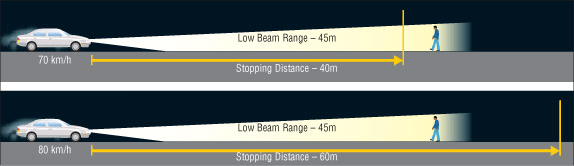
You are overdriving your headlights when you go so fast that your stopping distance is farther than you can see with your headlights. This is a dangerous thing to do, because you may not give yourself enough room to make a safe stop. Reflective road signs can mislead you as well, making you believe you can see farther than you really can. This may cause you to over-drive your headlights if you are not careful (Diagram 2-58).
Glare
Glare is dazzling light that makes it hard for you to see and be aware what others around you are doing. It can be a problem on both sunny and overcast days, depending on the angle of the sun’s rays and your surroundings. Glare can also be a problem at night when you face bright headlights or see them reflected in your rear view mirror.
When meeting oncoming vehicles with bright headlights at night, look up and beyond and slightly to the right of the oncoming lights. In daytime glare, use your sun visor or keep a pair of good quality sunglasses in your vehicle. When you enter a tunnel on a bright day, slow down to let your eyes adjust to the reduced light. Remove your sunglasses and turn on your headlights.
Cut down glare at night by following the rules of the road for vehicle lights. Use your low-beam headlights within 150 metres of an oncoming vehicle or when following a vehicle within 60 metres. On country roads, switch to low beams when you come to a curve or hilltop so you can see oncoming headlights and won’t blind oncoming drivers. If you can’t see any headlights, switch back to high beams.
Fog
Fog is a thin layer of cloud resting on the ground. Fog can reduce visibility for drivers, resulting in difficult driving conditions.
The best thing to do is to avoid driving in fog. Check weather forecasts and if there is a fog warning, delay your trip until it clears. If that is not possible or you get caught driving in fog, there are a number of safe driving tips you should follow. If visibility is decreasing rapidly, move off the road and into a safe parking area to wait for the fog to lift.
Tips for driving safely in fog
Before you drive – and during your trip – check weather forecasts. If there is a fog warning, delay your trip until it clears. If you are caught driving in fog, follow these safe-driving tips:
Do:
- Slow down gradually and drive at a speed that suits the conditions.
- Make sure the full lighting system of your vehicle is turned on.
- Use your low-beam headlights. High beams reflect off the moisture droplets in the fog, making it harder to see.
- If you have fog lights on your vehicle, use them, in addition to your low beams.
- Be patient. Avoid passing, changing lanes and crossing traffic.
- Use pavement markings to help guide you. Use the right edge of the road as a guide, rather than the centre line.
- Increase your following distance. You will need extra distance to brake safely.
- Look and listen for any hazards that may be ahead.
- Reduce the distractions in your vehicle. For example, turn off the cell phone. Your full attention is required.
- Watch for any electronically operated warning signs.
- Keep looking as far ahead as possible.
- Keep your windows and mirrors clean. Use your defroster and wipers to maximize your vision.
- If the fog is too dense to continue, pull completely off the road and try to position your vehicle in a safe parking area. Turn on your emergency flashers, in addition to keeping on your low-beam headlights.
Don’t:
- Don’t stop on the travelled portion of the road. You could become the first link in a chain-reaction collision.
- Don’t speed up suddenly, even if the fog seems to be clearing. You could find yourself suddenly back in fog.
- Don’t speed up to pass a vehicle moving slowly or to get away from a vehicle that is following too closely.
Remember:
- Watch your speed. You may be going faster than you think. If so, reduce speed gradually.
- Leave a safe braking distance between you and the vehicle ahead.
- Remain calm and patient. Don’t pass other vehicles or speed up suddenly.
- Don’t stop on the road. If visibility is decreasing rapidly, pull off the road into a safe parking area and wait for the fog to lift.
- Use your low-beam lights.
Rain
Rain makes road surfaces slippery, especially as the first drops fall. With more rain, tires make less contact with the road. If there is too much water or if you are going too fast, your tires may ride on top of the water, like water skis. This is called hydroplaning. When this happens, control becomes very difficult. Make sure you have good tires with deep tread, and slow down when the road is wet.
Rain also reduces visibility. Drive slowly enough to be able to stop within the distance you can see. Make sure your windshield wipers are in good condition. If your wiper blades do not clean the windshield without streaking, replace them.
In rain, try to drive on clear sections of road. Look ahead and plan your movements. Smooth steering, braking and accelerating will reduce the chance of skids Leave more space between you and the vehicle ahead in case you have to stop. This will also help you to avoid spray from the vehicle ahead that can make it even harder to see.
Avoid driving in puddles. A puddle can hide a large pothole that could damage your vehicle or its suspension, or flatten a tire. The spray of water could obstruct the vision of adjacent motorists and result in a collision, cause harm to nearby pedestrians or drown your engine, causing it to stall. Water can also make your brakes less effective.
Flooded roads
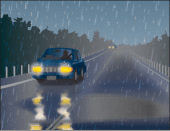
Avoid driving on flooded roads, water may prevent your brakes from working. If you must drive through a flooded stretch of road, test your brakes afterward to dry them out. Test your brakes when it is safe to do so by stopping quickly and firmly at 50 km/h. Make sure the vehicle stops in a straight line, without pulling to one side. The brake pedal should feel firm and secure, not spongy, that’s a sign of trouble. If you still feel a pulling to one side or a spongy brake pedal even after the brakes are dry, you should take the vehicle in for repair immediately.
Skids
A skid may happen when one or more tires lose their grip with the road’s surface. Skids most often happen on a slippery surface, such as a road that is wet, icy or covered with snow, gravel or some other loose material. Most skids result from driving too fast for road conditions. Hard braking and overly aggressive turning or accelerating can cause your vehicle to skid and possibly go out of control.
To avoid a skid on a slippery road, drive at a reduced speed and operate the vehicle’s controls in a smooth and constrained manner. Increasing tire forces, such as by braking or accelerating while steering may push tires even closer to a skid condition. It’s essential that the vehicle’s speed be maintained at a safe level and that turns be made gently.
If your vehicle begins to skid, try not to panic – it is possible to maintain control of your vehicle, even in a skid. Ease off on the accelerator or brake and on a very slippery surface slip the transmission into neutral if you can. Continue to steer in the direction you wish to go. Be careful not to oversteer. Once you regain control, you can brake as needed, but very gently and smoothly.
Anti-lock braking systems (ABS)
If your vehicle is equipped with anti-lock brakes, practise emergency braking to understand how your vehicle will react. It is a good idea to practise doing this under controlled conditions with a qualified driving instructor.
ABS is designed to sense the speed of the wheels on a vehicle during braking. An abnormal drop in wheel speed, which indicates potential wheel lock, causes the brake force to be reduced to that wheel. This is how ABS prevents tire skid and the accompanying loss of steering control. This improves vehicle safety during heavy brake use or when braking with poor traction.
Although anti-lock braking systems help to prevent wheel lock, you should not expect the stopping distance for your vehicle to be shortened.
Drivers unfamiliar with anti-lock braking may be surprised by the pulsations that they may feel in the brake pedal when they brake hard. Make sure you know what to expect so you will not be distracted by the pulsation or tempted to release the pedal during emergency braking manoeuvres.
Threshold braking
Threshold braking should bring you to a reasonably quick controlled stop in your own lane, even in slippery conditions. This technique is generally practised in a vehicle that is not equipped with ABS. Brake as hard as you can until a wheel begins to lock up, then release pressure on the pedal slightly to release the wheel. Press down on the brake pedal, applying as much braking force as possible without inducing a skid. If you feel any of the wheels begin to lock up, release the brake pressure slightly and re-apply. Don’t pump the brakes. Continue braking this way until you have slowed the vehicle to the desired speed.
Vehicles equipped with ABS should provide controlled braking on slippery surfaces automatically. Press the brake pedal hard and allow the system to control wheel lock-up.
Snow
Snow may be hard-packed and slippery as ice; rutted, full of hard tracks and gullies; or smooth and soft. Look ahead and anticipate what you must do based on the conditions. Slow down on rutted, snowy roads. Avoid sudden steering, braking or accelerating that could cause a skid. Do not use cruise control during times of snow and other inclement weather.
Whiteouts
Blowing snow may create whiteouts where snow completely blocks your view of the road. When blowing snow is forecast, drive only if necessary and with extreme caution.
Tips for driving in blowing snow and whiteout conditions
Before you drive – and during your trip – check weather forecasts and road reports. If there is a weather warning, or reports of poor visibility and driving conditions, delay your trip until conditions improve, if possible. If you get caught driving in blowing snow or a whiteout, follow these safe driving tips:
Do:
- Slow down gradually and drive at a speed that suits the conditions.
- Make sure the full lighting system of your vehicle is turned on.
- Use your low-beam headlights. High beams reflect off the ice particles in the snow, making it harder to see. If you have fog lights on your vehicle, use them, in addition to your low beams.
- Be patient. Avoid passing, changing lanes and crossing traffic.
- Increase your following distance. You will need extra space to brake safely.
- Stay alert. Keep looking as far ahead as possible.
- Reduce the distractions in your vehicle. Your full attention is required.
- Keep your windows and mirrors clean. Use defroster and wipers to maximize your vision.
- Try to get off the road when visibility is near zero. Pull into a safe parking area if possible.
Don’t:
- Don’t stop on the travelled portion of the road. You could become the first link in a chain-reaction collision.
- Don’t attempt to pass a vehicle moving slowly or speed up to get away from a vehicle that is following too closely.
Remember:
- Watch your speed. You may be going faster than you think. If so, reduce speed gradually.
- Leave a safe braking distance between you and the vehicle ahead.
- Stay alert, remain calm and be patient.
- If visibility is decreasing rapidly, do not stop on the road. Look for an opportunity to pull off the road into a safe parking area and wait for conditions to improve.
- If you become stuck or stranded in severe weather, stay with your vehicle for warmth and safety until help arrives. Open a window slightly for ventilation. Run your motor sparingly. Use your emergency flashers.
- Be prepared and carry a winter driving survival kit that includes items such as warm clothing, non-perishable energy foods, flashlight, shovel and blanket.
- It is important to look ahead and watch for clues that indicate you need to slow down and anticipate slippery road conditions.
Ice
As temperatures drop below freezing, wet roads become icy. Sections of road in shaded areas or on bridges and overpasses freeze first. It is important to look ahead, slow down and anticipate ice. If the road ahead looks like black and shiny asphalt, be suspicious. It may be covered by a thin layer of ice known as black ice. Generally, asphalt in the winter should look gray-white in colour. If you think there may be black ice ahead, slow down and be careful.
Snow plows
Snow-removal vehicles on public roadways are equipped with flashing blue lights that can be seen from 150 metres.
Flashing blue lights warn you of wide and slow-moving vehicles: some snow plows have a wing that extends as far as three metres to the right of the vehicle. On freeways, several snow plows may be staggered across the road, clearing all lanes at the same time by passing a ridge of snow from plow to plow. Do not try to pass between them. This is extremely dangerous because there is not enough room to pass safely, and the ridge of wet snow can throw your vehicle out of control.
Summary
By the end of this section, you should know:
- How to identify and manage situations where your visibility may be reduced
- How weather conditions such as rain, flooded roads, snow and ice may affect your vehicle and your ability to control it
- What to do if your vehicle skids or if you encounter heavy snow, whiteouts or black ice
- How to recognize and share the road with snow removal vehicles
Dealing with emergencies
If you drive often or travel alone, you need to be ready to deal with emergencies. Here are some suggestions for coping with some common road emergencies.
If your brakes fail
Try pumping the brake pedal to temporarily restore hydraulic brake pressure. If this does not work, apply the parking brake gently but firmly while holding the release button. It is a good idea for new drivers to practice a parking-brake emergency stop under controlled conditions with a qualified driving instructor. Total brake failure is very rare on modern vehicles. If your brakes do fail and you manage to stop, do not drive away. Call for help.
If your gas pedal sticks
First try to lift the pedal by slipping your foot under it. Do not reach down with your hands while the vehicle is moving. If this does not work, turn on your hazard lights, shift to neutral and stop as soon as you safely can, preferably off the road. Turn off the ignition and do not drive away. Call for help.
If your headlights go out
Check the switch immediately. If the lights stay out, turn on your hazard lights and bring your vehicle to a safe stop off the road. Call for help. It is dangerous and illegal to drive at night without lights.
If you have trouble on a freeway
At the first sign of trouble, begin to pull over. Do not wait for your vehicle to stall on the freeway. Check your mirrors, put on your hazard lights, take your foot off the gas pedal and pull over to the nearest shoulder as quickly as possible. Never stop in the driving lanes.
Be careful getting out of your vehicle. If possible, leave through the door away from traffic. Do not raise the hood.
While you wait for help, stay in your vehicle with the doors locked. If someone stops to help, ask them to call the police or automobile club for you. If you have a cellular phone, call for help yourself.
The Queen Elizabeth Way, the 400-series freeways and many other high-speed roads are patrolled by the Ontario Provincial Police. Stay with your vehicle, and help will arrive shortly.
If your wheels go off the pavement
Don’t panic. Grip the steering wheel firmly. Take your foot off the gas pedal to slow down. Avoid heavy braking. When the vehicle is under control, steer toward the pavement. Be prepared to correct your steering and increase speed when your wheels are fully back on the pavement.
If a tire blows out
Blowouts can cause tremendous steering and wheel vibration, but don’t be alarmed. Take your foot off the gas pedal to slow down and steer the vehicle firmly in the direction you want to go. Bring the vehicle to a stop off the road.
In a collision where someone is injured
St. John Ambulance recommends that all drivers carry a well-stocked first-aid kit and know how to use it. Consider reading a book about first aid or sign up for a first-aid course. It could mean the difference between life and death in a collision.
Every driver involved in a collision must stay at the scene or return to it immediately and give all possible assistance. If you are not personally involved in a collision, you should stop to offer help if police or other officials have not arrived.
In a collision with injuries, possible fuel leaks or serious vehicle damage, stay calm and follow these steps:
- Call for help or have someone else call. By law, you must report any collision to the police when there are injuries or damage to vehicles or other property exceeding $2,000.
- Turn off all engines and turn on emergency flashers. Set up warning signals or flares, or have someone warn approaching drivers.
- Do not let anyone smoke, light a match or put flares near any vehicle, in case of a fuel leak. If a vehicle is on fire, get the people out and make sure everyone is well out of the way. If there is no danger of fire or explosion, leave injured people where they are until trained medical help arrives.
- If you are trained in first aid, treat injuries in the order of urgency, within the level of your training. For example, clear the person’s airway to restore breathing, give rescue breathing or stop bleeding by applying pressure with a clean cloth.
- If you are not trained in first aid, use common sense. For example, people in collisions often go into shock. Cover the person with a jacket or blanket to reduce the effects of shock.
- Stay with injured people until help arrives.
- Disabled vehicles on the road may be a danger to you and other drivers. Do what you can to make sure everyone involved in a collision is kept safe.
In a collision where no one is injured
Follow these steps in a collision where there are no injuries:
- If the vehicles are drivable, move them as far off the road as possible as this should not affect the police officer’s investigation. This is especially important on busy or high-speed roads where it may be dangerous to leave vehicles in the driving lanes. So in a minor collision with no injuries, if you can “Steer it, Clear it”. If you cannot move the vehicles off the road, set up warning signals or flares far enough away to give other traffic time to slow down or stop.
- Call police (provincial or local, depending on where the collision takes place). By law, you must report any collision to the police when there are injuries or damage to vehicles or property exceeding $2,000.
- Give all possible help to police or anyone whose vehicle has been damaged. This includes giving police your name and address, the name and address of the registered owner of the vehicle, the vehicle plate and permit number and the liability insurance card.
- Get the names, addresses and phone numbers of all witnesses.
- If damage is less than $2,000, you are still required by law to exchange information with anyone whose vehicle has been damaged. However, the collision does not have to be reported to the police.
- If you have a camera or cell phone with a camera and it is safe to do so, take photos of the collision scene.
- If your vehicle must be towed, get the name and licence number of the tow truck operator and/or company. Make sure you understand where your vehicle is being towed.
- Contact your insurance company as soon as possible if you intend to make a claim.
Summary
By the end of this section, you should know:
- What to do in emergency situations such as vehicle component failure, driving off the pavement or vehicle trouble on a freeway
- The steps to take if you are involved in a collision with or without injuries
Driving efficiently
Vehicles powered by gasoline and diesel give off air pollutants and gases such as oxides of carbon, nitrogen and sulphur, hydrocarbons and soot. These pollutants affect the quality of the air we breathe, our health, crop yields and even the global climate.
Hydrocarbons and oxides of nitrogen react in sunlight to form ground-level ozone, better known as smog. Smog is a major health hazard responsible for respiratory ailments and other illnesses. Oxides of sulphur and nitrogen combine with water vapour to form acid rain, which damages our lakes, forests and crops.
Global warming is the result of too much carbon dioxide and other gases trapping heat in our atmosphere. Global warming could cause average temperatures to rise, causing droughts, crop failures, lower water levels and more frequent and severe storms.
A car gives off less carbon dioxide than a larger vehicle, such as an airplane, truck, bus or train, does. However, because so many people own cars and drive them so often, cars are responsible for nearly half the carbon dioxide produced by all forms of transportation. Vehicles that carry large numbers of passengers, such as buses, produce less carbon dioxide per passenger than cars.
As a driver, you can help to protect the environment from the harmful effects of driving by following these suggestions. Many of them can also save you money.
Before you drive
- Plan ahead. Combine several errands into one trip.
- Avoid driving during rush hours. Driving in off-peak times takes less time, uses less fuel and releases fewer emissions.
- Pay attention to smog alerts. It is especially important to follow these suggestions on days when smog is bad.
- For short trips, consider walking or cycling.
- For longer trips, public transit is an environmentally friendly alternative to driving alone.
- Carpool whenever possible. If you want to meet at a central location, there are free carpool lots in many parts of the province.
While driving
- Avoid starting your vehicle unnecessarily. A large burst of pollutants is emitted when a cold engine is started.
- Turn off your vehicle if parked more than 10 seconds. Even in cold weather, vehicle engines warm up within 30 seconds.
- Obey the speed limits. Driving at high speed uses more fuel and increases your chances of a serious collision.
- On the freeway, use your vehicle’s overdrive gear and cruise control for better fuel efficiency.
- Remove unnecessary weight from your vehicle, such as heavy baggage, wet snow and winter sand or salt.
- Maintain your vehicle’s aerodynamics. Remove roof racks and compartments when not in use. At high speeds, use your vents instead of opening the windows.
- Use your vehicle’s air conditioning wisely. Use your windows and vents in city and stop-and-go traffic. At high speeds, using your air conditioning is usually more fuel efficient than opening your windows and reducing the vehicle’s aerodynamics.
- Don’t “top-off” the tank when refueling. Spilled fuel releases harmful vapours.
At the garage
- Regular maintenance will keep your vehicle running at maximum efficiency, reducing the fuel you need to buy and the pollutants your vehicle emits.
- Keep your vehicle’s engine well tuned. Worn spark plugs, dragging brakes, low transmission fluid or a transmission not going into high gear can increase fuel consumption substantially.
- Follow the recommended maintenance schedule in your vehicle owner’s manual to maximize fuel efficiency.
- Have any fluid leaks checked by a specialist to avoid engine damage and harming the environment.
- Keep your tires properly inflated to reduce your fuel bill, emissions and tire wear.
- Have your vehicle’s alignment checked regularly to reduce uneven tire wear and fuel consumption.
Drivers are reminded that many collisions occur when the driving environment is less than optimal. Whether driving at night, during times of reduced visibility or when road conditions are wet and slippery, drivers are encouraged to use the appropriate safe-driving tips provided in this handbook.
10 ways you can help make Ontario’s roads the safest in North America
- Don’t drink and drive. Don’t drive when you’re taking medication that will affect your driving.
- Always wear your seatbelt and make sure passengers are using the appropriate child car seat,booster seat or seatbelt.
- Obey the speed limits. Slow down when road and weather conditions are poor.
- Don’t take risks: don’t cut people off in traffic, make sudden lane changes or run yellow lights.
- Don’t drive when you’re tired, upset or sick.
- If you’re in doubt, let the other driver go first – yield the right-of-way.
- Keep at least a two-second space between your vehicle and the one ahead. To check your distance: start counting when the vehicle ahead passes a fixed object, stop counting when your vehicle reaches the same spot.
- Cut the distractions: don’t overcrowd the vehicle or play loud music.
- Always check your blind spot: look in your mirror and over your shoulder before you change lanes.
- Check traffic in all directions, including any sidewalks and paths/trails, before entering an intersection.
Summary
By the end of this section, you should know:
- How passenger vehicles affect the environment
- Ways to reduce the amount you drive
- Ways to conserve fuel and reduce emissions when you drive
 Apperture Labs