Parking along roadways
Since parking rules change from road to road and place to place, always watch for and obey signs that say you may not stop or limit stopping, standing or parking. Be aware that not all parking by-laws are posted on signs.
Here are some basic parking rules:
- Never park on the travelled part of a road. Drive off the road onto the shoulder if you must stop for some reason.
- Never park on a curve, hill or anywhere you do not have a clear view for at least 125 metres in both directions.
- Do not park where you will block a vehicle already parked or where you will block a sidewalk, crosswalk, pedestrian crossing or road entrance.
- Do not park within three metres of a fire hydrant, on or within 100 metres of a bridge or within six metres of a public entrance to a hotel, theatre or public hall when it is open to the public.
- Do not park within nine metres of an intersection or within 15 metres if it is controlled by traffic lights.
- Do not park within 15 metres of the nearest rail of a level railway crossing.
- Do not park where you will get in the way of traffic or snow clearing.
- Never open the door of your parked vehicle without first making sure that you will not endanger any other person or vehicle or interfere with traffic. Generally, a good practice is to use the Dutch reach method, meaning you open the driver’s door with your right hand as this will force a shoulder check at the same time.. Take extra precautions to avoid opening a door in the path of cyclists, who often ride close to parked cars (Diagram 2-50). When you must open a door next to traffic, keep it open only long enough to load or unload passengers.

After parking your vehicle, always turn off the ignition and the lights, remove the key and lock the door to deter theft. Do not leave children or animals in the vehicle.
Before moving from a parked position, always signal and check for traffic, pulling out only when it is safe to do so.
Parking for people with disabilities
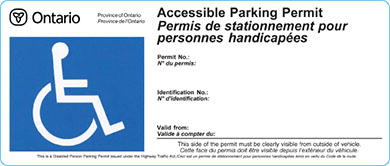
The Accessible Parking Permit, formerly known as the Disabled Person Parking Permit, is a laminated card that may be displayed on the dashboard or turned-down sun visor of any vehicle in which a person with a disability is travelling. The permit entitles the vehicle in which the person named on the permit is travelling to park in designated disabled parking, standing and stopping areas. The permit is issued to the permit holder, not a specific vehicle.
People who have the old version of the permit, the Disabled Person Parking Permit, may continue to use this permit until it expires. Upon its expiry, any new permit issued will be the Accessible Parking Permit.
The Accessible Parking Permit is issued free of charge to qualified individuals. To qualify for an Accessible Parking Permit, a licensed physician, chiropractor, nurse practitioner (extended class) physiotherapist or occupational therapist must certify that the applicant has one or more of the conditions detailed on the Accessible Parking Permit application form.
There are four types of Accessible Parking Permits.
- A regular permit (blue) is issued to people with permanent disabilities and is valid for five years. Until 2011, all individuals will need to be re-certified before renewing their permit. After that date, only individuals whose condition is deemed “subject to change” will need to be re-certified before renewing their permit.
- A temporary permit (red) is issued when the disability is expected to last more than two months, but is not a permanent disability. The temporary permit is not renewable.
- A traveller permit (purple) is valid for up to one year and is issued upon request to individuals who hold a valid Accessible Parking Permit and plan to fly from any Ontario airport. The permit holder places the traveller permit on the dashboard or sun visor of their vehicle when leaving it parked at the airport. The person’s regular permit travels with them.
- A company permit (green) is valid for up to five years and is issued to companies and non-profit organizations that own or lease vehicles used to transport people with physical disabilities.
Misuse or abuse of an Accessible Parking Permit should be reported to the police. Misuse of an Accessible Parking Permit will result in fines and revoked privileges.
Never park in a space designated for people with disabilities unless you display an Accessible Parking Permit in the windshield of your vehicle. The permit must belong to you or one of your passengers. This also applies to standing or stopping at curb areas reserved for picking up and dropping off passengers with disabilities.
Parallel parking
Parallel parking means parking a vehicle with its wheels parallel and next to the curb or side of the road. Park parallel to the curb on roads where parking is allowed, unless there are signs saying that vehicles should be parked at an angle. Park on the right side of the road in the direction of traffic. Unless there are signs saying otherwise, you can parallel park on both sides of a one-way road.
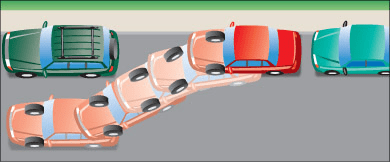
To parallel park on the right-hand side of the road, find a space that is about one and one-half times longer than your vehicle. Check the traffic beside and behind and signal your wish to pull over and stop. Drive alongside, or parallel to, the vehicle ahead of the empty space, leaving about a metre between the vehicles. Stop when your rear bumper is in line with the other vehicle. Follow these steps:
- Slowly and carefully reverse into the space, turning the steering wheel fully toward the curb.
- When you can see the outside rear corner of the vehicle in front of your space, straighten your wheels as you continue to reverse.
- Turn the steering wheel fully toward the road to bring your vehicle in line with the curb.
- If your vehicle is not parallel to the curb, drive forward to straighten.
- When you are properly parked, set the parking brake and move the gear selector into park, or shift into first or reverse gear if your vehicle has a manual transmission.
- Turn off the engine. Remember to remove the key from the ignition. Check traffic before opening your door. Lock your vehicle.
Parking on a hill
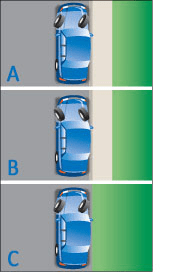
When parking facing downhill, turn your front wheels towards the curb or right shoulder. This will keep the vehicle from rolling into traffic if the brakes become disengaged (Diagram 2-53 A).
Turn the steering wheel to the left so the wheels are turned towards the road if you are facing uphill with a curb. The tires will catch the curb if it rolls backward (Diagram 2-53 B).
When facing uphill without a curb, turn the wheels sharply to the right. If the vehicle rolls, it will go off the road rather than into traffic (Diagram 2-53 C).
When parking on a hill, always set the parking brake and move the gear selector into park, or shift into first or reverse gear if your vehicle has a manual transmission. Turn off the engine and remove the key. Check for traffic before opening the door and remember to lock your vehicle.
Roadside stop
When you need to stop by the side of the road for a short time to check something outside your vehicle, or to look for directions on a map, for example, follow these directions:
- Before slowing down, check your mirrors and blind spot to see when the way is clear.
- Turn on your signal before slowing down unless there are vehicles waiting to enter the road from side roads or driveways between you and the point where you intend to stop. Wait until you have passed these entrances so that drivers will not think you are turning before the stopping point.
- Steer to the side of the road, steadily reducing speed, and stop parallel to the curb or edge of the road. You should not be more than about 30 centimetres away from it. Do not stop where you will block an entrance or other traffic.
- Turn off your signal and turn on your hazard lights.
If your vehicle has an automatic transmission, put the gear selector in park and set the parking brake. If your vehicle has a manual transmission, set the parking brake and shift into neutral if not turning off the engine, or shift into low or reverse if turning off the engine. When parking on a hill, set your wheels against the curb, in the appropriate direction to keep your vehicle from rolling.
Pulling out from a roadside stop
When pulling out from a roadside stop, do the following:
- Release the parking brake and move the gear selector to drive or shift into first gear.
- Turn off your flashers and turn on your left-turn signal.
- Just before pulling away from the stop, check your mirrors and blind spot to make sure the way is clear of vehicles and cyclists.
- Return to normal traffic speed by accelerating smoothly to blend with the traffic around you. In light traffic, accelerate moderately. In heavier traffic, you may have to accelerate more quickly. In a vehicle with manual transmission, shift gears as you increase speed.
- Turn off your left-turn signal as soon as you are back on the road.
Summary
By the end of this section, you should know:
- Basic parking rules that may not appear on posted street signs
- What an Accessible Parking Permit is, and who is eligible to park in spaces designated for people with disabilities
- What parallel parking is and what steps to follow to complete it successfully
- How to safely pull over your vehicle for a roadside stop and re-enter traffic
Freeway driving
A freeway – also called an expressway – is a high-speed, multi-lane road. On a freeway, traffic going in each direction is separated and ramps let vehicles enter and exit. Vehicle speed is higher on a freeway than on other roads, so driving can be more demanding and difficult. However, because there are no intersections, bicycles or pedestrians, freeway driving can be safer for experienced drivers.
New lanes called High Occupancy Vehicle (HOV) lanes are to be used for vehicles carrying a set minimum number of people. You will need to learn how to recognize markings and signs for these lanes, and the rules for using them.
New drivers need to learn how to drive with other vehicles around them at low speeds before trying freeway driving. Class G1 drivers may only drive on freeways with a licensed driving instructor.
Entering a freeway
There are usually two parts to a freeway entrance: an entrance ramp and an acceleration lane.
As you move along the freeway entrance ramp, look ahead and check your mirrors and blind spots to assess the traffic to see where you will move into the nearest freeway lane.
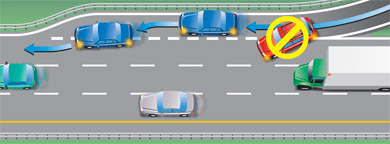
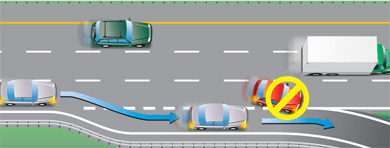
As you leave the ramp you enter the acceleration lane. In the acceleration lane, drivers increase their speed to the speed of traffic on the freeway before they merge with it. Signal and increase your speed to merge smoothly with traffic. Freeway drivers should move over, if it is safe to do so, leaving room for merging vehicles.
A few entrance ramps join the freeway on the left. This means you enter the fastest lane of traffic first. Use the acceleration lane to match your speed to the traffic, increasing your speed more quickly.
Driving along a freeway
Once on the freeway, a safe driver travels at a steady speed, looking forward and anticipating what’s going to happen on the road ahead. Traffic should keep to the right, using the left lanes for passing.
As in city driving, your eyes should be constantly moving, scanning the road ahead, to each side and behind. Look ahead to where you are going to be in the next 15 to 20 seconds, or as far ahead as you can see, when you travel at faster speeds. Remember to keep scanning and check your mirrors frequently.
Stay clear of large vehicles. Because of their size, they block your view more than other vehicles. Leave space around your vehicle. This will let you see clearly in every direction and will give you time and space to react.
Be careful not to cut off any vehicle, large or small, when making a lane change or joining the flow of traffic. It is dangerous and illegal for a slower moving vehicle to cut in front of a faster moving vehicle.
Use the far left lane of a multi-lane freeway to pass traffic moving slower than the speed limit, but don’t stay there. Drive in the right-hand lane when possible. On many freeways with three or more lanes in each direction, large trucks cannot travel in the far left lane and must use the lane to the right for passing. Get into the habit of driving in the right lane, leaving the other lanes clear for passing.
Leaving a freeway
There are usually three parts to a freeway exit: a deceleration lane for slowing down that leads drivers out of the main flow of traffic, an exit ramp and an intersection with a stop sign, yield sign or traffic light. When leaving the freeway, signal that you want to move into the deceleration lane, but do not slow down. When you are in the lane, reduce your speed gradually to the speed shown for the exit ramp. Check your speedometer to make sure you are going slowly enough. You may not realize how fast you are going because you are used to the high speed of the freeway. Losing your ability to judge your speed accurately is sometimes called speed adaptation or velocitization. It is a special danger when leaving a freeway. Be prepared to stop at the end of the exit ramp.
Signs telling you that there are freeway exits ahead are far enough in advance for you to make any lane changes safely. If you miss an exit, do not stop or reverse on the freeway. Take the next exit.
High Occupancy Vehicle (HOV) Lane
A High-Occupancy Vehicle (HOV) lane is a specially designed lane that is designated for use by certain types of vehicles with a specified number of occupants. It can offer travel-time savings to those who choose to carpool or take transit. HOV lanes can move a greater number of people than a general traffic lane, and encourage carpooling and transit use by providing travel-time savings and a more reliable trip time. HOV lanes are open 24 hours a day, seven days a week.
HOV lanes benefit all drivers, not only those who carpool, in the following ways:
- Improves highway infrastructure by moving more people in fewer cars
- Reduces the number of vehicles on the road
- Reduces overall emissions and improves air quality
HOV lanes on provincial highways are reserved for vehicles carrying at least two people (for example, a driver plus at least one passenger in any of the following passenger vehicles: cars, minivans, motorcycles, pickup trucks and buses).
- The HOV lane is separated from the other general traffic lanes by a striped buffer zone. It is illegal and unsafe to cross the striped buffer pavement markings.
- Certain vehicles are exempt from the HOV lane rules. Buses can use an HOV lane at any time, regardless of the number of occupants. Emergency vehicles such as police, fire and ambulance are also exempt from the restrictions.
- If you use the HOV lanes improperly, you can be stopped and ticketed by a police officer. You will be required to re-enter the general lanes at the next entry/exit zone.
- Commercial motor vehicles must have two or more people in the vehicle and be less than 6.5 metres in total length to be in the HOV lane. Single-occupant taxis and airport limousines are permitted in the HOV lane. Vehicles with the “Green” licence plate are permitted in the HOV lane with any number of occupants. Green plates are available for eligible plug-in hybrid electric vehicles and full-battery electric vehicles. Please consult the Ministry of Transportation website for more details.
Summary
By the end of this section, you should know:
- What a freeway is and which road users can and cannot use them
- Safe practices to follow when entering, driving along or exiting a freeway
- What provincial freeway HOV lanes are and who can use them
 Apperture Labs