Keeping Your Driver’s Licence
Ontario has a one-piece driver’s licence. The licence card has a photograph and signature of the driver. All drivers in Ontario should have a one-piece licence card.
You must carry your licence with you whenever you drive.
Renewing your licence
You will get a renewal application form in the mail. Take the form into any ServiceOntario Centre in the province. They are all equipped to take photographs. You will be asked to sign the form, show identification, pay a fee and have your photograph taken. You will get a temporary licence on the spot if your application and documents are in order, and your permanent one will be mailed to you. You must carry it with you whenever you drive and produce it when a police officer requests it.
If you do not get a renewal application form in the mail when your licence is due for renewal, call the Ministry of Transportation. You are responsible for making sure you have a valid driver’s licence. You can renew an expired car or motorcycle driver’s licence within one year without taking any tests.
If your licence has been suspended, cancelled or expired for more than three years, you will be required to re-apply for a licence in Ontario and meet all the requirements of graduated licensing, including passing all the required tests.
Senior drivers age 80 or older
Licensing
If you are 80 years of age or older, you are required to renew your driver’s licence every two years. This renewal process helps keep seniors mobile and independent longer, while helping to ensure that unsafe drivers are identified and appropriate actions are taken.
You need to undergo a driving-record review, complete a vision test and participate in a 45-minute group education session, followed by an in-class screening component. The in-class screening component will help better assess your fitness to drive.
You may be required to pass a road test before being able to renew your licence, or you may be able to renew but will have to follow up and submit medical information. The driver improvement counsellor at the group education session will discuss this with you.
There is no charge for any of the licence-renewal requirements. You only have to pay the licence-renewal fee.
How aging affects driving safety
- Reduced vision – especially at night
- Difficulty judging distance and speed
- Limited movement and range of motion
- Slower reaction time
- Difficulty focusing attention for long periods of time
- Easily distracted
- More time needed to understand what you see and hear
- More use of prescription and/or over-the-counter drugs that may impair your driving ability
What you can do to make your driving safer
Your health is a key factor in your ability to drive. To help you handle the demands of safe driving:
- Check with your doctor or pharmacist to make sure current and new medications will not negatively affect your ability to drive. Over-the-counter drugs and combinations of drugs can also impair your driving.
- Report to your doctor:
- vision changes, unexplained dizziness or fainting spells;
- frequent, chronic or severe pain.
- Avoid driving if you’re experiencing pain. It can decrease your ability to concentrate and limit your movement behind the wheel.
- Have your hearing and eyes checked regularly. Peripheral vision and depth perception tend to decline over the years.
- Your doctor can recommend an exercise program to improve flexibility and maintain strength, which can help your ability to drive safely.
- Consider taking a driver’s course to refresh your knowledge of the rules of the road and safe driving practices.
Ask yourself: How’s my driving?
Take this test and ask yourself these questions:
- Am I experiencing an increasing number of near collisions?
- Have I been directly involved in minor collisions?
- Do I have difficulty driving through intersections, judging distance or seeing pedestrians, road signs or other vehicles?
- Do I have difficulty concentrating while driving?
- Do I get lost or disoriented on familiar roads?
- Do I have difficulty coordinating hand and foot movements?
- Am I experiencing vision problems, especially at night?
- Do I get nervous behind the wheel?
- Do other motorists frequently honk at me?
- Do family members express concern about my driving ability?
- How important is driving to me?
Your answers to these questions can help you decide whether to continue to drive, cut back to certain times such as daylight hours or stop driving altogether. If you have checked one or more of the warning signs and are concerned about your driving ability, talk to your doctor or family and get their opinions.
At the group education session, you will learn more about these topics on senior driver safety.
Graduated licensing requalification
Under graduated licensing, novice drivers (Class G1, G2, M1 and M2) progress through a two-step licensing process by completing the mandatory time periods for each level and passing the required road tests. Except for Class M1, novice drivers have five years to complete the graduated-licensing process. However, if your Class G1, G2 or M2 licence is about to expire and you have not completed the process, you can regain or retain the same class of licence by passing a test and paying the five-year licensing fee. This is called “requalification.” A notice is sent to Class G1, G2 and M2 drivers before their licence expiry date to inform them of their options. If you do not complete the graduated-licensing process or requalify before your G1, G2 or M2 licence expires, you will not have a licence to drive, and you must reapply for a Level One licence.
Changing your name or address
You must tell the Ministry of Transportation within six days of changing your name or address.
You will need a new licence when you change your address. You can take the change of information to a Driver and Vehicle Licence Issuing Office, or mail it to the Ministry of Transportation, P.O. Box 9200, Kingston, ON, K7L 5K4. The ministry will send you a new licence. When you get it, destroy your old licence and carry the new one with you whenever you drive.
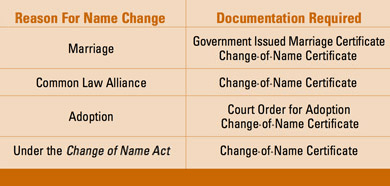
When your name changes, you need a new licence. Take the documents you must show (see the chart on this page) and your current licence to a Driver and Vehicle Licence Issuing Office. A new photograph will be taken. You will get a temporary licence to use until your permanent licence is mailed to you. Carry it with you whenever you drive.
There is no charge for getting a new licence because you change your name or address.
The chart on this page shows the documents you will need to change the name on your driver’s licence.
Driver’s licence laws
It is illegal to:
- Lend your licence
- Let someone else use it
- Use an altered licence
- Use another licence as your own
- Have more than one Ontario driver’s licence
- Use a fictitious or imitation licence
The demerit point system
The demerit-point system encourages drivers to improve their behaviour and protects people from drivers who abuse the privilege of driving. Drivers convicted of driving-related offences have demerit points recorded on their records. Demerit points stay on your record for two years from the date of the offence. If you accumulate too many demerit points, your driver’s licence can be suspended.
New drivers – demerit-point system for Level One and Level Two drivers
Two or more points
You will receive a warning letter.
Six points
You will receive a second warning letter encouraging you to improve your driving behaviour.
Nine or more points
Your licence will be suspended for 60 days from the date you surrender it to the Ministry of Transportation. You can lose your licence for up to two years if you fail to surrender your licence. After the suspension, the number of points on your record will be reduced to four. Any extra points could again bring you to the interview level. If you reach nine points again, your licence may be suspended for six months.
As a Level One or Level Two driver, you will have your licence suspended if you accumulate nine or more demerit points during a two-year period.
Note: If you are a novice driver and are convicted of violating any novice condition, an offence that is associated with four or more demerit points or receive a court-ordered suspension for an offence that would have resulted in four or more demerit points, you will receive the appropriate penalty and Novice Driver Escalating Sanction licence suspension. However, the demerit points will be recorded as zero on your record, and will not be counted towards the accumulated demerit point system.
Fully licensed drivers – demerit-point system for fully licensed drivers
Six points
You will receive a warning letter recommending that you improve your driving skills.
Nine points
You will receive a second warning letter encouraging you to improve your driving behaviour.
15 points
Your licence will be suspended for 30 days from the date you hand over your licence to the Ministry of Transportation. You can lose your licence for up to two years if you fail to surrender it. After the suspension, the number of points on your driver’s record will be reduced to seven. Any extra points could again bring you to the interview level. If you reach 15 points again, your licence will be suspended for six months.
Table of offences
Here are the demerit points for driving offences.
Seven points
- Failing to remain at the scene of a collision
- Failing to stop for police
Six points
- Careless driving
- Racing
- Exceeding the speed limit by 40km/h or more on roads with a speed limit of less than 80km/h
- Exceeding the speed limit by 50 km/h or more
- Failing to stop for a school bus
Five points
- Driver of bus failing to stop at unprotected railway crossing
Four points
- Exceeding the speed limit by 30 to 49 km/h
- Following too closely
- Failing to stop at a pedestrian crossover
Three points
- Exceeding the speed limit by 16 to 29 km/h
- Driving through, around or under a railway crossing barrier
- Driving while holding or using a hand-held wireless communications/entertainment device or viewing a display screen unrelated to the driving task
- Failing to yield the right-of-way
- Failing to obey a stop sign, traffic light or railway crossing signal
- Failing to obey traffic control stop sign
- Failing to obey traffic control slow sign
- Failing to obey school crossing stop sign
- Failing to obey the directions of a police officer
- Driving the wrong way on a divided road
- Failing to report a collision to a police officer
- Improper driving where road is divided into lanes
- Crowding the driver’s seat
- Going the wrong way on a one-way road
- Driving or operating a vehicle on a closed road
- Crossing a divided road where no proper crossing is provided
- Failing to slow and carefully pass a stopped emergency vehicle
- Failing to move, where possible, into another lane when passing a stopped emergency vehicle
- Driving a vehicle equipped with a radar detector
- Improper use of a high-occupancy vehicle (HOV) lane
- Improper opening of a vehicle door
Two points
- Failing to lower headlight beam
- Prohibited turns
- Towing people – on toboggans, bicycles, skis, for example
- Failing to obey signs
- Failing to share the road
- Improper right turn
- Improper left turn
- Failing to signal
- Unnecessary slow driving
- Reversing on a highway
- Driver failing to wear a seatbelt
- Driver failing to ensure infant passenger is secured
- Driver failing to ensure toddler passenger is secured
- Driver failing to ensure child is secured
- Driver failing to ensure passenger under 16 years is wearing seatbelt
- Driver failing to ensure that a passenger under 16 years is sitting in a seat that has a seatbelt
Other ways to lose your licence
To promote safe driving for Ontarians, the province has some of the strictest driving laws regarding driving while impaired by alcohol or drugs, careless driving, “stunt” driving, fleeing police or a collision scene, and so on. In addition to lengthy suspensions for driving offences, court sanctions can quickly escalate and include fines in the tens of thousands of dollars, reinstatement fees, licence restrictions, lifetime bans and even jail time.
Suspensions
Your licence may also be suspended for the following reasons:
- Escalating sanctions
- Zero Blood-Alcohol Concentration (BAC) for novice and young drivers
- Medical suspension
- Discretionary HTA suspensions
- Mandatory HTA suspensions
- Administrative driver’s licence suspension (ADLS)
- “Warn-range” suspension
- Novice-driver violations
Escalating sanctions
Escalating sanctions for novice drivers would apply if any of the following occurrences have taken place within a five-year period:
- Any repeat violations of novice restrictions
- Any HTA convictions for four or more demerit points
- Court-ordered licence suspensions.
Sanctions – dangerous behaviours
The risk of a fatality or serious injury is almost five times greater for vehicles crashing at 50 km/h or more above the posted highway limit. The increase in risk is even greater on roads with lower posted limits. For example, on roads with a posted limit of 60 km/h or less, the risk of a fatality or serious injury is almost eight times greater for vehicles colliding at 50 km/h or more above the posted limit.
Other types of aggressive driving include:
- Driving 40 km/h or more above the posted speed limit on roads with a speed limit less than 80km/h
- Driving 50 km/h or more above the posted speed limit
- Driving a motor vehicle to prevent another vehicle from passing
- Intentionally cutting off another vehicle
- Street racing
- Driving stunts
The use of a connected nitrous-oxide system while driving on a highway is prohibited.
Sanctions – careless driving
Careless driving is defined as: driving without due care, attention or without reasonable consideration for other persons using the highway; and, anyone, who chooses to put themselves and other road users at risk by driving aggressively or carelessly. If convicted of careless driving a driver can face tough sanctions.
Zero Blood-Alcohol Concentration (BAC) for novice and young drivers
All drivers who are 21 and under, regardless of licence class, must have a BAC level of zero when operating a motor vehicle. You will receive a 24-hour roadside driver-licence suspension. If convicted, you could face a fine and at least a 30-day licence suspension.
Medical suspension
All doctors must report the names and addresses of everyone 16 years or older who has a condition that may affect their ability to drive safely (for example, a stroke, heart condition or dizziness, among others). Doctors report this information to the Ministry of Transportation, and it is not given to anyone else. Your driver’s licence may be suspended until new medical evidence shows that the condition does not pose a safety risk.
Mandatory HTA suspensions
Your licence will be suspended:
- If you fail to stop for a police officer (a minimum of five years)
- If you don’t pay a traffic fine when ordered by the court
Administrative driver’s licence suspension (ADLS)
Your licence will be suspended immediately for 90 days:
- If your BAC is more than 80 milligrams in 100 millilitres of blood (.08)
- If you fail or refuse to give a breath, blood, oral fluid or urine sample when asked by police
- If you fail or refuse to perform physical co-ordination tests or submit to a drug evaluation when required by police
This suspension takes effect at the roadside or police station. It is separate from any criminal charges or prosecution that may also take place.
“Warn-range” suspension
Drivers who register a blood-alcohol concentration in the “warn range” of .05 to .08 pose an immediate danger to themselves and other road users. If caught driving in the warn range, you will receive an immediate driver’s-licence suspension at the roadside:
- For three days for a first occurrence
- For seven days for a second occurrence, and you must undergo a remedial alcohol-education program
- Substantially increased penalties and sanctions for each subsequent occurrence
Novice-driver violations
Drivers holding novice licences must follow the specific rules for their class of licence. If you violate any of the graduated-licensing conditions, your licence will be suspended for 30 days. This suspension takes effect from the time you surrender your licence. You can lose your licence for up to two years if you fail to hand it over.
Your licence will be cancelled:
- If you fail a driver’s re-examination
- If you don’t pay your reinstatement fee or administrative monetary penalty following a suspension
- If your cheque for licence fees are not honoured by your bank
- If you voluntarily surrender your driver’s licence to the Ministry of Transportation, or it is surrendered or returned by another jurisdiction
Criminal Code suspensions
You will receive a one-year licence suspension the first time you are convicted of a Criminal Code offence. Subsequent offences increase substantially to a lifetime ban from driving. Convictions will remain on your driver’s record for a minimum of 10 years.
Your licence will be suspended if you are convicted of any of the following Criminal Code offences:
- Driving or having care and control of a vehicle, including boats, when your BAC is more than 80 milligrams per 100 millilitres of blood (.08)
- Refusing to submit to a breath test for alcohol
- Failing or refusing to provide a breath sample for roadside testing
- Failing to remain at the scene of a collision
- Dangerous driving
- Causing death or bodily harm by criminal negligence
- Failing to stop for police
Remedial measures
There are several types of remedial measures. The mandatory Back on Track program is for all drivers convicted of impaired, driving-related Criminal Code offences. Drivers with more than one “Warn Range” conviction will be required to take an alcohol-education and/or alcohol-treatment program. If your driver’s licence has been suspended because of a Criminal Code conviction, your licence will remain suspended until you have completed the remedial requirements.
Driving under suspension
You may not drive, under any circumstances, when your licence is suspended. If you are convicted of driving while your licence is suspended for an HTA offence, you will face fines in the thousands of dollars. The court may order you to spend up to six months in jail. Six months will be added to your current suspension as well. If you are found guilty of driving while your licence is suspended for a Criminal Code offence, you can face fines of tens of thousands of dollars and spend time in jail.
Driving while prohibited
This is a prohibition order under the Criminal Code conviction. When convicted of violation of the order, you will get a suspension of one year for a first offence or two years for a subsequent offence.
Vehicle-Impoundment Program
To counter the dangerous behaviours of impaired and suspended driving, Ontario law includes seven-day vehicle impoundments for:
- Drivers operating a vehicle while under a Highway Traffic Act licence suspension
- Drivers caught without a required ignition interlock
- All drivers caught with a BAC over .08, or who fail/refuse to comply with a demand made by a police officer under the Criminal Code of Canada
If you are caught driving while your licence is suspended for a Criminal Code offence, the vehicle you are driving will be impounded for a minimum of 45 days. These vehicle impoundments apply regardless of whether the vehicle is borrowed from a friend or family member, business, employer or is rented. The owner of the vehicle must pay the towing and storage costs before the vehicle will be released.
The Vehicle-Impoundment Program makes vehicle owners responsible for ensuring that anyone driving their vehicles is not suspended. People loaning or renting their vehicles can verify that a driver’s licence is valid by phone or online. You can also get a driver’s abstract at any Service Ontario centre. There is a nominal fee for each licence checked.
Impaired driving
Driving when your ability is impaired by alcohol or a drug is a crime in Canada. Your vehicle does not have to be moving; you can be charged if you are impaired behind the wheel, even if you have not started to drive.
In circumstances involving possible impairment by a drug or a combination of alcohol and a drug, police can require a driver to:
- Provide breath samples
- Perform standardized field sobriety tests
- Conduct a drug recognition evaluation
- Provide oral fluid, urine or blood samples for screening
If you fail or refuse to comply with any of these demands, you will be charged under the Criminal Code.
If you are 21 years of age and under, you must not drive if you have been drinking alcohol. Your blood- alcohol level must be zero.
Alcohol
The police can stop any driver to determine if alcohol or drug testing is required. They may also do roadside spot checks. When stopped by the police, you may be told to blow into a machine that tests your breath for alcohol, a roadside screening device, or perform physical co-ordination tests.
If you cannot give a breath sample or it is impractical to obtain a sample of breath, the police officer can require you to provide a blood sample instead. The police may also require a driver to provide, blood, oral or urine samples. If you fail or refuse to comply with any of these demands, you will be charged under the Criminal Code.
Drugs
Criminal Code and HTA sanctions apply to drivers impaired by alcohol or a drug. In circumstances involving possible impairment by drugs or a combination of alcohol and a drug, police can require a driver to perform physical co-ordination tests and submit to a drug evaluation, and then require a driver to provide blood, oral fluid or urine samples. If you fail or refuse to comply with any of these demands, you will be charged under the Criminal Code.
Some drugs that your doctor may prescribe for you and some over-the-counter drugs can also impair your driving. Here are some points you should remember:
- If you use prescription medicines or get allergy shots, ask your doctor about side effects such as dizziness, blurred vision, nausea or drowsiness that could affect your driving.
- Read the information on the package of any over-the-counter medicine, including cold, allergy, sedative or diet pills.
- Drugs and any amount of alcohol together can have dangerous effects, even several days after you have taken the drug.
- Do not take a chance; ask your doctor or pharmacist.
Consider the consequences of impaired driving
Ontario leads the way in combating drinking and driving through some of the toughest laws and programs in North America, including licence suspensions, heavy fines, vehicle impoundment, mandatory alcohol-education and -treatment programs, and the ignition interlock program. Depending on your number of prior convictions, you may be fined up to $50,000, serve time in jail or lose your licence permanently.
For impaired driving that causes injury or death, the penalties are even more severe. If you are convicted of impaired driving causing bodily harm, you may be sentenced to up to 14 years in prison. Impaired driving causing death can carry a sentence of imprisonment for life.
If you drink and drive and are involved in a collision, you may suffer serious injury or cause serious injury to someone else. Your insurance company might not pay for your medical or rehabilitation costs, or for the damage to your or the other person’s vehicle. Your insurance costs may rise significantly. You may have to pay substantial legal costs as well.
If you are required to drive on the job, a licence suspension could mean losing your employment.
Driver-improvement interview
The other remedial-measures program is for drivers convicted of non-drinking-and-driving-related Criminal Code offences who have no previous alcohol-related convictions. You must undergo a Ministry of Transportation driver-improvement interview.
If you have not completed the driver-improvement interview by the time your Criminal Code suspension expires, your licence will be further suspended until you have completed the remedial requirements.
This program also applies to Ontario residents convicted of driving-related Criminal Code offences in any other province of Canada, or equivalent offences in the states of Michigan and New York, as well as to out-of-province drivers who are convicted in Ontario.
Summary
By the end of this section, you should know:
- Your responsibility to maintain a valid driver’s licence with the most correct and up-to-date information
- How the demerit-point system works for new and fully licensed drivers
- The driving offences that result in a loss of points upon conviction.
- Common circumstances where your licence can be cancelled or suspended
- How alcohol and drugs affect your ability to drive
- The consequences that can result from a suspended licence including reinstatement fees, remedial measures, ignition interlock, vehicle impoundment and jail time
 Apperture Labs