All motor vehicles on Ontario roads must be registered, insured and maintained to meet certain basic safety standards. If you own a vehicle, you are responsible for making sure it meets the requirements. People who buy and sell vehicles also have certain responsibilities.
- Maintaining your vehicle
- Vehicle insurance and registration
- Buying or selling a used vehicle
- Towing
- Test yourself – Sample knowledge test questions
Maintaining your vehicle
It is illegal to drive a vehicle in dangerous condition. But maintaining your vehicle also makes sense from an economic point of view: it can mean better gas mileage and a better price when you sell it. Maintaining your vehicle also helps to protect the environment.
A police officer or Ministry of Transportation inspector can examine your vehicle, its equipment and any trailer attached to it, at any time. If the vehicle is found to be unsafe, it may be taken off the road until the problem is fixed.
The following driver habits and regular maintenance will help keep your vehicle fit and safe.
Driver Habits
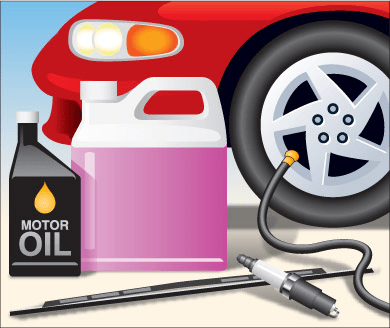
Driver habits are the things that you can do whenever you drive a vehicle. If you identify any concerns or deficiencies, further investigation or actions, including inspection and repair by a qualified mechanic, should be considered. The vehicle’s owner manual often has detailed information on what to look for when inspecting your vehicle and how to address minor problems.
When approaching your vehicle look for signs of:
- Fresh damage
- Fluid leaks underneath
- Under-inflated or flat tires
- Ajar doors, hood, trunk and fuel door/cap
- Unsecured loads
- Check for ice, snow, or dirt that may interfere with vehicle lighting, steering, driver visibility, or become a hazard to other motorists should it come free from your vehicle
From the driver’s seat and before driving, look for:
- Unobstructed visibility around entire vehicle
- Burned-out or dim headlamps
- Illuminated dashboard warning lights during engine start, then going out
- Loose objects in the vehicle
While driving, be alert for:
- Unusual engine or exhaust noises
- Squeaking or grinding noises when applying the brakes
- Dashboard warning lights coming on
When planning an extended trip, perform more detailed checks, including:
- Windshield wipers and washer-fluid level
- Tire pressures, condition and wear
- All lights work
- Under the hood when the engine is cold; oil and coolant levels, obvious defects with belts, hoses, and possible leaks. Using the vehicle owner’s manual for more information on what to look for
- Having your vehicle thoroughly inspected by a qualified mechanic
Regular Maintenance
In order to keep your vehicle running smoothly, vehicle manufacturers often establish a schedule for regular maintenance. Scheduling of this work is normally based upon accumulated vehicle mileage or time intervals (whichever comes first). Further details may be found in the vehicle’s owner’s manual. Regular maintenance may include oil and filter change, other fluid checks and changes, air and fuel filter replacement, tire rotation and brake inspection. Periodically, more intensive mechanical servicing such as engine adjustments and timing-belt replacement may be required.
Winter maintenance
A well-maintained vehicle will usally start in all weather conditions.
Carry emergency supplies. These should include:
- A shovel
- Booster cables
- Emergency flares or warning lights
- A blanket
- A chain for towing.
Always carry extra windshield washer fluid in the winter and refill the container when necessary.
Faulty exhaust systems are especially dangerous in the winter when drivers are more likely to drive with windows and vents closed. Have your exhaust checked if it sounds noisy or rattles.
Tires
The type of tires you have and the way they are made are critical for good traction, mileage and safety. Keep these points in mind when you buy or replace tires, and check your vehicle owner’s manual or the tire manufacturer’s guide for recommendations.
Tires must meet standards described in the Canadian Motor Vehicle Safety Act. Tires deteriorate with age, even when not in use. Aged tires have reduced traction, are more prone to cracking and may fail unexpectedly while in use. Tires should not be older than 10 years.
- Replace tires when the tread is less than 1.5 millimetres deep or when tread-wear indicators touch the road. Vehicles that weigh more than 4,500 kilograms must replace their front tires when tread is less than three millimetres deep.
- Replace tires that have bumps, bulges, knots, exposed cords or tread and sidewall cuts deep enough to expose cords.
- Any tire on a vehicle must not be smaller than the vehicle manufacturer’s specified minimum size. And it must not be so large that it touches the vehicle or affects its safe operation.
- You should use similar tires on all four wheels of your vehicle.
- To provide the best traction during the winter season, it is recommended that your vehicle be equipped with four winter or all-weather tires with the same tread pattern.
- If you live in northern Ontario, you can legally use studded tires on your vehicle.
- Scrap tires are a serious environmental concern. Proper maintenance will extend the life of a tire and delay its disposal. Some tips for longer wear: maintain the right air pressure; inspect tires for wear; rotate tires regularly and practice good driving habits.
Vehicle insurance and registration
Auto insurance – it’s the law!
Ontario has compulsory automobile insurance. This means every vehicle registered in the province must be insured.
You must show proof that you have insurance coverage before you can register a vehicle or renew your registration. The Financial Services Regulatory Authority of Ontario (FSRA), regulates insurance in Ontario.
Registration
Vehicle registration includes licence plates and a vehicle permit.
Licence plates in Ontario are based on a plate-to-owner system. This means that vehicle licence plates move with the vehicle owner, not the vehicle. When you sell or change vehicles, you must remove your plates.
If you do not intend to use them on another vehicle, you may return your plates to a ServiceOntario centre.
New residents
New Ontario residents have 30 days to register their vehicles. To get a permit and Ontario licence plates, go to a ServiceOntario centre. You must bring along:
- A safety standards certificate
- Proof of insurance
- Vehicle Import Forms, if you have brought the vehicle in from another country
- The vehicle permit, or ownership, from where you used to live
Protect yourself from auto insurance fraud
By being vigilant, Ontario drivers can help put a stop to fraudsters who abuse the automobile insurance system. Keep this in mind to protect yourself from auto insurance fraud.
When Buying Auto Insurance:
- Use a licensed insurance company, agent or broker. The Financial Services Regulatory Authority of Ontario (FSRA), an agency of the Ministry of Finance, regulates insurance in Ontario. Visit FSRA’s website, to check whether an insurance company or agent is licensed. The Registered Insurance Brokers of Ontario (RIBO) is the self-regulatory body for insurance brokers in Ontario. Visit RIBO’s website, to check whether an insurance broker is licensed.
After an Auto Collision:
- Collect as much information as possible. Take photos of the collision scene. Get the names, addresses, phone numbers, licence plate and driver’s licence numbers, and insurance information from all those involved in the collision, including passengers in the other vehicle(s).
- Be suspicious of referrals. Be wary if you are pressured or offered money by a tow truck operator to go to a particular body shop, lawyer, paralegal or health-care provider. Contact your insurance company for information on towing and where to take your vehicle to be repaired.
- Refuse to sign blank forms in advance of receiving any services or health-care treatment related to your collision.
- Demand detailed repair and medical bills for any goods and services related to your collision, and review them carefully.
Towing
This chapter tells you what you need to know to tow a trailer behind a car, van or small truck in Ontario. This includes licence and registration requirements, trailer size and characteristics, as well as safety tips to follow when towing a trailer.
Before you attempt to tow a trailer, consider the size, power and condition of your vehicle. Make sure it is capable of towing both the trailer and the load you intend to carry, and that your trailer and hitch meet all the requirements described in this chapter.
Towing a trailer brings unique challenges to drivers. Almost half of the reported collisions while towing a recreational vehicle are single-vehicle collisions. Another 20 per cent involve rear-end collisions. In collisions where the driver was determined to be at fault, about 30 per cent of the drivers had “lost control” of their vehicle.
Licence and permit
You must have a valid driver’s licence (Class G1, G2 or G) or higher class of licence to tow a trailer with a gross vehicle weight of up to 4,600 kilograms. If your trailer and load exceeds the size and weight specified in the Highway Traffic Act, you may need a higher class of licence or an oversize vehicle permit to tow it.
It is against the law to tow more than one trailer behind non-commercial vehicles.
Registering your trailer
A trailer is considered a separate vehicle. Before you can tow one on any public road, you must register it and pay a one-time registration fee at a ServiceOntario centre. When you register your trailer you will receive a licence plate and vehicle permit. Attach the licence plate to the back of your trailer where it is clearly visible. Always carry your permit, or a copy of it, to show to a police officer when asked.
Make sure your trailer is in good condition
Your trailer must be in safe operating condition. If it is not, a police officer may remove your trailer from the road until it is made safe to operate.
Brakes
If your trailer has a gross trailer weight, vehicle and load of 1,360 kilograms or more, it must have brakes strong enough to stop and hold the trailer.
Lights
Your trailer must have:
- A white licence plate light
- A red tail light
- Two red reflectors at the rear of the trailer, as far apart as possible
If your trailer is wider than 2.05 metres, it must also have:
- Two yellow clearance lights, one on each side at the front of the trailer, as far apart as possible, to let drivers coming toward you know the width of your trailer
- Two red clearance lights, or reflectors, one on each side at the rear of the trailer, as far apart as possible, to let drivers behind you know the width of your trailer
Your trailer must have mud guards, fenders and flaps or be designed in such a way that it does not spray or splash traffic travelling behind you.
If the load in your trailer blocks your vision to the rear, you must have additional mirrors that provide a clear view of the road to the rear. Load your trailer carefully so that nothing comes loose or falls off while you are moving.
Attaching your trailer
Your trailer must have two separate ways of attaching to your vehicle so that if one fails or comes loose, the trailer will stay attached.
If safety chains are used, they must be crossed under the tongue to prevent the tongue from dropping to the road if the primary hitch accidentally disconnects. The chain hooks must have latches or devices that will not accidentally become detached.
No passengers
You may not carry any person in any trailer, including a house or boat trailer, when it is being towed.
Trailer hitch
Use a good-quality trailer hitch. The class of trailer hitch you use depends upon the gross weight of your trailer – the gross weight being the total weight of the trailer and its load. Make sure you use the right trailer hitch for the weight of your trailer. It should be securely attached to your vehicle following the manufacturer’s recommendations.
The hitch-ball should be installed so that when the trailer is attached and tightened, it is level with no tilting. If the hitch pulls down the rear of your vehicle, you may need to use a load-equalizing trailer hitch. You may also be able to shift some of the load in the trailer to the rear to reduce the load on the rear of your vehicle.
In addition to a ball and hitch, be sure to use safety chains or cables strong enough to hold the trailer and load, in case the ball and hitch accidentally come apart.
Loading your trailer
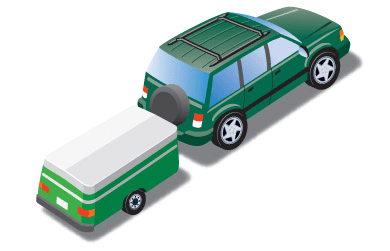
When loading your trailer, strap everything down inside, as well as outside. It is an offence to have a load that may become dislodged or fall off. Do not overload your trailer. Too much weight in the trailer can put a strain on your vehicle and damage your tires, wheel bearings and axle. When carrying a boat on a trailer, do not carry cargo in the boat unless your trailer is designed and equipped for the extra weight.
The distribution of the weight in your trailer is also very important. Generally, more of the trailer load should be in front of the trailer axle than behind it for proper hitch weight. About five to 10 per cent of the trailer’s total weight should be supported on the hitch, within the weight limit marked on the hitch. Poor load balance can cause your trailer to sway or fishtail. The ball and hitch may also become separated, especially if there is too much weight in the rear of the trailer.
Heavy and improperly placed loads can pull down the rear of your vehicle, lifting the front end and affecting your steering, especially in wet and slippery conditions. It may also affect the aim of your headlights so that your low beams blind approaching drivers. The alignment of your mirrors may also be affected.
Starting out
Before each trip, check the trailer hitch, wheels, tires, lights, load distribution and load security to make sure they are safe. Check your tire pressure with the trailer loaded while the tires are still cold. When you start to drive, accelerate carefully. Drive slowly and carefully.
Curves and turns
Stay close to the middle of your lane when taking a curve. When making a right turn, check traffic. Look in your right mirror. Signal and slow down. If the turn is sharp, move ahead until your vehicle’s front wheels are well ahead of the curb before turning to the right.
When making a left turn, check traffic. Signal. Proceed slowly. When you make your turn, swing wide by driving well into the intersection before turning.
Slowing down and stopping
A sudden stop can cause your trailer to jackknife or slide sideways or the load to shift. To avoid sudden stops, increase the following distance between you and the vehicle ahead. Keep out of the fast lanes and maintain a speed that will allow you to slow down and stop smoothly in any situation.
Passing
You cannot accelerate as quickly when you are towing a trailer. You also need more space because the length of your vehicle is much longer with a trailer attached. Before you pass, make sure you have enough time and room to complete the pass. Once you have passed, allow more room before you move back to your lane. Do not cut back into the lane too soon. This can cause your trailer to sway and make it difficult to control.
Being passed
If you are holding up a line of traffic, signal, pull over and let the other vehicles pass. Fast-moving trucks and buses create a strong air disturbance behind them. If a large bus or truck passes you, the wall of wind behind it may whip your trailer to the side, pushing it out of control. When you experience this, do not brake. Carefully steer your vehicle and trailer back into position. A slight increase in speed may help.
Backing up
Back up very slowly and have someone outside the vehicle direct you. Use a series of small turns to steer. It is a good idea to practise this skill off the road in an empty parking lot until you are comfortable with your ability.
To back up to the right, steer to the left. The front end of the trailer will go left, but the rear end will go right. To back up to the left, steer to the right. The front end of the trailer will go right, but the rear end will go left.
Towing disabled vehicles
If your vehicle breaks down, you should get help from a tow truck designed to tow vehicles. If you must use another vehicle to tow, use warning signals or emergency flashers and make sure you attach the vehicles securely. Someone must sit in the disabled vehicle and use the brakes to keep the tow cable tight. If the engine cannot run, don’t tow vehicles that have power braking and steering. Without the engine, braking and steering is difficult and towing may lead to a collision.
Trying to start a disabled vehicle by towing is dangerous and could damage both vehicles.
Summary
By the end of this section you should know:
- The checks that need to be performed on your vehicle: daily/weekly, at its regular servicing and for its use in the winter
- How to buy the right tires for your vehicle and how to know when they need replacing
- Your responsibility to ensure that the vehicle you are driving is properly registered and insured
- Information about buying and selling used vehicles including the safety standards certificate
- Licensing requirements to properly tow a trailer or disabled vehicle
- Vehicle requirements such as brakes, lights, mirrors and trailer hitches
- The proper way to load a trailer and attach it to your vehicle
- Driving techniques for driving with a trailer attached
Test yourself – Sample knowledge test questions
The following questions will give you an idea of what to expect on the knowledge test. All knowledge-test questions follow this multiple-choice format. The answers to these sample questions are provided at the bottom of the page.
1. To get your vehicle out of a skid, you should first:
- Steer straight ahead.
- Steer in the opposite direction of the skid.
- Steer in the direction you want to go.
- Apply brakes hard.
2. When may you lend your driver’s licence?
- In emergencies.
- To a person learning to drive.
- It is not permitted.
- For identification purposes.
3. What must a driver do before entering a highway from a private road or driveway?
- Enter or cross the highway as quickly as possible.
- Yield right-of-way to all vehicles approaching on the highway.
- Sound horn and proceed with caution.
- Give hand signal then take right-of-way.
4. Never change lanes in traffic without:
- Looking in the rear view mirror only.
- Giving proper signal and looking to make sure the move can be made safely.
- Blowing your horn and looking to the rear.
- Decreasing speed and giving correct signal.
5. When the driver of another vehicle is about to overtake and pass your vehicle, you must:
- Speed up so that passing is not necessary.
- Move to the left to prevent passing.
- Signal to the other driver not to pass.
- Move to the right and allow such vehicle to pass.
6. When you are deciding whether or not to make a U-turn, your first consideration should be to check:
- Traffic regulations.
- Presence of trees, fire hydrants or poles near the curb.
- Turning radius of your car.
- Height of curb.
7. It is more dangerous to drive at the maximum speed limit at night than during daytime as:
- Your reaction time is slower at night.
- You cannot see as far ahead at night.
- Some drivers unlawfully drive with parking lights only.
- The roadways are more apt to be slippery at night.
8. You should under all conditions drive at a speed which will allow you to:
- Stop within 150 metres (500 feet).
- Stop within 90 metres (300 feet).
- Stop within 60 metres (200 feet).
- Stop within a safe distance.
Answer Key: 1-c, 2-c, 3-b, 4-b, 5-d, 6-a, 7-b, 8-d
 Apperture Labs