This section describes how to do the most common driving manoeuvres safely and with consideration for other road users. It focuses on:
- Moving off,
- Your position on the road,
- Changing traffic lanes,
- Overtaking,
- Reversing,
- U-turns,
- Slowing down or stopping,
- Towing,
- Day time running lights,
- Driving at night, and
- Using a horn.
Moving off
- Before moving off, carry out the following safety checks:
- check that all doors, the bonnet and the boot are closed;
- make sure your seat and head restraint are properly adjusted;
- make sure your rear view mirrors are clean and properly adjusted; and
- check that all safety belts (yours and those of your front-seat and back- seat passengers) are fastened.
- Before moving off from the kerb, you must take the appropriate all around observations, check your mirrors and signal, just before moving off check the blind spot to the relevant side, over the right shoulder if moving off to the right or over the left shoulder if moving to the left.
- When the way is clear, move out and adjust your speed to that of the normal safe and legal flow of traffic.
- When you are ready to move off, check your mirrors and signal your intention to move out into traffic.
- Always look in your mirror but remember that there are blind spots, so always check over your shoulders as well. Traffic and pedestrians may be coming up beside your vehicle. When moving off from a stationary position check your blind spots by looking around you.

Your position on the road
Make sure you drive your vehicle far enough to the left to allow traffic to safely pass or overtake on the right, but not so far to the left that you are driving on a cycle lane or blocking or endangering cyclists or pedestrians.
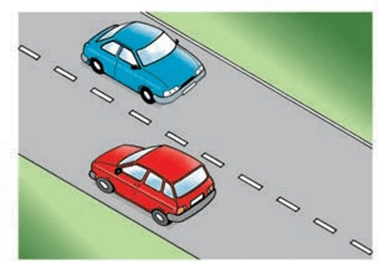
What to do if you need to change your road position
- If you are overtaking, turning right or passing pedestrians, cyclists, horse riders, other road users or parked vehicles, make sure it is safe to do so.
- Always check in your mirrors for any vehicles coming up on your right or who may be overtaking from behind, and don’t forget to check your blind spots when necessary and appropriate to all other prevailing traffic conditions.
- Give a clear signal to warn traffic in good time of your intentions and proceed.
Taking care with buses and pedestrians
You should allow signalling buses back into the stream of traffic after they let passengers on and off. Be especially careful of pedestrians getting on and off buses and of children near schools. When driving near schools, always be prepared to stop. We advises you to drive your vehicle in a defensive manner, be prepared to stop, sound the horn and brake. Always expect the unexpected.
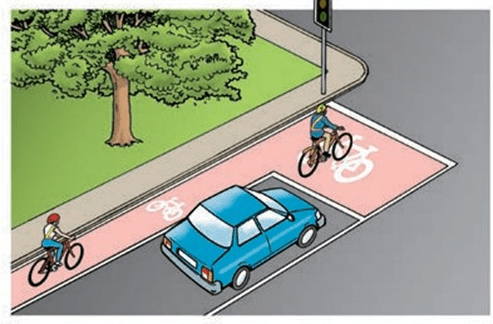
Taking care with cyclists
If you are at a junction where there is an advanced stop line for cyclists, you should allow cyclists to move off ahead of you.
When turning left, all drivers, especially drivers of heavy goods vehicles, must watch out for cyclists and motorcyclists going ahead or turning.
On left turns, watch out for cyclists and mopeds close to the kerb in front of you or coming up on your left. Do not overtake a cyclist as you approach a junction if you are turning left, as the cyclist might be continuing straight ahead. You should give extra space when overtaking a cyclist, as they may need to avoid uneven road surfaces and obstacles. This is particularly important on wet or windy days.
Sharing the road with cyclists
Correct road positioning will allow a cyclist to move safely and competently on the road network.
Drivers should be aware that cyclists may need to move out from the normal secondary position of the road (left hand side of the lane) to a more primary position (centre of the lane) in order to:
- Get the best view of the road and junctions ahead.
- Increase visibility for approaching traffic, especially where a driver’s view may be blocked.
- Turn left or right, enter a roundabout, change lanes or approach a bend.
Before changing position on the road, cyclists should ‘look, signal in good time and look again’ to ensure that it is safe to proceed. Where a cyclist is not confident in taking up the ‘primary’ position, it may be safer to get off the bike and cross the roadway on foot where it is safer.
Drivers, always check and give extra space to cyclists, as they may need to change position to safely avoid uneven road surfaces and obstacles.
Changing traffic lanes
Don’t move from one traffic lane to another without good reason. You must give way to traffic already in the lane into which you are moving.
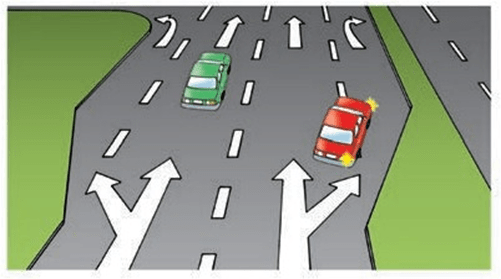
Remember: Signalling does not give you the right of way.
How to change lanes safely
- If you have good reason to change lanes, use your mirrors and check in plenty of time to ensure that the way is clear. To check your blind spot when travelling at speed, take a quick sideways glance to check the position of a vehicle that may have disappeared from your view in the mirror.
- Signal your intention and change lane when it is clear and safe to do so.
- When in a lane or approaching a junction, obey any road signs or markings (usually arrows) indicating the direction that traffic in those lanes must take.
Overtaking
Only overtake if it is safe for you and other road users. Be particularly careful of features that may hinder your view of the road ahead, such as hills, dips, bends, bridges, pedestrian crossings or roads narrowing. Pay attention to the rules on road signs or markings (continuous, broken, single, double white lines).
How to overtake safely
Make sure the road ahead is clear so you have enough distance to overtake and get back to your own side of the road without forcing any other road user to move to avoid you.
- Never directly follow another overtaking vehicle.
- Give way to faster traffic already overtaking from behind.
- Before overtaking check that the way is clear, check in your mirror and check your blind spots to ensure another vehicle is not approaching from behind. Give your signal in good time, move out when it is safe to do so, accelerate and overtake with the minimum of delay.
- When you are well past, check the mirror, signal and gradually move in again making sure not to cut across the vehicle you have passed.
- Take extra care when overtaking a vehicle displaying a ‘LONG VEHICLE’ sign. This means that the vehicle is at least 13 metres long and you will need extra road length to pass it and safely return to the left-hand side of the road.
- You must not break the speed limit, even when overtaking.
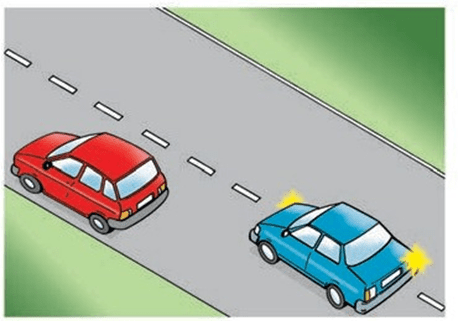
Remember: You must normally overtake on the right. However, you are allowed to overtake on the left in the situations listed below.
You may overtake on the left when
- You want to go straight ahead when the driver in front of you has moved out and signalled that they intend to turn right.
- You have signalled that you intend to turn left.
- Traffic in both lanes is moving slowly but traffic in the left-hand lane is moving more quickly than the right-hand lane – for example, in slow- moving stop-start traffic.
You must not overtake when
- You are at or near a pelican crossing, zebra crossing or at pedestrian signals.
- A traffic sign or road marking prohibits it.
- You are approaching a junction.
- You are on the approach to a corner, bend, dip in the road, hump-back bridge, brow of a hill or on a narrow road.
- You are in the left-hand lane of a dual carriageway or motorway when traffic is moving at normal speed.
- It would cause danger or inconvenience to another road user.
What to do when somebody overtakes you
- Continue at the same pace, unless it becomes unsafe to do so.
- Keep as near to the left as is safe.
- Do not accelerate.
- Be alert in case the overtaking vehicle suddenly pulls back in front of you.
Reversing
How to reverse safely
- Check for nearby pedestrians and traffic by looking carefully all around, in front of and behind you, over both your shoulders, directly through your rear window and in your mirrors.
- Take special care where small children may be gathered, such as schools, playgrounds, residential roads, car parks or your own driveway.
- If your view is restricted, ask for help when reversing.
- Give way to other traffic or pedestrians.
- When reversing from a major road onto a minor road, wait until it is safe to reverse slowly far enough into the side road to allow you to take up the correct position on the left-hand side when rejoining the major road.
- Take extra care when reversing if it is dark.
- If you are in doubt, get out of your vehicle and check the area.
- You must not reverse from a minor road onto a major road as it is unsafe to do so.
- When parking in your own driveway or in a car park, you should, where possible, reverse ‘in’ which enables you to safely drive out.
U-turns
You must not make a U-turn unless traffic conditions make it completely safe to do so.
- Check there are no signs or road markings prohibiting a U-turn, for example a continuous centre white line.
- Check that the road is not one way.
- Look for a safe place, where you can see clearly in all directions.
- Give way to all other road users.
- Check carefully for cyclists and motorcyclists.
- Do not delay or prevent pedestrians from crossing safely.
- Make sure there is sufficient room to complete your manoeuvre safely and smoothly.

Slowing down or stopping at the side of a road
- Check in your mirror to make sure you can slow down and stop safely.
- You must signal your intention when changing course and pulling in to stop.
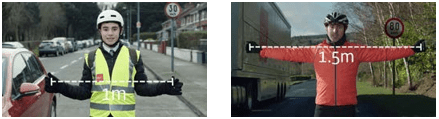
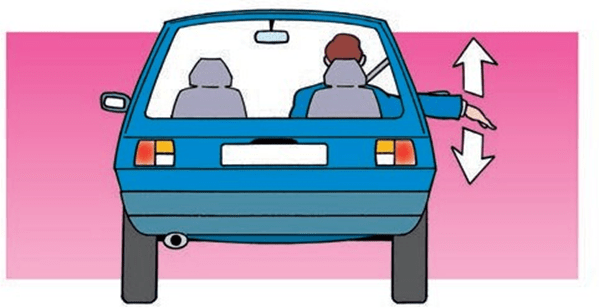
- In addition to your indication you can signal your intention to slow down either through the brake lights or by moving your right arm up and down outside your vehicle window (shown below) if you think your brake lights might not be seen or might not be working. If they are not working, have them repaired as soon as possible.
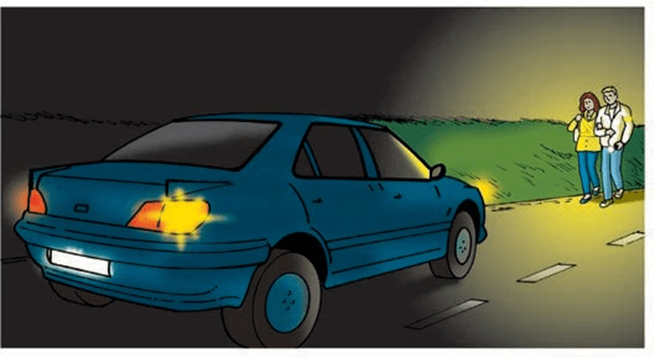
- You should not leave your headlights on when stopping at the side of the road, including laybys or private property. If you need to leave your lights on, you should use your ‘side’ or ‘parking’ lights only.
- Use a traffic lay-by if one is provided or pull in and stop close to the left- hand edge of the road.
Towing
If you are towing another vehicle or a trailer (including a boat trailer or a caravan), remember the following points.
- Make sure the tow bar or other towing device is strong enough and is attached securely so that it does not break or become loose when used.
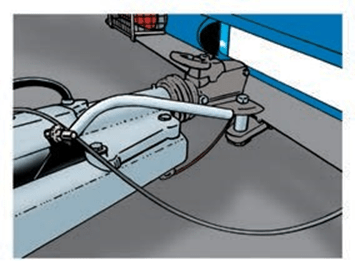
- Make sure the breakaway brake or secondary coupling is in place and secured.
A ‘breakaway brake’ attached to a trailer is a braking device that can automatically stop the trailer if it becomes detached from the towing vehicle while moving. A ‘secondary coupling’ is usually a safety chain or wire rope or other similar connection which ensures the trailer stays attached to its towing vehicle if the main coupling fails or becomes detached. A secondary coupling is not needed if the trailer is equipped with a breakaway brake.
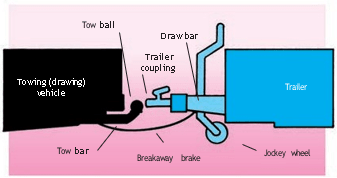
- Do not allow a distance of more than 4.5 metres (about 15 feet) between the vehicles or the vehicle and the trailer.
- If more than 1.5 metres separates the vehicles, use some warning device such as a white flag of at least 30 centimetres squared to draw attention to the tow bar.
- If you need to tow another vehicle using a rope or strap – for example, a broken down vehicle – you should only do so to the nearest convenient safe place of repair.
- If towing a vehicle that has its own steering gear, make sure somebody remains in that vehicle to take charge of the steering.
- If towing a vehicle, the person who steers the towed vehicle must hold a licence to drive the same category of vehicle.
- Make sure a trailer is fitted with brakes if it has a Maximum Authorised Mass (MAM) of more than 750kg or is more than half the laden weight of the drawing vehicle (whichever is lower). This includes a parking brake and a breakaway brake. Older trailers that don’t have a breakaway brake must have a secondary coupling (a chain or wire rope) fitted instead.
- A combination of vehicles or an articulated vehicle more than 13 metres long must display a ‘LONG VEHICLE’ sign or signs on the back of the last trailer.
Loads must be safely distributed and securely tied down. You should avoid carrying loads that extend over the side of the trailer while it’s being towed. Loads may extend over the side and rear of trailers provided the following limits are not exceeded:
- Loads (other than poles intended for use by telephone or electricity services) must not project more than 3 metres beyond the rearmost part of a trailer.
- Loads overhanging to the rear by more than 1 metre must be marked during the day with a red flag or cloth which is at least 300 millimetres square (about 12 inches square). However, at night time, overhanging loads must be fitted with a red reflector and a red light.
- Loads (other than loose agricultural produce which is not baled or in crates) must not project more than 300 millimetres (about 12 inches square) over the outermost point of the side of the trailer. At night, these loads must be fitted with lights showing a white light to the front and a red light to the rear. These lights must be placed as close as possible to the outermost point of the load.
- If possible, loads should be evenly distributed across the trailer and positioned in such a way as to keep the nose weight (that is, the weight exerted by the trailer drawbar on the coupling) within the recommended limits for the drawing vehicle. Consult the owner’s handbook for further details. If you have to carry a load that cannot be evenly distributed, make sure it is properly restrained and that individual axles or the drawbar are not overloaded. You might have to reduce the overall load to achieve this.
- When towing a trailer, the maximum speed at which the vehicle can travel may be different from the posted speed limit. Please see page 114 for more information.
Driving at night
Make sure your lights, indicators, reflectors and number plate lighting are clean and in good working order so that you can see clearly and be seen at all times. A clean windscreen is especially important when driving at night.
You must drive at a speed that allows you to stop within the distance covered by your lights. Assuming good driving conditions on an unlit road, the headlights of a typical car let you see for about 100 metres. Dipped lights will let you see for about 30 metres and a car travelling at 100km/h will cover this distance in about a second.

Keep your headlights adjusted properly. If they are out of line, they are less effective and may dazzle oncoming traffic, even when dipped.
Even with the best headlights, you can see less at night than during the day. Pedestrians and unlit bicycles are extremely difficult to see in the dark, particularly if you have to deal with the glare of oncoming lights.
Some junctions are marked with special coloured studs or delineator posts to help road users to see where a junction is as they approach it at night or during periods of poor visibility.
Daytime running lights
‘Daytime running lights’ refers to the white lighting systems on the front of a vehicle which generally operate automatically when the engine is running. These are to increase its visibility and are only suitable for daylight hours. Unlike head lights, daytime running lights are not designed to illuminate the road ahead.
Make sure to turn on your dipped head lights at lighting up time as daytime running lights are not suitable or safe to use at night time.
If your vehicle is not fitted with daytime running lights, you should drive with your dipped headlights on during the daytime.
When to use headlights
If conditions require you to use headlights to drive safely, you must use them. Use dipped headlights at night or main beam headlights as appropriate. When in doubt, turn them on. Make sure that the red lights and number plate lighting at the back of your vehicle are working.
Use dipped headlights:
- Just after the beginning (dusk) and before the end (dawn) of lighting-up hours;
- As long as they are needed to let you see clearly;
- When stopped in traffic;
- When meeting other traffic;
- In built-up areas where there is good street lighting;
- On continuously lit roads outside built-up areas;
- When following behind another vehicle;
- Where there is dense fog, falling snow or heavy rain;
- When daylight is fading; and
- Generally to avoid inconveniencing other traffic.
It is good practice to use dipped headlights or to dim or dip your lights instead of using only sidelights in built-up areas where there is good street lighting.
- Use main beam headlights in situations, places and times outside of those listed above.
- Use fog lights only during dense fog or falling snow. You must turn them off at all other times.
- It is recommended that, if stopped (other than in traffic), you do not leave your headlights on and switch to your ‘side’ or ‘parking’ lights instead. You should not leave headlights on when parked.
What to do if you are dazzled by another vehicle’s headlights or by the sun
- Slow down and stop if necessary.
- Always watch for pedestrians or cyclists on your side of the road.
- If the dazzle is from an oncoming vehicle or you are being blinded by the sun then you can avoid this by looking towards the verge (edge of your side of the road) until the effect has passed. If the dazzle is from a vehicle behind you and reflected in your mirror, operate the night- driving mode on the mirror.
Driving carefully behind other vehicles
Don’t drive on the tail lights of the vehicle in front. It gives a false sense of security and may lure you into driving too close or too fast, or both. If you see red vehicle lights in front of you, dip your headlights to avoid dazzling the driver of the vehicle ahead.

Using a horn
Only use a horn to:
- Warn other road users of on-coming danger; or
- Make them aware of your presence for safety reasons when reasonably necessary.
Remember, the horn does not give you the right of way. Do not use a horn in a built-up area between 11.30 at night and 7 in the morning unless there is a traffic emergency.
Remember: You must drive having due regard to other road users.
 Apperture Labs