This section outlines the correct way to approach and drive at junctions and roundabouts.
Junctions
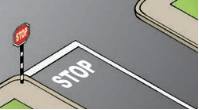
If you see a ‘Stop’ sign (shown below), you must stop at the sign or at the stop line on the road, if provided, even if there is no traffic on the road you would like to enter.

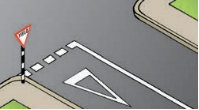
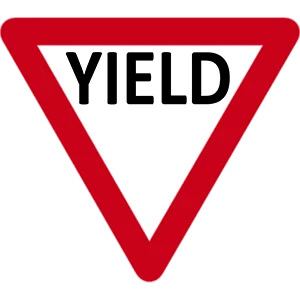
If you see a ‘Yield’ sign or yield line (shown below), you must slow down, but you do not have to stop completely unless you need to wait for any oncoming traffic to pass.
Right of way
- Traffic travelling straight ahead in either direction along a major road generally has right of way at all times.
- If you are at a junction where the roads are of equal importance, the traffic on your right has right of way. You must let that traffic pass before you move on. It is important to understand that the right of way is not an absolute right. You must proceed with caution while showing regard for other users of the road.
- If you are approaching a T junction, the traffic already on the road you are joining has right of way. This means any traffic on the road ending at the junction must wait for the other traffic to pass before turning left or right.
- If you are turning right at a junction, the traffic coming straight through the junction from the opposite direction has right of way.
- If you plan to turn right at a junction and a vehicle from the opposite direction wants to turn into the same road, the vehicle that is turning left has right of way. If yours is the vehicle turning right, you must wait for the other vehicle to turn first.
- If you are approaching a junction with a major road, you must yield to other traffic. This means giving right of way or letting them pass before you enter the road you are joining.
Vehicles do not have an automatic right of way on the road. The overriding rule is, in all circumstances, to proceed with caution.
You must always yield to:
- Pedestrians already crossing at a junction;
- Pedestrians on a zebra crossing;
- Pedestrians on a pelican crossing when the amber light is flashing; and
- Pedestrians and traffic when you are moving off from a stationary position (for example from your position at a stop sign or a parking space).
To avoid doubt and in the interest of road safety, a vehicle should always yield to pedestrians.
You must also yield to:
- Traffic already turning at a junction;
- traffic in another lane when you wish to change lanes; and
- Traffic on a public road when you are coming out of a private entrance.
Stop, look, listen, and look again. This is your duty when entering the roadway.
Motorists should watch for cyclists emerging from the end of a cycle track, and watch for mopeds and motorcycles emerging from junctions. Bicycles, mopeds and motorcycles might be difficult to see because of their small size.
It is important to understand that the right of way is not an absolute right of way. You must proceed with caution, having regard for other road users.
Turning right from a major road onto a minor road
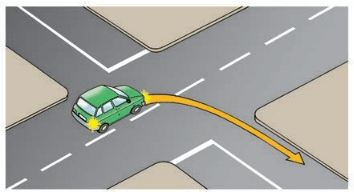
- Check your mirrors well in advance and check blind spots, if appropriate, for traffic following behind you, and give a right hand signal.
- As soon as you can do so safely, take up a position just left of the middle of the road or in the space provided for right-turning traffic.
- Where possible, leave room for other vehicles to pass on the left.
- Do not turn the steering wheel until you are ready to make the turn.
- When a safe gap occurs in oncoming traffic, finish your turn so that you enter the left-hand side of the road into which you are turning.
- Do not cut the corner when you turn. Do not make a ‘swan neck’ by passing the correct turning point and then having to turn back into the road you want to enter.
Turning right from a minor road onto a major road
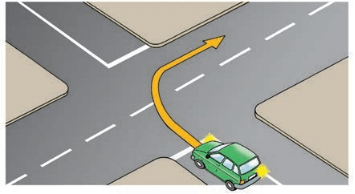
- Check your mirrors well in advance for traffic following behind you and give a right turn signal.
- As soon as you can do so safely, take up a position just left of the middle of the road.
- If you are at a junction controlled by a Stop or a Yield sign, wait at the entrance to the junction until the road is clear in both directions.
- Where possible, leave room for other vehicles to pass on the left.
- When a safe gap occurs in traffic coming from both directions, finish your turn so that you enter the left-hand side of the road onto which you are turning.
- Be alert for road markings which direct you to follow a certain course.
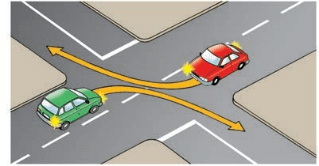
Turning right at a crossroads
When turning right at a crossroads and a car coming from the opposite direction is also turning right, if possible you should both try to turn back to back (pictured below). This allows you and the other driver to see oncoming traffic and allows the traffic to see you.

If you cannot do this, you may turn near-side to near-side if necessary. This means starting the turn while the vehicles are still facing each other.
Turning right from a one-way street
Drive as close as you safely can to the right-hand side of the one-way street. Look out for areas where two lanes may be allowed for turning right.
Turning left from a major road to a minor road
- Check your mirrors well in advance for traffic following behind you.
- Give a left-turn signal and, when safe, slow down.
- Keep as close as you safely can to the left-hand edge of the road, using your mirrors to watch for cyclists or motorcyclists coming up on your left.
- At a controlled junction, watch for flashing amber arrows that allow you to proceed to the left if no traffic is approaching from the right.
- Where possible, leave room for other vehicles to pass on the right.
- Make the turn, keeping close to the left-hand edge. Do not hit or mount the kerb.
Turning left from a minor road to a major road
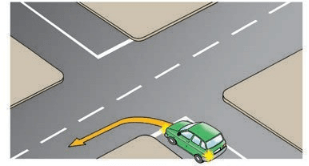
- Check your mirrors well in advance for traffic following behind you.
- Give a left turn signal and slow down.
- If you are at a junction controlled by a Stop or a Yield sign, wait at the entrance to the junction until the road is clear.
- At a controlled junction, watch for flashing amber arrows that allow you to proceed to the left if no traffic is approaching from the right.
- If a left-turn slip lane is provided, you should use it.
- When it is safe, finish your turn so that you enter the left-hand side of the road onto which you are turning.
Take care not to swing wide when you turn and always give way to pedestrians and cyclists crossing the junction before you start any turn.
Yellow box junctions
These junctions consist of patterns of criss-cross yellow lines.
Remember: You must not enter the yellow box junction unless you can clear it without stopping.
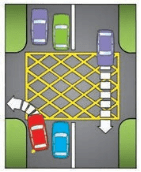
An exception is when you want to turn right. In this case, you may enter the yellow box junction while waiting for a gap in traffic coming from the opposite direction. However, don’t enter the box if to do so would block other traffic that has the right of way.
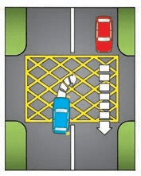
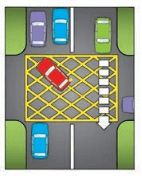
Yellow box junctions can also be found at railway level crossings or tramway crossings. Never enter these yellow box junctions unless you can leave them without stopping
Junctions and dual carriageways
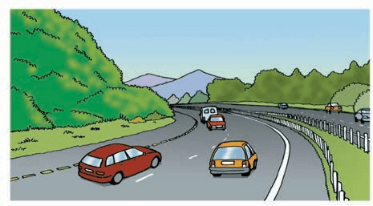
Dual carriageways are roads with two or more lanes of traffic travelling in each direction. The outer or right-hand lane in each direction is the lane nearest to the centre of the dual carriageway.
You must normally drive in the left-hand lane of a dual carriageway. You may use the outer lane of a two-lane or three-lane dual carriageway only:
- For overtaking; and
- When intending to turn right a short distance ahead.
Turning left onto a dual carriageway
- Drive as close as you safely can to the left-hand edge of the approach road.
- Watch for oncoming traffic.
- Take the turn when it is safe to do so.
- Keep to the left-hand lane on the dual carriageway and build up your speed to that of the normal flow of traffic, subject to the speed limits and road conditions.
Crossing a dual carriageway or joining it by turning right
- As soon as you can do so safely, take up a position just left of the middle of the road.
- If the median (the space in the central dividing strip) is too narrow for your vehicle, wait on the minor road until you can clear both sides of the carriageway, and complete your turn in one go.
- If the median is wide enough for your vehicle, when it is safe to do so you may proceed and stop and wait in the median space until there is a safe gap in traffic.
- Finish your crossing or turn into the second half of the dual carriageway and build up your speed to that of the normal flow of traffic, subject to speed limits and prevailing road conditions.
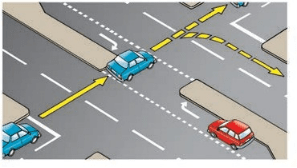
If another vehicle is already blocking the median space, wait on the minor road until there is enough space to clear the first half of the road without stopping on the carriageway.
When driving a large vehicle, it is generally not safe to treat each half of the dual carriageway as a separate road. You should remain on the minor road until you can cross both sides of the dual carriageway without having to stop.
Always take care when you are behind large vehicles or vehicles towing trailers when they are turning. Remember, a long vehicle or combination needs extra room to finish a turn. Cyclists, motorcyclists and pedestrians, in particular, should be extra careful when near these vehicles.
Turning right from a dual carriageway
- Follow the normal procedure and move into the right-hand lane. If there is a deceleration lane, move into it.
- At the junction, turn into the median space and wait for a safe gap in traffic.
- When it is safe to do so, finish your turn and move into the left-hand lane of the road you are entering.
Roundabouts
Not every roundabout is the same. They are different shapes and sizes and can have different numbers of exits. Some are controlled by traffic lights. Regardless of the size of roundabouts, the general rules below must be applied.
The purpose of a roundabout is to:
- Reduce delays – traffic flows smoothly compared to the stop and go traffic at normal intersections such as at traffic lights;
- Significantly reduce the risk of collisions; and
- Reduce pollution – emissions from vehicles on roundabouts are less than they would be at traffic light junctions.
Golden rule
This ‘golden rule’ should help motorists to drive safely at any roundabout regardless of the number of exits:
Think of the roundabout as a clock.
- If taking any exit from the 6 o’clock to the 12 o’clock position, motorists should generally approach in the left-hand lane.
- If taking any exit between the 12 o’clock to the 6 o’clock positions, motorists should generally approach in the right-hand lane.
- If there are road markings showing you what lane you should be in, follow those directions. Traffic conditions might sometimes mean you have to take a different approach but, in the main, the ‘golden rule’ will help you to drive safely on almost any roundabout.
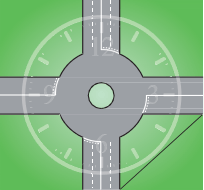
Approaching a roundabout
- Conditions at roundabouts may vary. When you are coming up to a roundabout, look for directional arrows, road markings or signs which might be indicating which lane you should use for the exit you’re taking.
- Move into the correct lane in good time. Use the 12 o’clock ‘golden rule’ to help you plan a safe course of action unless road signs or road markings indicate otherwise.
- Treat the roundabout as a junction. You must yield to traffic coming from the right or traffic already on the roundabout, but keep moving if the way is clear.
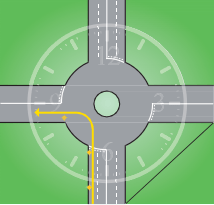
Making a left turn
Approach in the left-hand lane, indicate ‘left’ as you approach, and continue until you have taken the left exit.
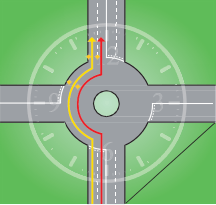
Going straight ahead (any exit between 6 o’clock and the 12 o’clock position)
Approach in the left-hand lane (unless road markings say otherwise) but do not indicate ‘left’ until you have passed the exit before the one you intend to take. Where traffic conditions dictate otherwise, for example a long line of traffic in the left lane signalling left or roadworks in the left lane, you may follow the course shown by the red line.
When leaving the roundabout take extra care at all exits, checking for other road users – for example, cyclists and motorcyclists who may be continuing on the roundabout.
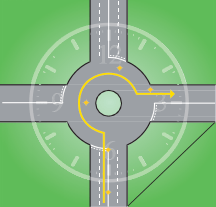
Taking any later exits (those from 12 o’clock to the 6 o’clock position)
Approach in the right-hand lane (unless road markings say otherwise), indicate ‘right’ on your approach and leave your indicator on until you have passed the exit before the one you intend to take. Then change to the ‘left’ turn indicator. Move over towards the left on the roundabout and continue signalling left to leave.
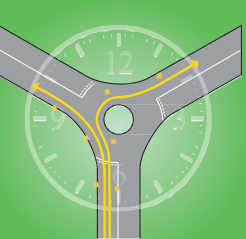
In all cases watch out for and give plenty of room to:
- Pedestrians who may be crossing the approach and exit roads
- Traffic crossing in front of you on the roundabout, especially vehicles intending to leave by the next exit
- Traffic that may be straddling lanes or positioned incorrectly
- Motorcyclists
- Cyclists and horse riders who may stay in the left-hand lane and signal right if they intend to continue round the roundabout
- Long vehicles (including those towing trailers), which might have to take a different course approaching or on the roundabout because of their length. Watch out for their signals.
Remember: Conditions at roundabouts may vary. Exercise caution at all times. In particular, be aware of traffic signs, traffic lights, road markings and traffic coming from your right when approaching roundabouts.
Parking
General rules
- Where possible, park facing in the direction of traffic flow.
- Park close to, and parallel with, the kerb or edge of the road, except at any location where straight or angled parking bays are marked out on the surface of the road.
- Where a parking bay is marked out on a road, you must park your vehicle fully within the parking space.
- Apply the handbrake.
- Switch off the engine.
- Leave the vehicle in first gear or reverse, or, in the case of an automatic, select P.
- Before opening any doors, check for other road users nearby, in particular motorcyclists, cyclists and pedestrians.
- Open your doors only when you need to and keep them open only for as long as necessary.
- Get out of your vehicle only when it is safe and you and your passengers are not blocking other road users.
- Passengers should exit on the kerbside.
- Lock your vehicle as you leave it.
- You should not leave headlights on when parked.
How to make sure your vehicle is parked safely
Make sure you do not interfere with normal traffic flow and that your vehicle does not disturb, block or endanger other road users.
| Dos ✓ | Don’ts ✗ |
| Do park as close as possible to the kerb or edge of the road. | Don’t park opposite another vehicle on a narrow road. |
| Do make sure the sides of your vehicle are parallel to the kerb or edge, unless a traffic sign indicates otherwise. | Don’t double park. |
| Do park facing in the same direction as the traffic. | Don’t park at roadworks. |
| Do make sure your vehicle can be seen at night. | Don’t park at the entrance or exit of a fire station, Garda station, ambulance station or hospital. |
| Do park courteously, without blocking other road users’ views of a traffic signal or the road ahead. | Don’t park where you would block other road users’ views of a traffic signal or the road ahead. |
| Do park where you would not block the entrance to a property unless you have the owner’s permission. | Don’t park where parking is forbidden by traffic signs or road markings. |
| Don’t leave headlights switched on when parking at the side of the road, or just off the side of the road. |
Remember: Drivers can quickly become dazzled and disorientated by headlights of parked or stopped vehicles. If you need to have lights on in these circumstances, you should use only ‘side’ or ‘parking’ lights. You should not leave headlights on when parked.
The following traffic signs and road markings show where parking is not allowed or is allowed only at certain times.
Traffic signs
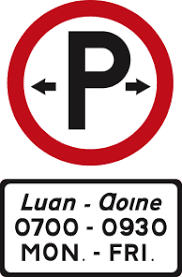
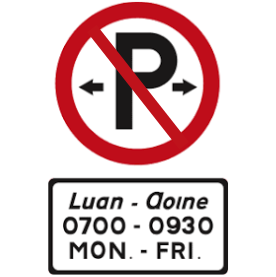
These signs and their information plates show that you can park only during certain periods (sign 1) or outside certain periods (sign 2).
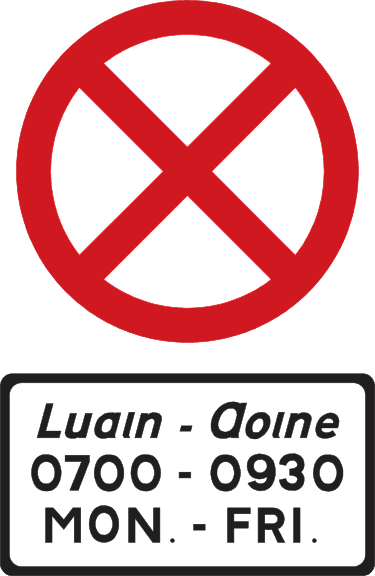
The sign below shows a clearway – an area of road that must be kept clear for moving traffic during certain times of the day (usually busy periods). The times when stopping or parking is prohibited are shown on an information plate under the sign.
Other vehicles may stop during these times only if they are waiting in a line of traffic, but they are not allowed to park, even if disc or metered parking is normally available.
Road markings
This single yellow line usually has an upright information plate nearby. Together, the road marking and information plate mean you must not park during the times shown.
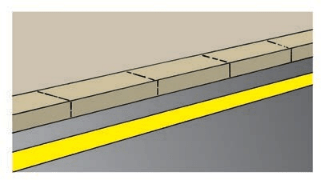
The double yellow lines mean no parking at any time.
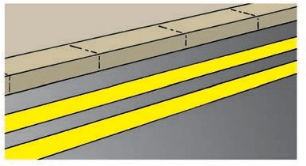
No parking
Even if you do not see a particular ‘no parking’ sign or yellow line on the road, you must not stop or park:
- In a designated disabled persons parking space unless you display a ‘reserved for a person with a disability’ permit. Wheelchair users need to use the extra-wide, special parking bay to open their car door fully. This will allow a person to get from a wheelchair to a vehicle or from a vehicle to a wheelchair. Normal parking bays are too narrow to give the access needed by wheelchair users, so other road users must not park in the designated disabled persons parking spaces. It is an offence to do so.

- Where there are white or yellow zig-zag lines on either side of pedestrian lights or either side of pelican or zebra crossings
- Wholly or partly on a zebra or pelican crossing or at pedestrian lights
- 15 metres before or 5 metres after a pedestrian crossing or traffic lights
- Near a school entrance where there are yellow zig-zag lines along the edge of the roadway enclosing the words ‘SCHOOL KEEP CLEAR’
- Near an entrance or exit from a Fire, Ambulance or Garda station
- Within an area marked as a bus stop or taxi rank – white roadway markings line the areas and, in addition show the word ‘BUS’ at a bus stop and ‘TAXIS’ at a taxi rank
- Where there is a single or double continuous white line along the centre of the road
- Wholly or partly on a footpath, a grass margin, a cycle lane or track or a median strip
- Within 5 metres of a road junction unless parking spaces are clearly marked
- On a part of a road reserved for casual trading during trading hours
- In a contra-flow bus lane at any time or in a with-flow bus lane during the hours the bus lane is in force
- In a loading bay (reserved for goods vehicles to use while loading or unloading goods for a maximum period of 30 minutes) – roadway markings show the word ‘LOADING’ repeated across the entrance of the parking area
- In an entrance or exit for vehicles to or from a premises, unless authorised by the occupier of the premises
- In a tram lane during the period the tram lane is in force (tram lanes operate on a 24-hour basis unless an alternative period is shown on an information plate beside the lane)
- On the approach to a level crossing
- Where the kerb has been lowered to help wheelchair users.
Remember: You must not park in any way which interferes with the normal flow of traffic, or which obstructs or endangers other road users.
You must never park:
- At a corner, a bend, the brow of a hill or on a hump-back bridge
- Where there is a sharp dip in the road; or
- Anywhere that blocks the view of a school warden or junior school warden service – this restriction does not apply to a vehicle displaying a disabled persons parking permit.
Disc parking
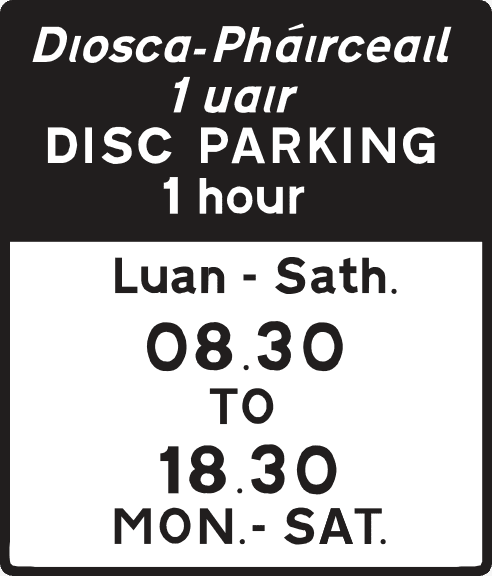
Disc parking operates in built-up areas to restrict parking during certain times of the day. You will see the regulatory sign and information plate pictured below in areas covered by disc parking. When you park, you must buy a disc for a set period of time and leave the parking space by the time this period ends. You must not park again in the same street within one hour of leaving a disc-parking space. The restriction does not apply to a vehicle displaying a parking permit for a person with a disability.
Clamping or removing vehicles
Some local authorities have introduced systems to combat illegal parking. If your vehicle is parked illegally, a clamp may be fixed to a wheel, or your vehicle may be towed to another place and have a clamp attached there, or your vehicle could be removed and locked up in a vehicle pound. You must then pay a fee to remove the clamp or have your vehicle returned to you.
Dangerous parking
If you park in a way that is likely to cause danger to other road users, for example, if it forces a pedestrian out onto the roadway, a Garda can decide that you have committed an offence of dangerous parking, for which you may be liable to a fixed charge of €80 and up to 5 penalty points.
Remember: Always ensure not to endanger other road users – particularly vulnerable road users – when parking. In particular, never park on a footpath.
 Apperture Labs