Assisting Gardaí
An Garda Síochána are responsible for enforcing road traffic law. This section covers the Garda signals and instructions you must obey when on the road.
Signals
If a Garda is controlling traffic, their signals override all other signals from traffic lights. This means that if they signal you to stop, for example, you must do so even if a green light is showing. The signals and their meanings are shown below. You must understand them so you know how to respond when in traffic.
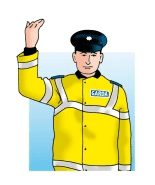
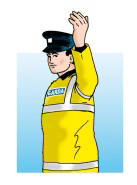
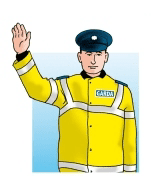
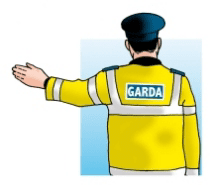
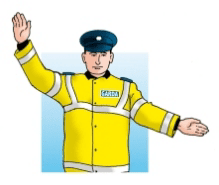
Instructions
You must do the following if a Garda asks you to:
- Show your driving licence, which you must carry at all times when driving.
- Allow the Garda to examine the insurance disc, tax disc and, where relevant, the NCT and CVRT disc, all of which you must display on your vehicle.
- Produce a certificate of roadworthiness or NCT certificate, as appropriate, at a named Garda station within 10 days.
- Produce a valid motor insurance certificate to a Garda within 10 days of it being requested. A Garda may ask to see a valid motor insurance certificate any time up to a month after observing or reasonably believing that an uninsured vehicle has been used in a public place.
- Produce the vehicle registration certificate at any reasonable time.
- Stop your vehicle and allow a Garda to check it for defects.
- Give your name and address.
- Write out your signature.
- Give a sample of your breath or saliva. You may be required to provide a roadside breath or saliva sample at any time when requested by a member of An Garda Síochána.
- Perform ‘impairment tests’. You may be required to perform impairment tests where a Garda suspects that you are driving under the influence of drink or drugs. Before conducting such a test, a Garda will ask whether you have any disability or medical condition which you think might prevent you from participating in the relevant test.
A Garda may conclude from observing your ability to perform these tests that your ability to drive is impaired. It is an offence to refuse to perform impairment tests if required by a Garda.
Gardaí can set up checkpoints to take roadside breath samples without the need to form the opinion that you have consumed an intoxicant. It is a criminal offence to refuse to provide a sample.
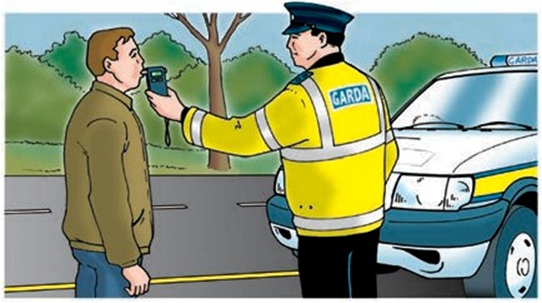
If you are arrested for an offence related to alcohol and driving or refusing to give a roadside breath sample, you will be required to provide a sample of breath and blood or urine at a Garda station.
Gardaí may also require you to permit a nurse or doctor to take a blood or urine sample from you in situations where you have been involved in an accident in which you were driving and are attending at hospital. It is an offence to refuse to allow a doctor or nurse to take a sample in such situations (unless the doctor or nurse themselves refuse to take the sample on medical grounds).
Where a person is incapable of complying with this above requirement (for example, the driver is unconscious), the Gardaí may direct the doctor or nurse to take a sample of blood from the person. It is an offence for a person to refuse permission for that blood sample to be subsequently tested (unless they have a special or substantial reason for their refusal).
If a doctor advises the Garda that the taking of either a urine or blood sample from the person may adversely affect that person’s health, the Garda will not make the above requirement of a person or give the above direction to a doctor or nurse.
Other controls on road users
- Officials from the Revenue Commissioners, including Customs, may also stop and examine vehicles.
- Your vehicle may also be impounded by a Revenue Official or Gardaí.
- You may also be stopped by the Gardaí working with Transport Officers from the Road Safety Authority who will check the tachograph and Operator’s Licence.
What to do when an emergency service vehicle approaches
You need to know what to do when you see an emergency vehicle. You must
react quickly, safely and carefully to allow emergency service vehicles to pass.
It is important to be alert and attentive at all times. You should keep noise levels in your vehicle at a level that allows you to hear the sirens from emergency vehicles.
Be alert at intersections and observe your surroundings as emergency service vehicles may come from behind you or from a secondary road.
You should also leave plenty of space between you and the vehicle in front when stopped in traffic. This will give you room to manoeuvre your vehicle if, for example, you need to pull in to let the emergency service vehicles pass – something you cannot do if you are sandwiched between two vehicles in traffic.
Gardaí, fire fighters and ambulances save lives in the course of their work and every second counts when they are responding to an emergency.
When an emergency vehicle approaches:
- Clear the way as soon as you can do so safely when you see the flashing lights or hear the sirens.
- Never mount the kerb unless you absolutely have to and, even then, only if you are certain that there are no pedestrians there.
- Check your rear mirror and both side mirrors to gauge the speed of the emergency vehicle and also look out for pedestrians, cyclists, motorcyclists and other road users. Indicate your intention to pull over. Pull over only in a place which has enough space for the emergency vehicle to pass you safely.
- Stay there until the emergency vehicle has passed. Watch out for other emergency vehicles as there may be more than one.
- Take the appropriate observations and then indicate that you are going to pull out again. When it is safe to do so, gradually merge back into traffic.
Never ever:
- Tailgate or overtake an emergency vehicle with lights or sirens unless directed to do so.
- Race after an emergency service vehicle to get through a traffic light.
- Break a red light or speed to allow emergency service vehicles to pass you unless you’re directed to do so by the Gardaí or emergency service personnel.
- Brake suddenly or block the road.
- Overtake a moving emergency service vehicle that is displaying flashing lights.
Pedestrians, cyclists and motorcyclists
Pedestrians, cyclists and motorcyclists should look and listen for emergency service vehicles.
It is important to think about the route of the emergency service vehicle to make sure that you are not in its path. Keep in as far as possible on the correct side of the road.
If you are a pedestrian and there is an embankment or grass verge, you should use it (if it is safe to do so) in order to keep out of danger. If you are pushing a pram or buggy, this may not be possible so make sure that you keep in as far as possible. Try to anticipate the route that the emergency service vehicle is taking and attempt to alert the emergency service vehicle to your presence on the road.
If you have children with you, make sure that you are holding their hands at all times. It is important to wear hi-viz clothing at all times to make sure other
road users can see you. Pedestrians should always wait until emergency service vehicles have passed before crossing the road at traffic lights, pedestrian lights, zebra crossings or pelican crossings.
Factors that affect safe driving
The main factors that can affect your driving are:
- Alcohol
- Drugs (prescription and non-prescription)
- Tiredness and fatigue
- Road rage or other forms of aggression.
Individually or together, these factors will:
- Affect your judgment
- Slow your ability to react to and avoid hazards
- Cause you to lose concentration; and
- Make you a less safe and socially responsible driver.
Alcohol
Alcohol is a major factor in crashes that lead to death and injury.
Research proves that even small amounts of alcohol affect your judgment and ability to drive.
Remember: The only safe advice is to NEVER EVER drink and drive. Could you live with the shame?
There is no reliable way to tell how much you can drink before you exceed the legal limit. Our best advice is to never ever drink and drive.
Penalties for drink driving
Once stopped by An Garda Síochána, a driver may be tested for alcohol and taken to a Garda station for further testing. In all cases, if a driver fails a preliminary breath test at the roadside, they will be arrested and required to provide an evidential breath, blood or urine specimen at a Garda station.
The offence of refusing to provide a sample of breath, blood or urine for evidential purposes will attract an automatic disqualification of four years for a first offence and six years for a second or subsequent offence.
Under the system, if a driver is not already disqualified from holding a driving licence or a learner permit at the time of detection, or has not availed of the fixed penalty notice option in the preceding three years, and the BAC (Blood Alcohol Concentration) levels in the body do not exceed 100mg (qualified, non novice or non professional) or 80 mg (learner, novice or professional) they will be subsequently served with a fixed penalty notice. Court proceedings will not be initiated if payment of the fixed charge is made and the disqualification accepted.
The penalties which apply are:
- If a driver is tested and their BAC is between 50mg and 80mg, the driver will be served an on-the-spot fixed penalty notice, receive a fine of €200 and an immediate 3 month disqualification. The driver cannot drive in a public place the entire of the 3 month calendar period. To drive while banned is a criminal offence and will lead to prosecution.
- If a driver is tested and their BAC is between 80mg and 100mg, they will be served an on-the-spot fixed penalty notice, receive a fine of €400 and will be disqualified from holding a licence for six months.
- If a driver who is a learner, novice or professional driver is tested, and they are above the 20mg limit (but less than 80mg), they will be served with an on-the-spot fixed penalty notice, receive a fine of €200 and be disqualified from holding a driving licence for three months.
Where a driver is tested and their BAC is above 100mg (or 80mg for a learner, novice or professional driver), or they have failed to pay a fixed penalty notice, they will have to go to court where the disqualification periods range from 1 to 6 years depending on the level of alcohol detected, and whether it is a first or subsequent offence.
Remember: Never ever drink and drive.
Drugs
It is against the law to drive a car, motor bike, truck, bus, pedal bike or an animal-drawn vehicle while ‘under the influence of an intoxicant to such an extent as to be incapable of having control of the vehicle’.
Intoxicants include alcohol and drugs, whether taken separately or together. The word ‘drugs’ here includes legal prescribed and over the counter (OTC) medicines.
If a Garda suspects you of driving under the influence of drugs, they may require a saliva sample and for you to perform ‘impairment tests’. Before conducting such tests, a Garda will ascertain whether you have any disability or medical condition which you think might prevent you from participating in the relevant test. These impairment tests may involve the performance of the following five tests:
- A ‘pupil dilation’ test
- A test of your ability to balance
- A ‘walk and turn’ test
- A ‘one leg stand’ test; and
- A ‘finger to nose’ test.
It is an offence to refuse to perform impairment tests if required by a Garda.
A Garda may conclude from observing your ability to perform these tests that your ability to drive is impaired and consequently arrest you. The results of these tests may be used as evidence, along with any blood or urine samples taken and tested for the presence of any drugs, in order to convict you of driving while under the influence of an intoxicant.
The Gardaí can use preliminary drug testing devices, called the Drager Drug test 5000, at the roadside or in a Garda station to test a person’s oral fluid for Cannabis, Cocaine, Opiates and Benzodiazepines. If positive, a blood specimen can be taken, which will be sent to the Medical Bureau of Road Safety (MBRS) for evidential testing.
If the Garda forms the opinion that you are impaired and you have not had a preliminary drug test, or the results of that test were negative, they can request either a blood or urine specimen, which will be sent to the Medical Bureau of Road Safety for testing.
The penalty for drug driving is the same as for drink driving – a maximum of €5,000 fine and up to 6 months imprisonment on summary conviction.
In terms of disqualification periods, for those convicted of the new offence of being above the threshold for cannabis, cocaine and heroin with no proof of impairment necessary by the Gardaí, the disqualification period is not less than 1 year for the first offence, and not less than 2 years for the second or subsequent offence.
Road rage and aggressive driving
If you display road rage as a driver, it means you have uncontrolled anger that results in intimidation or violence against another driver.
Aggressive driving is inconsiderate, stupid driving. It can involve speeding, tailgating (driving too close behind another vehicle), failing to use an indicator for lane changes, recklessly weaving in and out of traffic and over-use of a horn or flashing headlights.
If another driver is attempting to provoke you, don’t react. Don’t be tempted to speed up, brake or swerve suddenly. This could cause a crash or make other drivers think you are confronting them. Instead, stay calm and remain focused
on your driving to complete your journey safely. Always remember that safety is your number one concern.
Report all incidents to your local Garda station or contact Traffic Watch on: Lo-Call 1890 205 805.

Litter
Remember: Throwing litter from a vehicle is not only irresponsible but can cause a hazard to other road users and yourself.
Remember: It is an offence to supply a mechanically propelled vehicle to anyone who is under 16 years of age for use in a public place. Similarly, it is an offence to drive a vehicle whilst under age and without the necessary driving licence or learner permit. The word ‘supply’ means sell, hire, loan, gift or provide in any other way. If you do, you can be fined up to €5,000 or face up to six months’ imprisonment.
Correct behaviour at the scene of an accident
This section covers what you must do if you have been involved in an accident, whether with another vehicle, another user of the road or with an object along the road. It also outlines what to do if you come across an accident.
What drivers must do at an accident or in an emergency
- If you are involved in an accident, you must stop your vehicle and remain at the scene for a reasonable time. If anyone is injured or appears to need assistance, the driver of the vehicle must offer assistance. If vehicles are blocking the roadway or posing a danger to other road users, the roadway should be marked and the vehicle should then be removed as soon as possible.
- If you are asked by a Garda, you must give your name and address, the address where the vehicle is kept, the name and address of the vehicle owner, the vehicle’s registration number and evidence of insurance, such as the name of your insurance company or a disc or motor insurance certificate. If there is no Garda at the scene, you must give this information to any person involved in the crash or, if requested, to an independent witness.
- If you or another person is injured and there is no Garda at the scene, the accident must be reported to the nearest Garda station.
If you fail to comply with the above requirements, with the intent of escaping civil or criminal liability, in situations where:
- You know someone has been injured and needs medical attention, or
- You know someone has been killed, or are reckless as to that fact,
You may be convicted and receive a fine of up to €20,000 or a prison term of up to 10 years.
- If the accident damages property only, and there is a Garda in the immediate vicinity, you must report it to the Garda. If there is no Garda available, you must provide this information to the owner or the person in charge of the property. If, for any reason, neither a Garda nor the owner is immediately available, you must give all relevant information at a Garda station as soon as reasonably possible.
Remember: Gardaí must conduct mandatory testing of drivers for alcohol at the scene of a crash where someone has been injured, or of a driver who has been injured and removed to hospital.
- You are advised, where possible, to take pictures at the scene of an accident, showing the conditions, the position of vehicles and any damage done.
- Take care when moving damaged or broken-down vehicles and make every effort to warn oncoming traffic of the accident.
- You can warn them by using your hazard lights.
- If you need to ask for another road user’s help to warn traffic, do so right away.
- If you have a reflective advance-warning triangle, (heavy vehicles and buses must have one), place it on the road far enough from the scene of the accident to give enough warning to approaching traffic. A warning triangle should not, however, be used on a motorway or in a place where it would be unsafe.
- When placing a triangle, you should take account of prevailing road conditions, traffic speed and volume. This is particularly important on motorways and dual-carriageways.
- If the breakdown occurs near a bend in the road, make sure you give warning to traffic on both sides of the bend.
- Leaking fuel from a crashed vehicle is dangerous, so be careful approaching any vehicle after an accident.
- Carry at least two high-visibility vests or jackets and a torch in your vehicle. If there is an accident, wear the vest or jacket and use the torch to alert other road users to your presence.
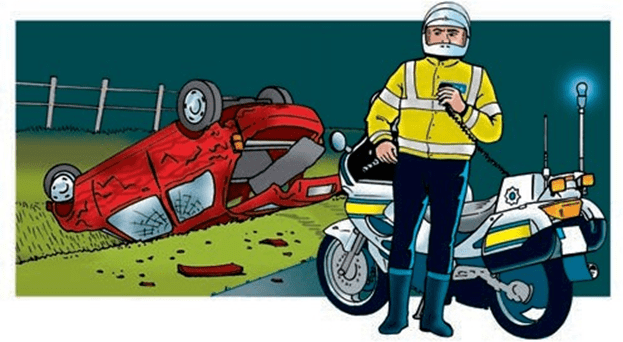
What to do if you arrive at the scene of an accident
| Dos ✓ | Don’ts ✗ |
| Do remain calm. | Don’t panic – assess the situation before taking action. |
| Do switch off the engine and apply the handbrake. | Don’t stay at the scene if there are enough people helping and keeping it under control. |
| Do use a reflective advance-warning triangle if available, except on a motorway. | Don’t get injured yourself – park your vehicle safely out of the way. |
| Do switch on hazard warning lights and parking lights. | Don’t move an injured person unless there is a risk of fire or of the vehicle turning over. |
| Do make sure you are safe as you try to help others. | Don’t attempt to lift a car off an injured person without help. |
| Do make sure others are safe. You should keep any injured people warm by placing coats or rugs around them. | Don’t remove helmets from injured motorcyclists. Neck injuries are common in motorcycle collisions, and any attempt by inexperienced people to remove the helmet may leave the injured person paralysed from the neck down. |
| Do organise bystanders to warn oncoming traffic from both directions, if this has not already been done. Be particularly careful at night so that people giving help are visible (by wearing reflective armbands or bright clothes or carrying lit torches). | Don’t allow anyone to smoke at, or close to, the scene. |
| Do call for help. Contact the emergency services on 999 or 112. | Don’t give an injured person anything to eat or drink. |
Accidents involving dangerous goods
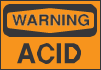
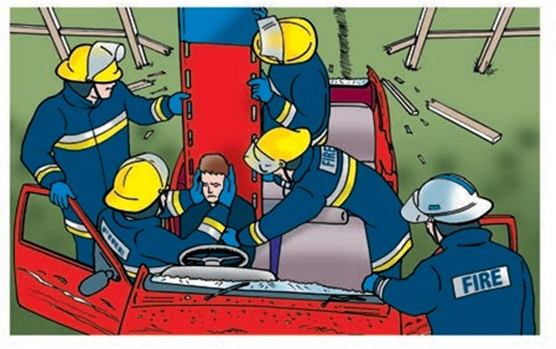
If a vehicle carrying petrol, heating fuel or acid is in an accident, you should:
- Keep well clear of the scene;
- Position yourself, if possible, to make sure that the wind is not blowing from the accident towards you;
- Warn other road users about the danger;
- Give as much information as possible about the marking labels on the vehicle when summoning help; and
- Let the emergency services do any rescuing.
The signs for vehicles carrying hazardous chemicals are shown below.


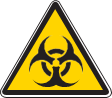
If you would like to know more about transporting dangerous goods by road, contact the Health and Safety Authority for a guide to the relevant domestic and EU laws governing this area.
Penalty points, fixed charges and driving bans
Encouraging road users to behave well is important, and Ireland has adopted a system of penalty points to support this change. This system is a key part of road safety policy in this country, and is designed to save lives.
If you break the law, there’s a price to pay. The system will record your failure and the penalty on your driver licence record. For minor offences, the penalty is a sum of money, a fixed charge, and points that attach to your licence record: penalty points. For more serious offences you may be brought to court. The system applies to both full licence and learner permit holders.
If you break the law and are caught, you will be fined and you will build up penalty points.
Remember:
- A first-time learner driver who receives 7 points in a 36-month period will be banned from driving for 6 months.
- A novice driver who receives 7 points in a 36-month period will be banned from driving for 6 months.
- A fully licensed driver who receives 12 points in a 36-month period will be banned from driving for 6 months.
This section describes how penalty points and fixed charges work and outlines the points and charges that apply to road traffic offences.
Penalty points
The penalty points system covers offences that relate to road safety. Offences can be detected either:
- By Gardaí directly; or
- By safety cameras, in the case of speeding.
If a Garda stops you for committing an offence
- You must show your driving licence or learner permit, and give your name and current address, if asked.
- You will receive a fixed charge notice by post.
- You have the choice to pay the fixed charge within the time allowed (up to 56 days) or let the matter go to court.
- Penalty points will be applied to your licence record 28 days after the notification has been sent to you. This notification will be issued when you pay the fixed charge or if you are convicted of the offence in court.
If your vehicle is recorded breaking the speed limit
- If you are the registered owner of the vehicle, you will receive the fixed charge notice.
- If you were not driving the vehicle when the offence took place, you must give the Gardaí the name and address of the driver of your vehicle within 28 days. If you do, the named driver will receive the fixed charge notice. If you don’t, you will be assumed to be the driver of the vehicle when the offence took place.
- Penalty points will be applied to the driver’s licence record either when the charge is paid or when the driver is convicted of the offence in court.
Remember: Most penalty point offences attract a fixed charge. Some offences will result in a mandatory court appearance without the option of only paying a fixed charge.
Fixed charge system
This system applies to many offences, including most of the penalty point offences.
How it works
- You receive a fixed charge notice setting out:
- The details of the offence;
- The fixed charge amount to be paid; and
- Where that charge can be paid.
- You have 28 days to pay the fixed charge.
- If you do not pay the charge within this time, it increases by 50%. You then have another 28 days to pay the increased charge.
- If you do not pay it, the matter goes to court.
The Unaccompanied Learner Driver
The owner of a vehicle who allows an unaccompanied learner or unlicensed driver to drive their vehicle is liable to have their vehicle seized by the Gardaí and could face a fine of up to €1,000.
A vehicle being driven by an unaccompanied learner driver will be detained by Gardaí.
A learner driver detected of driving unaccompanied faces
- An €80 fine and two penalty points if paid within 28 days;
- A €120 fine and two penalty points if paid within the next 28 days; and
- A €120 fine and four penalty points if convicted in court.
A lower threshold of penalty points leading to disqualification will apply to any driver who is granted their first learner permit on or after 1 August 2014 while they drive under a learner permit, and subsequently during the first two years while they drive under their first full driving licence.
Note: Under the Graduated Driver Licence GDL system, learner drivers must always be accompanied by a fully qualified driver (not a novice).
Driving bans
- If you build up 12 or more penalty points (as a fully licensed driver) or 7 or more penalty points (as a learner or novice driver) in 36 months:
- You will receive a notice telling you that you have been banned from driving for 6 months from a particular date; and
- You will have to post your driving licence to the NDLS within 14 days of the start of the driving ban.
- You will be banned from driving if you are convicted in court of an offence such as drink driving, dangerous driving or leaving the scene of a crash. You will be banned from driving as a result of the conviction alone, no matter how many penalty points are on your licence record.
- The courts can issue driving bans for any offences involving vehicles, not just the offences already resulting in automatic bans. The court will decide the length of the ban in each case.
- If you are convicted in court, you may be fined and, in some cases, face a prison term.
Remember:
- It is an offence not to surrender your licence.
- It is an offence to drive while banned from doing so.
 Apperture Labs