This chapter tells you how to deal with particular driving situations you will encounter. This includes freeway driving, driving at night and in bad weather. It gives you tips for driving on dangerous and difficult surfaces, driving in a group and carrying passengers or cargo.
Starting on a Hill when Driving a Motorcycle with Clutch and Gears
Starting a motorcycle with a clutch and gears on a hill is more difficult than on level ground. Follow these steps to avoid stalling or rolling backward:
- Use the front brake to hold the motorcycle while you start the engine and shift into first gear.
- Change to the foot brake to hold the motorcycle while you operate the throttle with your right hand.
- Twist the throttle a little bit for more power.
- Release the clutch gradually. If you release it too quickly, the front wheel may lift off the ground or the engine may stall, or both.
- Release the foot brake when the clutch begins to engage.
Vehicles Turning Left in Front of you
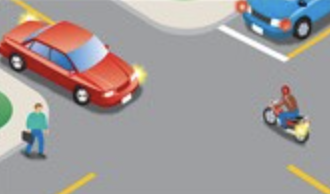
One of the most common causes of collisions between motorcycles or mopeds and cars is the car driver turning left in front of the motorcycle or moped. This is because the car’s driver either does not see the motorcycle or moped or misjudges its speed. You can help to avoid such collisions by following these steps:
- Prepare to slow down and proceed with caution if you are going faster than a driver would expect when you approach an intersection with a vehicle waiting to turn left.
- Take a defensive lane position. Move as far as possible to the right to give a little more room between you and the vehicle.
- Think about what you will do if the car turns in front of you. Where will you go? Is there a clear area to swerve? How fast will your motorcycle stop on the road surface?
- Do not focus only on the left- turning vehicle. Pay attention to everything going on around you. Check to make sure there is nothing else in the intersection that could cause trouble, such as another vehicle or a pedestrian.
Driving at Night
Driving a motorcycle or moped at night can be risky. You cannot see or be seen as well as you can in the daytime. Because of their inexperience, Level One (M1) drivers are not allowed to drive at night.
Another major problem for motorcycle and moped drivers when driving at night is alcohol. There are more drinking drivers on the road to put you at risk. And some motorcycle and moped drivers put themselves at risk by drinking. Alcohol reduces your ability to control your vehicle and to anticipate trouble from other drivers. Follow these tips for driving at night:
- Keep your headlight(s) clean, and switch to your high beam when- ever you are not following or approaching another vehicle. Get as much light as you can.
- Wear reflective clothing, such as a reflective vest and helmet. Also, wear warmer clothing when riding at night.
- Reduce your speed, particularly on roads that you do not know well. If there is something lying on the road ahead, you may not see it in time to avoid it.
- Use the lights of the vehicle in front of you to get a better view of the road ahead. Watch the movement of the vehicle’s tail lights as well. Tail lights bouncing up and down can alert you to bumps or rough pavement.
- Increase your distance from other vehicles. You cannot judge distance as well at night. Make up for this by allowing extra distance between you and other vehicles. Give yourself more distance to pass.

Overdriving your Headlight(s)
You are overdriving your headlight(s) when you go so fast that your stopping distance is farther than you can see with your headlight. This is a dangerous thing to do, because you are not giving yourself enough room to make a safe stop. Reflective road signs can mislead you as well, making you believe you can see farther ahead than you actually can. This may cause you to overdrive your headlight if you are not careful.
Freeway driving (excludes LSMs and mopeds)
As a motorcyclist, you have to be careful not to drive too fast on a freeway. Although it is easy for motorcycles to cut through traffic and speed on a freeway, driving faster than traffic is dangerous because you will not be able to react quickly enough in an emergency.
Drive at a steady speed on a freeway. Keep checking traffic all around you and look in your mirrors every five to 10 seconds. As in city driving, you should be constantly scanning the road ahead and to each side, and checking your rearview mirrors. Look ahead to where you are going to be in the next 15 to 20 seconds, or as far ahead as you can see.
Always keep at least a two- to three-second distance behind the vehicle in front of you. If another vehicle follows too closely, give yourself even more room in front or change lanes. Keep a cushion of space all around you and avoid driving in the blind spots of other vehicles. Stay clear of large vehicles. They block your view more than other vehicles and create a strong air disturbance behind them. If you get behind one of these vehicles, the wall of wind can whip around your motor- cycle, making it difficult to control.
Entering a Freeway
Entrance ramps can be especially difficult for motorcycles. In addition to tight turns, entrance ramps often have slippery surfaces, causing you to drive more slowly than you would in a larger vehicle. And because other drivers are usually unaware of the risks faced by motorcyclists, you may have to deal with other vehicles tailgating or trying to pass you.
As you move along the ramp, check traffic in the lane you will move into and find a safe space to enter. Remember to look ahead and check your mirrors and your blind spots. Turn on your signal as soon as traffic on the freeway can see your motorcycle on the ramp. Increase your speed to match that of freeway traffic. Continue to divide your attention between watching in front, checking your mirrors and looking over your shoulder until you can merge safely with traffic. Merge in a smooth, gradual movement to the left tire track of the nearest freeway lane.
Changing Lanes on a Freeway
Be extra cautious when changing lanes on a freeway. On multi-lane roads you need to check that the lane is clear before you enter it, and you also need to make sure someone from another lane is not moving into that spot.
Because traffic moves so quickly on a freeway, it is especially important that you let vehicles behind you know that you intend to change lanes. Once you have made certain that a lane is clear, signal early and increase your speed slightly as you move into the lane. Watch to make sure that any vehicle behind you does not speed up.
When approaching an entrance ramp where other vehicles are merging onto the freeway, adjust your speed to allow the vehicle to merge safely ahead of you or behind you. This will help you avoid being hit by drivers who do not see you. If necessary, move over one lane and resume the curb lane when it is safe to do so.
Do the same thing when approaching exit ramps. If you are driving in the lane closest to the exit ramp, you may be cut off by a driver who does not see you and cuts across the lane in front of you to get to the exit ramp.
Leaving a Freeway
When leaving a freeway, get into the right lane well before the exit and signal that you want to move into the exit lane, but do not slow down. Look left and right and check your mirrors. Turn on your signal. Enter the exit lane with a smooth, gradual motion. Once you are in the exit lane, reduce your speed gradually to the speed shown for the exit ramp. Check your speedometer to make sure you are going slowly enough. You may not realize how fast you are going because you are used to the high speed of the freeway.
If you miss an exit, keep going and take the next exit.
Driving on Dangerous Surfaces
Because motorcycles and mopeds balance on only two wheels, those two wheels must have good traction in order to stay upright. Any surface that affects your motorcycle or moped’s traction will affect the steering, braking and balance. Slippery surfaces reduce your control and increase your chances of falling. It is almost impossible to keep your motorcycle or moped balanced on wet wooden surfaces or ice. If you cannot avoid such surfaces, slow down as much as possible before you get there. Do not brake once on the slippery surface. If you are riding a motorcycle with a clutch and gears, pull in the clutch and coast across.
Pulling in the clutch removes the engine drag from the rear wheel and helps avoid skidding. Stay off the brakes. If necessary, use your foot to hold the motorcycle up.
Watch for uneven road surfaces such as bumps, broken pavement, potholes, railroad tracks and construction areas. If the condition of the road is bad enough, it could affect your control of your vehicle. Here are some tips on handling uneven surfaces:
- Slow down to reduce the impact.
- Keep your motorcycle or moped as upright as possible and avoid turning.
- Rise slightly on the footrests so that you can absorb the shock with your knees and elbows.
Traction on gravel roads is not as good as on pavement. Some areas are better than others. Stay in the tire tracks away from the loose gravel at the edge of the road.
Drive with extra care in a construction area. Slow down; the road could have ruts, mud or damaged pavement.
Stopping at a Railway Crossing
All railway crossings on public roads in Ontario are marked with large red and white “X” signs. Watch for these signs and be prepared to stop. You may also see yellow advance warning signs and large “X” pavement markings ahead of railway crossings. Some railway crossings have flashing signal lights and some use gates or barriers to keep drivers from crossing the tracks when a train is coming. Some less-travelled crossings have stop signs posted. On private roads, railway crossings may not be marked, so watch carefully. When you come to a railway crossing, remember the following:

- Slow down, listen and look both ways to make sure the way is clear before crossing the tracks.
- It can take up to two kilometres for a train to stop under full emergency braking.
- If a train is coming, stop at least five metres from the nearest rail or gate. Do not cross the track until you are sure the train or trains have passed.
- Never race a train to a crossing.
- If there are signal lights, wait until they stop flashing and, if the crossing has a gate or barrier, wait until it rises before you cross the tracks.
- Never drive around, under or through a railway gate or barrier while it is down, being lowered or being raised. It is illegal and dangerous.
- Avoid stopping in the middle of railway tracks. Make sure you have enough room to cross the tracks completely before you begin to cross.
- Avoid shifting gears while crossing tracks.
- If you get trapped on a crossing, immediately leave your vehicle and move to a safe place, then contact authorities.
- Buses and other public vehicles are required to stop at railway crossings that are not protected by gates, signal lights or a stop sign. School buses must stop at railway crossings whether or not they are protected by gates or signal lights. Watch for these vehicles, and be prepared to stop behind them.
- If you are approaching a railway crossing with a stop sign, you must stop unless otherwise directed by a flagman.
It is usually not necessary to change your path when crossing railway tracks that run across (perpendicular to) the road. Be prepared for a bump and avoid braking or turning while on the tracks. Railway and streetcar tracks are extremely slippery.
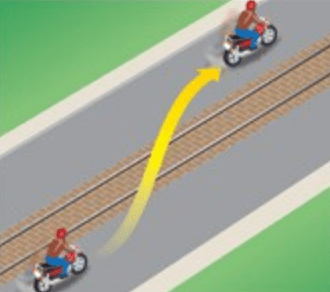
When you want to cross railroad or streetcar tracks that run parallel to your path, cross at a distinct angle (no less than 45 degrees) to prevent getting stuck in the tracks or losing control. Do not try to edge across the tracks or brake heavily. Do the same thing when crossing other uneven surfaces such as a pavement seams or a gravel shoulder.
Grooves, Gratings and Scraped Roads
When you drive over certain surfaces, such as grooved or rutted pavement or metal bridge gratings, you may feel as though you are losing control of your motorcycle or moped. This effect is greater on smaller vehicles than it is on larger ones; the smaller your vehicle, the larger the effect. Avoid overreacting. Keep a gentle but firm grip on the handlebars and drive as smoothly as you can, choosing the best route possible until you get back on a good surface.
Driving in Difficult Weather Conditions
Driving in Rain
Driving in rain can be risky. You are more likely to be tired and cold. The road is slippery, traction may be poor, visibility is reduced and your brakes may be less effective. The best thing to do is to sit it out. However, if you cannot avoid driving in the rain, here are some tips:
- Make yourself visible. Wear bright colours and reflective or fluorescent material.
- Have good equipment. Make sure you have good tire tread, a quality helmet and face shield, as well as warm clothing. A one-piece rain suit will help keep you warm and dry.
- Reduce speed. It takes a lot longer to stop on slippery surfaces. You must make up for this by driving at slower speeds. It is particularly important to reduce your speed on curves. Remember that speeds posted on curves apply to good surface conditions.
- Avoid sudden moves. Any sudden change in speed or direction can cause a skid on slippery surfaces. Turn, brake, accelerate and change gears as smoothly as possible.
- Use both brakes. Both brakes together are more effective than the back brake alone, even on a slippery surface.
- Avoid the most slippery areas. Oil from other vehicles tends to build up in the centre of the lane, particularly near intersections where vehicles slow down or stop. Avoid standing water, mud and other dangerous surfaces, such as wet metal or leaves.
- Watch out for shiny areas and puddles. Old worn pavement is often polished smooth and is very slippery when wet. You can spot these extra slippery sections if you look for shiny areas on the road surface. Puddles can hide potholes and traction is worse in deep water.
- Avoid driving in puddles. A puddle can hide a large pothole that could damage your vehicle or its suspension, or flatten a tire. The spray of water could obstruct the vision of adjacent motorists and result in a collision, cause harm to nearby pedestrians or drown your engine, causing it to stall. Water can also make your brakes less effective.
- Stay away from the edge of the road when you make sharp turns at intersections or enter or exit freeways. Dirt and gravel tend to collect along the sides of the pavement and can cause you to slide.
Driving in Fog
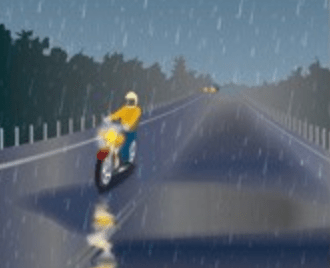
Fog is a thin layer of cloud resting on the ground. Fog reduces visibility for drivers, resulting in difficult driving conditions. The best thing to do is to avoid driving in fog. Check weather forecasts and, if there is a fog warning, delay your trip until it clears. It could save your life. If that is not possible or you get caught driving in fog, there are a number of safe driving tips you should follow.
Tips for Driving Safely in Fog
Before you drive — and during your trip — check weather forecasts. If there is a fog warning, delay your trip until it clears. It could save your life. The best thing to do is to avoid driving in fog. If you are caught driving in fog, follow these safe driving tips:
Do:
- Pay full attention to your driving.
- Slow down gradually and drive at a speed that suits the conditions.
- Use your low-beam lights. The high beam reflects off the moisture droplets in the fog, making it harder to see.
- If you have fog lights on your vehicle, use them, in addition to your low beams.
- Be patient. Avoid passing, changing lanes and crossing traffic.
- Use pavement markings to help guide you. Use the right edge of the road as a guide, rather than the centre line.
- Increase your following distance. You will need extra distance to brake safely.
- Look and listen for any hazards that may be ahead.
- Watch for any electronically operated warning signs.
- Keep looking as far ahead as possible.
- Keep your windows and mirrors clean. Use your defroster and wipers to maximize your vision.
- If the fog is too dense to continue, pull completely off the road and try to position your vehicle in a safe parking area. Turn on your emergency flashers, in addition to keeping on your low-beam headlights.
Don’t:
- Don’t stop on the travelled portion of the road. You could be hit from behind.
- Don’t speed up suddenly, even if the fog seems to be clearing. You could find yourself suddenly back in fog.
- Don’t speed up to pass a vehicle moving slowly or to get away from a vehicle that is following too closely.
Remember:
- Watch your speed. You may be going faster than you think. If so, reduce speed gradually.
- Leave a safe braking distance between you and the vehicle ahead.
- When visibility is reduced, use your low-beam lights.
- Remain calm and patient. Don’t pass other vehicles or speed up suddenly.
- Don’t stop on the road. If visibility is decreasing rapidly, pull off the road into a safe parking area and wait for the fog to lift.
Driving in Cold Weather
In winter or cold weather, other drivers do not expect to see motorcycles or mopeds out on the roads, even when road conditions are good. You must be even more careful and drive more defensively.
You need to anticipate sudden changes in the road surface, especially if the temperature is close to or below freezing. A road may be dry in one area, but wet and slippery in another. Watch for icy or snow-covered patches, which may appear on bridges, shady spots on the road, windswept areas and side roads that have not been completely cleared.
Be alert. Generally, asphalt is a grey-white colour in the winter. Be suspicious of black and shiny asphalt. The road may be covered with a thin layer of ice known as black ice.
It is best to avoid driving your motorcycle or moped when you know there is likely to be snow or ice. If you cannot avoid driving on a very slippery surface, slow down as much as possible before you get to it. If your motorcycle has a clutch and gears, pull in the clutch, coast across and stay off the brakes. If necessary, use your foot to hold your motorcycle or moped up. On a long section of snow-covered road, try to drive on loose or fresh snow. Hard-packed snow has less traction than loose snow.
The other danger of driving in winter is the cold. Cold affects your performance and that of your motorcycle or moped. Here are some things to watch for:
- Cold weather lowers tire pressure. Check it regularly.
- Face-shield fogging will be worse in cold weather.
Probably your greatest danger is from fatigue brought on by the cold. Dress in multiple layers. Keep dry. Do not expose bare skin, and be alert to your own slowed reactions.
Driving in a Group
If you want to drive with other motorcycle or moped drivers, you must do it in a way that is not dangerous and does not interfere with the flow of traffic.
Never drive directly alongside another motorcycle or moped. If you have to avoid another vehicle or something in the road, you will have no place to go. To speak to another driver, wait until you both have stopped.
The best way for a group of motorcycles or mopeds to drive together is in a “staggered formation.” This means the leader drives on the left side of the lane while the second driver stays a little behind — about a one-second distance — and drives on the right side of the lane. A third driver would take the left side, leaving a two-second distance behind the first driver. The fourth driver would be a two- second distance behind the second driver. This staggered formation allows the group to stay close together without reducing following distance and without having drivers drive alongside one another. Staggered formation can be safely used on an open road. However, you should drive in a single line on curves, in turns or when entering or leaving a freeway.
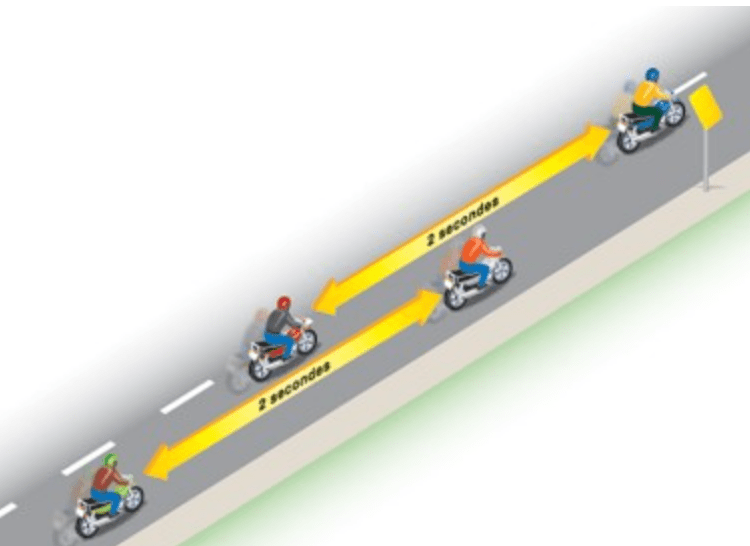
When drivers in a staggered formation want to pass another vehicle on the road, they should do it one at a time. When it is safe, the lead driver should pull out and pass. When the leader returns to the lane, she or he should move to the left of the lane and keep going to open a gap for the next driver. As soon as the first driver has passed safely, the second driver should move to the left of the lane and watch for a safe chance to pass. After passing, this driver should return to the right of the lane and open up a gap for the next driver.
Here are some tips to help you keep your group together without interfering with traffic or endangering others:
- Plan ahead. If you are the leader, look ahead for changes. Give signals early so the word gets back in plenty of time. Start lane changes early enough to let everyone complete the change.
- Put beginner drivers up front. Place inexperienced drivers behind the leader where they can be watched by more experienced drivers.
- Check the driver behind you. Let the driver at the back set the pace. Use your mirrors to keep an eye on the driver behind you. If she or he falls behind, slow down. If everyone does this, the group will stay together.
Driving in a Group of Slower-Moving Vehicles
When driving in a group of vehicles that cannot maintain the posted speed of the road, do not travel in staggered formation. Ride in single file and, when necessary, as close as possible to the right-hand curb or edge of the roadway. The “two-second rule” gives a minimum following distance. If you are travelling in a very large group, break into several smaller groups in order to allow faster traffic to pass.
Carrying Passengers
The following section is applicable only to drivers of motorcycles, since it is an offence under the Highway Traffic Act to carry passengers on mopeds.
It is illegal for Level One (M1) drivers to carry passengers. Even with a Level Two (M2) licence, you should avoid carrying passengers or large loads until you are an experienced driver.
Before carrying a passenger, make certain your motorcycle is equipped to carry passengers. Your motorcycle seat must be large enough to hold both you and your passenger without crowding. The motorcycle must also have footrests for your passenger. Without a firm footing, your passenger can fall off, and pull you off too. Your passenger must also wear an approved helmet and protective clothing.
Adjust the mirrors and headlight to the change in the motorcycle’s angle due to the extra weight. Have the passenger sit on the seat while you make the adjustments. If you carry a passenger, it is a good idea to add additional air pressure to the tires (check your owner’s manual). If the suspension units are adjustable, they should also be adjusted to carry the added weight.
When carrying a passenger on a motorcycle, remember that your motorcycle will respond more slowly because of the extra weight. It takes longer to speed up, slow down or make a turn; the heavier the passenger, the slower the response. To adjust for the added weight, you should do the following:
- Drive at a lower speed, particularly on corners, curves and bumps.
- Begin to slow down earlier than usual when you approach a stop.
- Allow a greater following distance and keep more distance between you and vehicles to either side. Look for larger gaps when you cross, enter or merge with traffic.
Instruct your passenger before you start to drive. Do not assume your passenger knows what to do, even if he or she is a motorcycle driver. Warn your passenger when you are about to start moving, stop quickly, turn sharply or drive over a bump. Provide complete instructions before you start. You should tell your passenger to:
- Get on the motorcycle after the engine has started.
- Sit as far forward as possible without crowding you.
- Hold tightly to your waist or hips.
- Keep both feet on the footrests at all times, even when the motorcycle is stopped. Lean with the motorcycle.
- Avoid unnecessary motions or talk.
Carrying Cargo
Follow these guidelines for carrying cargo:
- Keep the load light. Motorcycles and mopeds are not designed to carry much cargo. If you are using a top box or tank bags, do not overload them.
- Keep the load low. Do not pile loads against a frame on the back of the seat. This will change the centre of gravity and disturb the balance of the motorcycle or moped.
- Keep the load forward. Place the load over or in front of the rear axle. Anything mounted behind the rear wheel can affect how the vehicle turns and brakes. It can also cause wobble.
- Distribute the load evenly. If you have saddlebags, make certain the load in each is about the same. An uneven load can cause the vehicle to pull to one side.
- Secure the load. Make sure the load is securely fastened and near the centre of gravity. It is generally not a good idea to tie bundles to the top of the seat.
- Check the load. Check the load regularly when you are stopped. Make sure it has not moved or become loose.
Summary
By the end of this section, you should know:
- How to deal with potentially difficult/dangerous situations like starting on a hill, vehicles turning left in front of you and crossing railway tracks
- Special considerations you must make when operating your motorcycle on a freeway
- How to deal with specific road and weather conditions
- The proper way for motorcyclists to drive in a group and how to safely carry passengers and cargo
 Apperture Labs