Level One Road Test
Statistics show that new drivers of any age are far more likely to be involved in serious or fatal collisions than experienced drivers.
To help new drivers develop better, safer driving habits, Ontario introduced graduated licensing in 1994 for all drivers applying for their first car or motorcycle licence. Graduated licensing lets you gain driving skills and experience gradually, in lower-risk environments. The two-step licensing system takes at least 20 months to complete and includes two road tests.
Passing the Level One (M1) road test allows you to move to Level Two and receive a Class M2 licence. If you have passed the test on a limited-speed motorcycle or a moped, an L condition is added to your driver’s licence. The L condition means you are restricted to driving a limited-speed motorcycle or moped on only certain roads.
If you have passed the test on a three-wheeled motorcycle, an M condition is added to your driver’s licence. The M condition means you are restricted to driving only three-wheeled motorcycles.
The Level One road test deals with basic driving skills. It includes a three-part motorcycle skill test. Sets of two cones placed one metre apart, with each set 4.5 metres apart (from the centre of the cone), are used to test your skill in manoeuvring your motorcycle.
Road tests are conducted according to set time frames. It is best to arrive early in order to complete the registration process and be ready for your test at the proper time. When you arrive, your examiner will tell you how long you have to complete the test.
The following details each part of the Level One test:
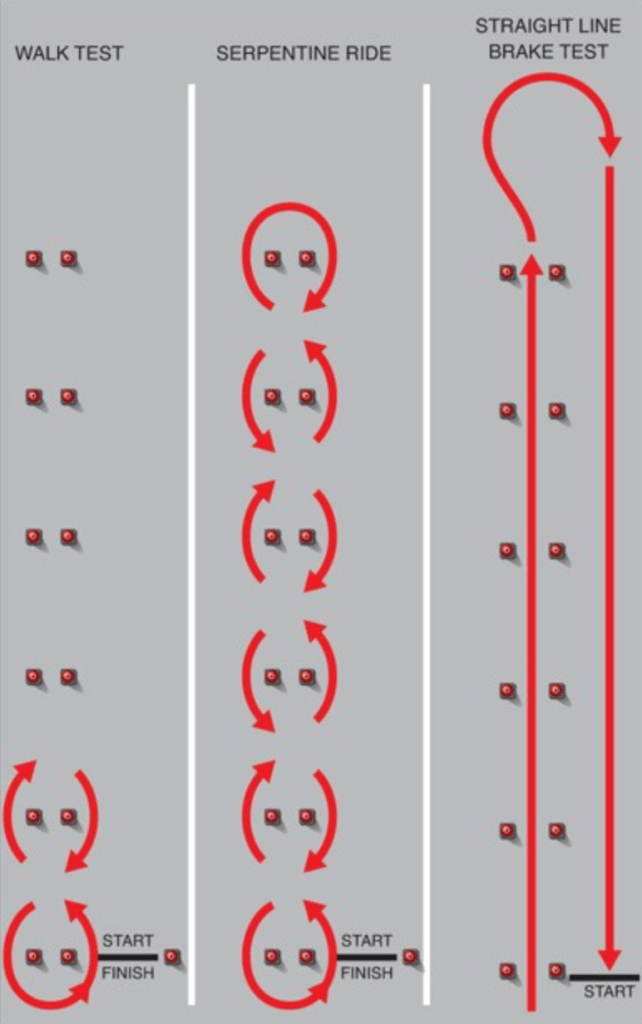
Walk Test
Walk the motorcycle or moped around the cones in a figure eight, preferably with both hands on the handgrips. Without losing control or dropping the vehicle, stop the front wheel on the stop line at the end of the figure eight.
Serpentine Drive
While moving slowly and keeping both feet on the footrests, drive in a serpentine pattern in a controlled manner.
Straight Line Brake Test
While moving slowly and keeping both feet on the footrests, drive in a straight line between the rows of cones. Turn and accelerate in preparation for the brake test. Bring the vehicle to a quick, safe, controlled stop using both brakes evenly with the front wheel on the finish line.
This test is to determine balance and control at low speeds and is meant to be done in one continual motion. If you must put a foot down or you knock a cone over, recover as best you can and continue on.
On-road Driving Demonstration
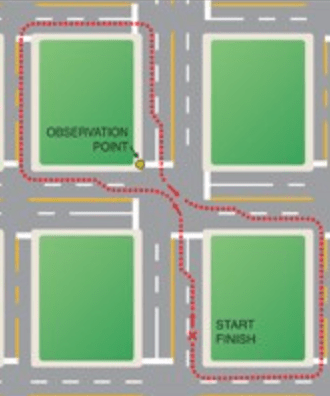
This illustration shows a typical on-road driving route used at DriveTest Centres across the province that give motorcycle tests.
Your examiner will watch your demonstration from a strategic location where the bike can be observed at several intersections. You are expected to obey all the rules of the road, signal all your intentions, maintain a good blocking position, keeping yourself visible to other traffic. You will be marked on your lane positioning, your turning arcs, your use of the vehicle’s controls and your observation of traffic.
Level Two Road Test
The Level Two road test deals with advanced knowledge and skills that are generally gained with driving experience.
When you take the test, the examiner will follow you in another vehicle and talk to you by radio through a disposable earphone. The examiner will give you directions. As you complete the driving tasks, the examiner will watch to make sure you successfully perform the actions associated with them.
To help prepare for the Level Two road test, this chapter tells you the various tasks and actions that you will be expected to perform.
Limited-Speed Motorcycles and Mopeds
If your vehicle is capable of maintaining the posted speed limit of the road, you should use the proper tire-track position. However, if your vehicle cannot maintain the posted speed limit, you may drive as close as safely possible to the right-hand curb or edge of the roadway. You must allow faster vehicles to pass you when it is safe to do so. Where it is dangerous to drive too closely to the curb or edge of the roadway due to grates or other hazards, or if the lane is too narrow to safely allow vehicles to pass you, you may use a blocking position in the lane so that no one can pass you.
Left and Right Turns
The Approach
This driving task begins when the examiner tells you to make a left or right turn and ends at the point just before you enter the intersection. Make sure you take the following actions:
Traffic Check
Before slowing down, look all around you. Use your mirrors to check traffic behind you, and check your blind spot. If you change lanes, remember to check your blind spot.
Lane
Move into the far left or far right lane as soon as the way is clear. If possible, change lanes before you begin to slow down for the turn. Generally, use the left tire track to turn left from a one-lane road and the right tire track to turn left from a two-lane road. A right turn is usually made from the left tire track of the far right lane
Signal
Turn on your signal before slowing down for the turn unless there are vehicles waiting to enter the road from side roads or driveways between you and the intersection. Wait until you have passed these entrances so that drivers will not think you are turning before the intersection.
Speed
Steadily reduce speed as you approach the turn. If your motorcycle has a clutch and gears, downshift into a lower gear as you slow down, but do not rely on downshifting only to slow down. Use both your front and rear brakes. This will also let other drivers know that you are slowing down. Do not drive slower than the speed at which your vehicle is stable (about 15 km/h). At such low speed, the vehicle may weave to keep upright. Even if you are skilled enough to balance the motorcycle without weaving, the low speed leaves you with only minimum control.
Space
While slowing down, keep at least a two- to three-second distance behind the vehicle in front of you.
If stopped
You will need to do this driving task if you cannot complete your turn without stopping, either because the way is not clear or you face a stop sign or red traffic light. Remember to do the following:
- With both front and rear brakes on, come to a complete stop.
- At the point of stopping, put your left foot down while still keeping both brakes on. Do not put your foot down until you can do so without dragging it along the ground.
- Once stopped, do not let your motorcycle or moped roll forward or backward.
- Keep the brake light showing while stopped.
- When traffic conditions allow, move forward to check that the way is clear or to start the turn.
- If you have to stop after you have passed the stop line, do not back up.
Tire Track
Stop in the correct tire track to block other vehicles from pulling up beside you in the lane. Generally, use the left tire track when turning left from a one-lane road and the right tire track when turning left from a two-lane road. A right turn is usually made from the left tire track of the far right lane. When you stop, you may point your motorcycle or moped in the direction of the turn to let other drivers know you are turning and to keep them from pulling up beside you. If you stop behind a large vehicle, make sure the driver can see you through a side mirror.
Space
When stopped behind another vehicle at an intersection, leave enough space to pull out and pass without having to back up — about one motorcycle length. If the vehicle in front is large, leave more space. Leaving this space protects you in three ways: it lets you pull around the vehicle in front if it stalls; it helps prevent you from being pushed into the vehicle ahead of you if you are hit from behind; and it reduces the risk of collision if the vehicle ahead rolls backward or backs up.
Stop Line
If you are the first vehicle approaching an intersection with a red light or stop sign, stop behind the stop line if it is marked on the pavement. If there is no stop line, stop at the crosswalk, marked or not. If there is no crosswalk, stop at the edge of the sidewalk. If there is no sidewalk, stop at the edge of the intersection.
Turning
This driving task involves your actions as you make the turn. Remember to do the following:
Traffic Check
If you are stopped, waiting for a green light or for the way to be clear, keep checking traffic all around you. Just before entering the intersection, look left, ahead and right to check that the way is clear. If there is any doubt about the right-of-way, try to make eye contact with nearby drivers or pedestrians. If it is possible for another vehicle to overtake you while you are turning, check your blind spot before starting to turn. You have not properly checked traffic if another vehicle or pedestrian has the right-of-way and must take action to avoid your vehicle.
Both Feet
Keep both feet on the footrests throughout the turn. Do not walk the motorcycle or moped to ease into or around a turn. You are most at risk from other traffic when turning. Keeping both feet on the footrests gives you maximum control when you need it most.
Gears (if applicable)
Do not shift gears during the turn. An incorrect gear change during a turn can cause the rear wheel to skid. Generally, not changing gears gives you more control and balance over your vehicle when it is turning.
Speed
Move ahead within four to five seconds after it is safe to start. Increase speed enough that the engine does not stall or over-rev. Make the turn at a steady speed, slow enough to keep full control of the motorcycle or moped while turning, but fast enough to keep your balance and not slow down other traffic.
Wide/Short
Turn into the corresponding lane on the intersecting road without going over any lane markings or curbs.
Completing the Turn
This driving task completes the turn. It begins when you enter the intersecting road and ends when you return to normal traffic speed. Take the following actions:
Lane
End your turn in the lane that corresponds to the lane you turned from. Generally, you should end the turn in the left tire track. If you are turning left onto a multi-lane road, return to normal traffic speed and move into the curb lane when it is safe to do so. If you are turning right onto a road where the right lane is blocked with parked vehicles or cannot be used for other reasons, move directly to the next available lane.
Traffic Check
As you return to normal traffic speed, check your mirrors to become aware of the traffic situation on the new road.
Speed
Return to normal traffic speed by accelerating smoothly to blend with the traffic around you. In light traffic, accelerate moderately. In heavier traffic, you may have to accelerate more quickly. If your vehicle is equipped with gears, shift gears as you increase speed.
Cancel Signal
Turn off your signal if it does not work automatically.
Stop Intersection
The approach
This driving task is done at intersections where you must come to a stop. It begins at the point where you can see the intersection and ends just before you enter the intersection. Be sure to follow these actions:
Traffic Check
Before slowing down, look all around you. Check your mirrors and your blind spots.
Speed
Steadily reduce speed as you approach the intersection. Downshift into a lower gear as you slow down, but do not rely on downshifting only to slow down. Use both your front and rear brakes. This will also let other drivers know that you are slowing down. Do not drive slower than the speed at which your motorcycle or moped is stable (about 15 km/h). At such low speed, the motorcycle or moped may weave to keep upright. Even if you are skilled enough to balance the motorcycle without weaving, the low speed leaves you with only minimum control.
Space
While slowing down, keep at least a two- to three-second distance behind the vehicle in front of you.
The Stop
This task includes the actions you take as you drive through the intersection and return to normal traffic speed. Be sure to follow these actions:
Stop
With both front and rear brakes on, come to a complete stop. At the point of stopping, put your left foot down while still keeping both brakes on. Do not put your foot down until you can do so without dragging it along the ground. Once stopped, do not let your motorcycle or moped roll forward or backward. Keep the brake light showing while stopped. When traffic conditions allow, move forward to check that the way is clear or to start across the intersection. If you have to stop after you have passed the stop line, do not back up.
Tire Track
Stop in the correct tire track to block other vehicles from pulling up beside you in the lane. Generally, this will be the same one you used when approaching the intersection. However, if you stop behind a large vehicle, make sure the driver can see you through a side mirror.
Space
When stopped behind another vehicle at an intersection, leave enough space to pull out and pass without having to back up — about one motorcycle length. If the vehicle in front is a large vehicle, leave more space. Leaving this space protects you in three ways: it lets you pull around the vehicle in front if it stalls; it helps prevent you from being pushed into the vehicle ahead of you if you are hit from behind; and it reduces the risk of collision if the vehicle ahead rolls backward or backs up.
Stop Line
If you are the first vehicle approaching an intersection with a red light or stop sign, stop behind the line if it is marked on the pavement. If there is no stop line, stop at the crosswalk, marked or not. If there is no crosswalk, stop at the edge of the sidewalk. If there is no sidewalk, stop at the edge of the intersection. Stop in a position where other vehicles cannot pull up beside you in the lane.
Driving Through
This task includes the actions you take as you drive through the inter-section and return to normal traffic speed. Be sure to follow these actions:
Traffic Check
If you are stopped, waiting for a green light or the way to be clear, keep checking traffic all around you. Just before entering the intersection, look left, ahead and right to check that the way is clear. If there is any doubt about the right-of-way, try to make eye contact with nearby drivers or pedestrians. You have not properly checked traffic if another vehicle or pedestrian has the right-of-way and must take action to avoid your motorcycle.
Gears (if applicable)
Do not shift gears crossing the intersection. If you need to, you may shift gears immediately after your motorcycle is moving, but before it is well into the intersection. You may also shift gears in an intersection wider than four lanes, if not doing so would slow down other traffic. Generally, not changing gears gives you more control over your motorcycle.
Traffic Check
As you return to normal traffic speed, check your mirrors to become aware of the traffic situation after you have gone through the intersection.
Speed
Move ahead within four to five seconds after it is safe to start. Return to normal traffic speed by accelerating smoothly to blend with the traffic around you. In light traffic, accelerate moderately. In heavier traffic, you may have to accelerate more quickly. If your vehicle is equipped with gears, shift gears as you increase speed.
Through Intersection
The Approach
This driving task is done at intersections where you may not need to stop. It begins at the point where you can see the intersection and ends just before the entrance to the intersection. Remember to do the following:
Traffic Check
As you approach the intersection, look left and right for traffic on the intersecting road. If you have to slow down for the intersection, check your mirrors for traffic behind you.
Speed
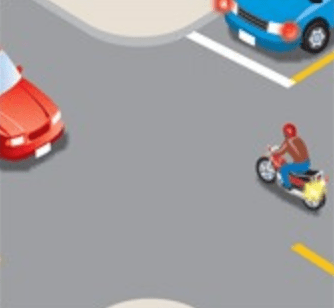
Keep at the same speed as you go through the intersection unless there is a chance traffic may cross the intersection in front of you. If so, slow down and be ready to stop. Watch for pedestrians about to cross the intersection and vehicles edging into the intersection or approaching at higher speeds. Steadily reduce speed as you approach the intersection. Downshift into a lower gear as you slow down, but do not rely on downshifting only to slow down. Use both your front and rear brakes. This will also let other drivers know that you are slowing down. Do not drive slower than the speed at which your motorcycle or moped is stable (about 15 km/h). At such low speed, the motorcycle or moped may weave to keep upright. Even if you are skilled enough to balance the motorcycle or moped without weaving, the low speed leaves you with only minimum control.
Space
Keep at least a two- to three-second distance behind the vehicle in front of you.
Driving Through
This driving task includes your actions from the time you enter the intersection until you have crossed it and are returning to normal traffic speed. Remember these points:
Lane
Do not go over lane markings or change tire tracks in the intersection. If a vehicle turning left or a vehicle edging into the intersection from the right blocks your lane, slow down or stop instead of pulling out to go around the vehicle.
Gears (if applicable)
Do not shift gears crossing the intersection. If you need to, you may shift gears immediately after your motorcycle is moving but before it is well into the intersection. You may also shift gears in an intersection wider than four lanes if not doing so would slow down other traffic. Generally, not changing gears gives you more control over your motorcycle.
Traffic Check
If you slowed down for the intersection, check your mirrors again before returning to normal traffic speed.
Freeway
Entering
This section does not apply when taking the test on a limited-speed motorcycle or moped.
This driving task begins on the entrance ramp to a freeway and ends when you have reached the speed of traffic on the freeway. Remember to do the following:
Traffic Check
While on the ramp, as soon as you can see freeway traffic approaching from behind, check your mirrors and your blind spot for a space to merge safely. At the same time, watch any vehicles in front of you on the ramp and keep back a safe distance. Continue to divide your attention between watching in front, checking your mirrors and looking over your shoulder to check your blind spot until you can merge safely with traffic.
Signal
If you have not done so already, turn on your signal as soon as traffic on the freeway is able to see your motorcycle on the ramp.
Space
Drive in the left tire track. While on the ramp and merging with freeway traffic, keep at least a two- to three second distance behind the vehicle in front of you. If traffic is heavy or moving at such a high speed that it is difficult to keep an ideal following distance, change your speed to get the best spacing possible.
Merge
Merge with freeway traffic in a smooth, gradual movement to the left tire track of the nearest freeway lane.
Cancel Signal
Turn off your signal as soon as you have merged with freeway traffic.
Driving Along
This section does not apply when taking the test on a limited-speed motorcycle or moped.
This driving task checks your actions driving along the freeway but not merging, changing lanes or exiting. Be sure to remember the following points:
Traffic Check
While driving along, keep checking traffic all around you and look in your mirrors every five to 10 seconds.
Speed
Avoid exceeding the speed limit or driving unreasonably slowly. Drive at a steady speed whenever possible. Look ahead to where you are going to be in the next 12 to 15 seconds for dangerous situations or obstacles that you can avoid by changing your speed.
Space
Always keep at least a two- to three second distance behind the vehicle in front of you. If another vehicle follows too closely behind you, give yourself even more room in front or change lanes. Try to keep a space on both sides of your motorcycle and avoid driving in the blind spots of other vehicles. Try not to drive behind large vehicles. Because of their size, they block your view of traffic more than other vehicles. Drive in the correct tire track.
Exiting
This section does not apply when taking the test on a limited-speed motorcycle or moped.
This driving task begins when you are driving in the far right lane of the freeway and can see the exit you want to take. It ends when you reach the end of the exit ramp. Remember to do the following:
Traffic Check
Before moving into the exit lane, look left and right and check your mirrors. If there is a lane of traffic on your right, such as an acceleration lane from an entrance ramp, or a paved shoulder, remember also to check your right blind spot.
Signal
Turn on your signal before you reach the exit lane.
Exit lane
Enter the exit lane at the beginning of the lane with a smooth, gradual movement. Drive in the left tire track and stay inside the lane markings.
Speed
Do not slow down before you are completely in the exit lane. Once you are in the lane, gradually slow down without causing traffic to pile up behind you. Use both your front and rear brakes to slow down. This will let other drivers know that you are slowing down. Downshift as you reduce speed.
Space
Keep at least a two- to three-second distance behind the vehicle in front of you.
Cancel Signal
Turn off your signal once you are on the exit ramp.
Lane Change
This driving task begins as you look for a space to change lanes and ends when you have completed the lane change. Remember to follow these actions:
Traffic Check
While waiting to change lanes safely, look all around you. Divide your attention between watching in front, watching the mirrors, and checking your blind spot. If there is another lane beside the one you are moving into, check traffic in that lane to avoid colliding with a vehicle moving into the lane at the same time as you.
Signal
Turn on your signal when there is enough space for you to change lanes. After signalling, check your blind spot one more time before starting to move into the other lane. Your signal should be on soon enough to give traffic behind you time to react to the signal. If traffic in the lane you are moving into is heavy, you may turn on your signal before there is enough space to change lanes. This will let traffic behind you know that you are looking for a space to change lanes.
Space
Keep at least a two- to three-second distance behind the vehicle in front of you. If there is another lane beside the one you are moving into, be careful not to move in beside another vehicle or into the blind spot of another vehicle.
Change Lanes
Change lanes with a smooth, gradual movement into the new lane. Drive in the tire track that gives you the most space between vehicles in the lanes beside you.
Cancel Signal
Turn off your signal as soon as you have changed lanes.
Roadside Stop
The approach
This driving task begins when the examiner tells you to stop and ends once you have come to a stop. Make sure you take these actions:
Traffic Check
Before slowing down, check traffic in front and use your mirrors to check for traffic behind you. If there is a chance of traffic or pedestrians overtaking you on the right, check your right blind spot just before pulling over.
Signal
Turn on your signal before slowing down unless there are vehicles waiting to enter the road from sideroads or driveways between you and the point where you intend to stop. Wait until you have passed these entrances, so that drivers will not think you are turning before the stopping point.
Speed
Steadily reduce speed as you approach the stop. If your motorcycle is equipped with a clutch and gears, downshift into a lower gear as you slow down, but do not rely on downshifting only to slow down. Use both your front and rear brakes. This will also let other drivers know that you are slowing down. Come to a stop without weaving.
Position
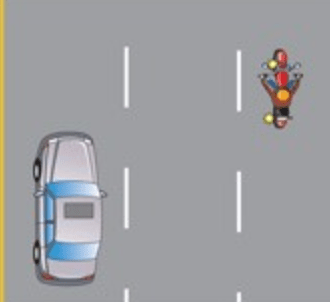
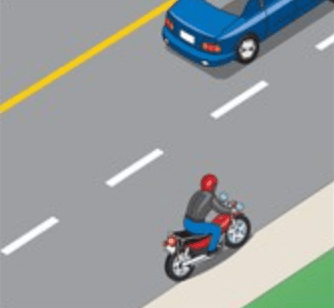
Stop as far as possible off the travelled part of the road. Do not stop where you will block an entrance or other traffic.
The Stop
This driving task includes the actions you take after stopping. Remember to do the following:
Signal
If your motorcycle or moped has four-way flashers, turn off your signal and turn on the four-way flashers.
Park
Depending on the parking surface, position your motorcycle or moped so it will be stable when the kick stand is down. Shift into neutral, or turn off the engine. Put the kick stand down.
Resume
This driving task begins when the examiner tells you to move back onto the road and ends when you have returned to normal traffic speed. Take the following actions:
Start
Holding the motorcycle or moped steady, put the kickstand up and start the engine, if necessary.
Signal
Turn off your four-way flashers and turn on your left signal.
Traffic Check
Just before pulling away from the stop, check your mirrors and your left blind spot.
Speed
Return to normal traffic speed by accelerating smoothly to blend with the traffic around you. In light traffic, accelerate moderately.
In heavier traffic, you may have to accelerate more quickly. If your vehicle is equipped with gears, shift gears as you increase speed. Drive in the left tire track.
Cancel Signal
Turn off your signal as soon as you are back on the road.
Curve
This driving task begins when the curve comes into sight and ends when you have gone completely around it. Follow these actions:
Speed
As you approach, try to determine the safe speed for the curve. To do this, look for clues such as a sign that shows the safe speed, the shape of the curve and the type of road you are driving on. Enter the curve at a safe speed. In a blind curve where you cannot see all the way around it, drive more slowly in case oncoming traffic wanders into your lane, or the curve is tighter than you expected. If your motorcycle has gears and you need to downshift, do so before entering the curve; do not shift gears in the curve. Not changing gears gives you more control over your motorcycle and reduces the risk of your wheels locking while downshifting. While in the curve, drive at a speed that balances the forces created by turning on the curve. Near the end of the curve, begin accelerating to return to normal speed.
Lane
As you enter the curve, look as far around it as possible. This helps you stay in a smooth line around the curve. If you look only at the road directly in front of you, you are likely to wander back and forth across the lane, constantly correcting your steering. On a curve with a short sight distance, drive in the tire track where you can see more of the road ahead. If the curve is to the left, use the right tire track. If the curve is to the right, keep as far left as possible while watching for oncoming traffic that might be cutting the curve short. You may also change tire tracks in order to drive through a more gradual curve than if you followed the full curve of the road.
Business Section
This driving task is done on straight sections of road where a number of businesses are located. Be sure to do the following actions:
Traffic Check
In a business area, there are many places other than intersections where vehicles or pedestrians are likely to enter the road. These include entrances to businesses, institutions and construction sites, as well as pedestrian and railway crossings. At these and any other locations, look left and right to check for vehicles or pedestrians about to enter the road.
Mirror Check
While driving along, check your mirrors every five to 10 seconds. Check your mirrors more often in heavy traffic or where vehicles are moving at different speeds.
Lane
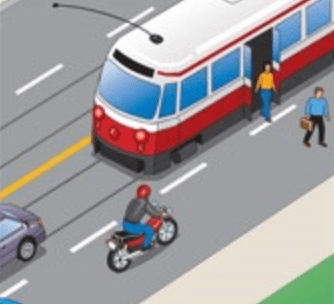
Drive in the safest lane for through traffic. This is usually the curb lane. However, if the curb lane is blocked by traffic or there are many curbside hazards, the centre lane may be a safer choice. Drive in the best tire track for traffic conditions. Usually, this is the left tire track in the curb lane and the right tire track in the centre lane. Stay within the lane markings. Look ahead to where you will be in the next 12 to 15 seconds for dangerous situations or obstacles that you can avoid by changing lanes.
Speed
Avoid exceeding the speed limit or driving unreasonably slowly. Whenever possible, drive at a steady speed. Look ahead to where you will be in the next 12 to 15 seconds for dangerous situations or obstacles that you can avoid by changing your speed.
Space
Keep at least a two- to three-second distance behind the vehicle in front of you. Increase the distance if another vehicle follows too closely behind you. On a multi-lane road, try to keep a space on both sides of your motorcycle or moped, and try not to drive in the blind spots of other vehicles. In slow traffic, avoid driving behind large vehicles that block your view of traffic ahead of you. When you stop behind another vehicle, stay back at least a motorcycle length.
Residential Section
This driving task is done on straight sections of residential or rural road. Remember these points:
Traffic Check
On a residential road, watch out for entrances to schools, pedestrian crossings, driveways, sidewalks and any other locations where there might be traffic hazards. On rural roads, watch out for entrances to residences, farms, businesses and industrial sites. At all these locations, look left and right to check for vehicles or pedestrians about to enter the road.
Mirror Check
While driving along, check your mirrors every five to 10 seconds. Check your mirrors more often in heavy traffic or where vehicles are moving at different speeds.
Lane
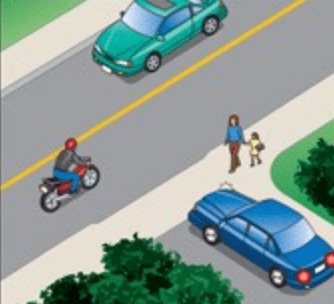
Generally, drive in the left tire track. If there are no lane markings, stay on the travelled part of the road. On a wide residential street, stay toward the centre of the road away from parked vehicles or pedestrians. Where you cannot see far ahead on the road because of a curve or a hill, drive in a tire track that will keep you from colliding with an oncoming vehicle that is over the centre line. Look ahead to where you will be in the next 12 to 15 seconds for dangerous situations or obstacles that you can avoid by changing lanes.
Speed
Avoid exceeding the speed limit or driving unreasonably slowly. Whenever possible, drive at a steady speed. Look ahead to where you will be in the next 12 to 15 seconds for dangerous situations or obstacles that you can avoid by changing your speed.
Space
Keep at least a two- to three-second distance behind the vehicle in front of you. Increase the distance if another vehicle follows too closely behind you. In slow traffic, avoid driving behind large vehicles that block your view of traffic ahead of you. When you stop behind another vehicle, stay behind at least one motorcycle length.
Conversion Chart
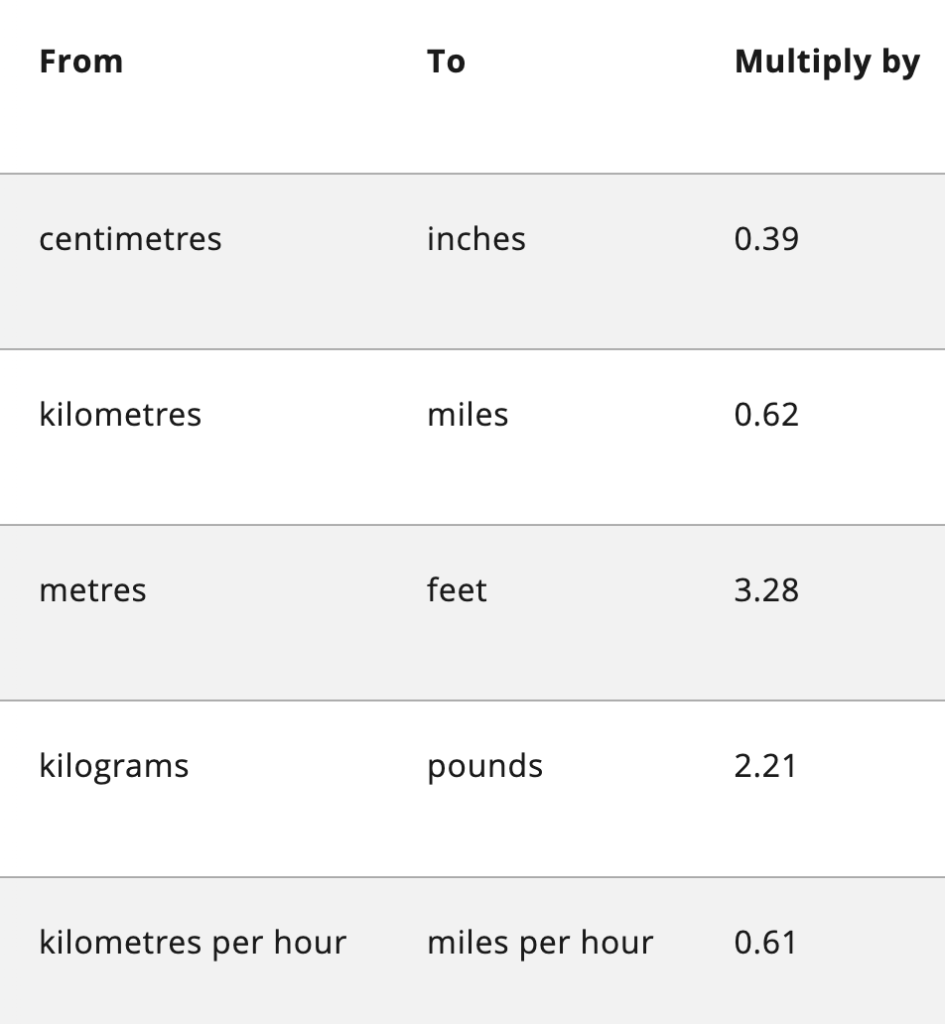
Imperial to Metric Converter

Metric to Imperial Converter
 Apperture Labs