Driving Defensively
Driving a motorcycle or moped in traffic is more dangerous than driving a car or truck. That is why it is so important to learn the basic skills of driving before you attempt driving in traffic. When driving in traffic, you will need to focus all your attention on what you are seeing and hearing, and then judging what is going to happen next.
This chapter tells you about the most important principles of safe and responsible driving. These include seeing and being seen; clearly communicating with other drivers; keeping a cushion of space around your motorcycle for safety; and positioning yourself in the best possible spot on the road. Together these strategies are the basis for what is called defensive driving or strategic driving.
Visibility
Seeing
The best way to avoid trouble is to see it coming. Skilled drivers have very few surprises on the road because they see and understand possible problems before getting to them. Learn to look far ahead of where you are driving. In the city, look one-half to one full block ahead. On the freeway, look as far ahead as you can see. Looking well ahead gives you time to adjust to problems. It also helps you to avoid panic stops or sudden swerves that can cause even more trouble.
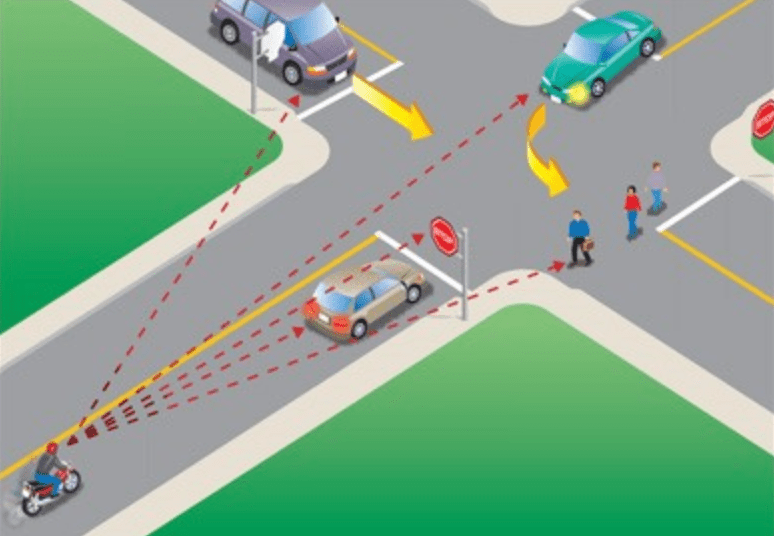
Follow these steps to develop driver awareness:
- Keep your eyes constantly moving and scanning the road ahead, beside and behind. Do not look at one place for more than two seconds; trouble could be developing while you are not looking.
- Look ahead as far as you can see. Look beyond the vehicle in front of you for others that are stopping or turning ahead.
- Check the roadside. Watch for vehicles that may leave the curb or enter from side streets or driveways.
Sometimes you cannot see an area because a bridge or truck blocks your view. Good drivers have good imaginations. Ask yourself what might be there that you cannot see yet. Remember, what you cannot see can hurt you.
When looking ahead and scanning the road, check the surface of the road for slippery spots, bumps, broken pavement, loose gravel, wet leaves or objects lying in the road. When driving in winter, be alert for ice and snow patches. Learn to see these spots well ahead so you do not have to look down at the road surface.
In some situations, you can put your motorcycle in a position to see things that other drivers cannot. For example, in a blind curve, where you cannot see all the way around, move to the side of the lane where you can see as much as possible of the road ahead.

At blind intersections, after stopping, ease forward past obstructions to see if anything is coming.
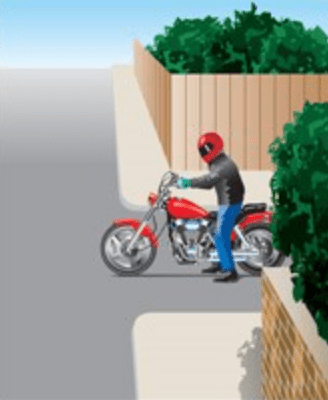
When you are parked or stopped at the side of the road and want to join traffic, angle your motorcycle across the road so that you can see in both directions.

Check your Mirrors
Check your mirrors every five to seven seconds to keep track of traffic coming up behind you. You should have a good picture in your mind of what is behind so someone passing you will not surprise you. You also need to know in order to stop quickly or swerve if necessary.
It is especially important to check your mirrors in the following situations:
- Before you have to slow down or stop suddenly or when you are stopped at an intersection. If the driver behind you is not paying attention, she or he may be dangerously close before noticing you are there. Be prepared to get out of the way.
- Before you make a turn. Check vehicles behind you when you plan to slow down and turn. Remember to use your brake lights to signal that you are slowing down. (Gearing down does not activate your brake lights.) If drivers behind you do not appear to be aware that you are turning, it may be safer to continue going straight.
- Before you change lanes. Make sure no one is trying to pass you.
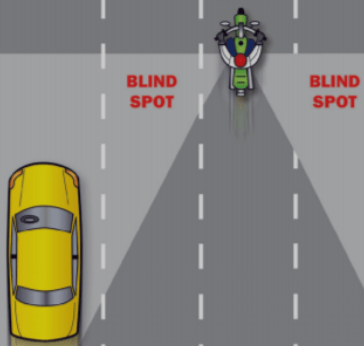
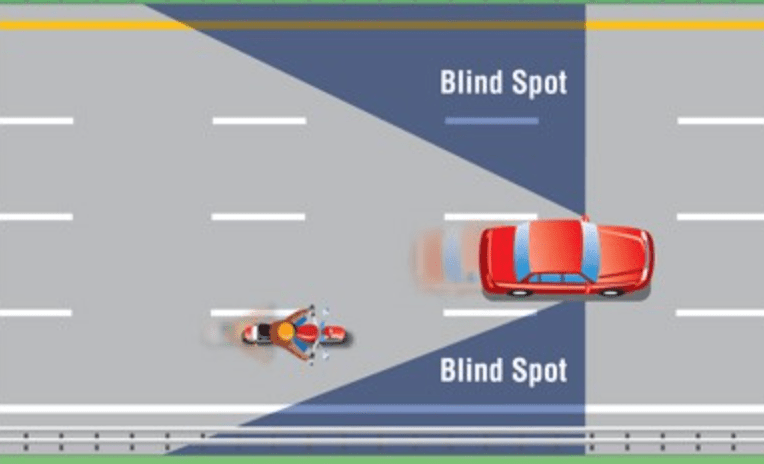
Remember that mirrors do not give the whole traffic picture. There is an area on each side of your motorcycle or moped that you cannot see in your mirror. You may not see people or vehicles when they are in these blind spots. Always turn your head and check over your shoulder before you turn or change lanes.
Being Seen
You cannot assume that other drivers see you. Drivers who have collided with motorcycles often say they did not see the motorcycle until it was too late.
A motorcycle or moped is more difficult to see than other vehicles. Your profile is smaller from most angles. Even if you are seen, your speed or distance from other vehicles may be misjudged. If a driver does not see you, she or he may pull out or turn in front of you or cut you off. Always ask yourself if the other driver sees you.
Even when other drivers see you, you may be hit if they misjudge your speed, are aggressive or impaired, or just careless. Be alert and try to anticipate what other drivers are likely to do.
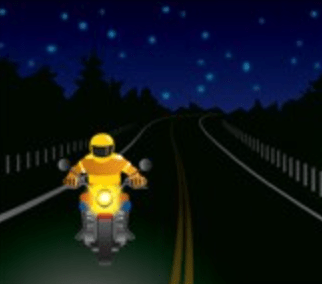
While your motorcycle or moped’s headlight(s) and tail light(s) help to make you visible, there are a number of other things you can do to increase your visibility:
- Wear brightly coloured clothing and helmet. This will help make you more visible during the day, especially from angles where your headlight cannot be seen. Yellow, orange, red and other bright colours are highly visible. Black and dark colours are not. Think about wearing a reflective vest, especially at night. Consider adding reflective tape to your helmet, clothing and vehicle. In the rain, wear reflective rainwear.
- Slow down when driving at night in front of a group of vehicles. When you are driving in traffic with other headlights behind you, a driver ahead may not be able to pick out your single light from all the lights behind you. This problem is especially bad when the roads are wet because of lights reflecting off the road surface.
- Think about your lane position. Sometimes you can make yourself more visible by moving from one side of the lane to the other or by changing lanes when appropriate.
Do not drive in another driver’s blind spot, and do not let another vehicle drive in your blind spot. Drop back or pass the other driver. When you pass another vehicle, get through the blind spot as soon as you can. Approach cautiously but, once you are alongside, get by quickly. As a general rule, if you can see a driver in his or her mirror, the driver can see you.
Being Seen at Intersections
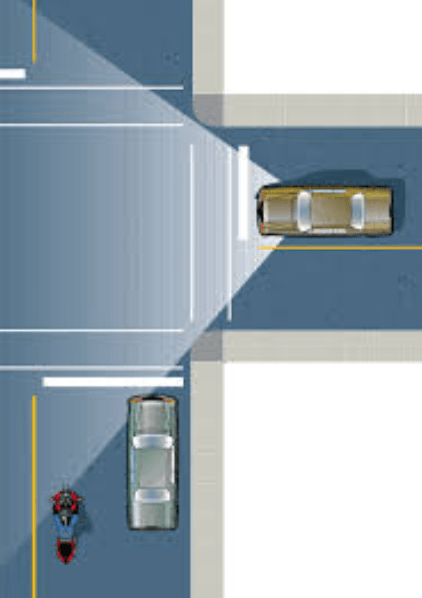
Most collisions between motorcycles or mopeds and other vehicles happen at intersections. The two leading causes of these collisions are: 1) drivers often have a hard time seeing a motorcycle or moped coming toward them; and 2) a vehicle may make a left turn across your path or pull out from a side street. To cut down your chances of being hit, follow these steps:
- Approach slowly. If a driver does pull out suddenly, your chances of making a quick stop or a quick turn are better if you are going slowly.
- Move as far away as you can from the other vehicle. If the vehicle is on your right, move to the left. For a vehicle on your left or an oncoming vehicle with a left-turn signal on, move to the right.
- Move away from things that could block the other driver’s view. When you approach an intersection with a vehicle waiting to pull out, move toward the centre of the road so that you are in the other driver’s line of sight.
Summary
By the end of this section you should know:
- How and where to look when you are driving along
- How to use your mirrors to see behind you in a variety of situations
- How to make yourself more visible to other road users
Communicating with other Drivers
In addition to seeing and being seen, it is important to communicate with other drivers to make sure they see you and know what you are doing. Make eye contact with other drivers. Check over your shoulder often to make sure other drivers are not crowding you.
Be ready to use your horn, if necessary, before you pass a vehicle, or approach a driveway or intersection where a vehicle may pull out in front of you. You can use your horn before passing a vehicle you think might move into your lane. Watch for situations such as a driver in the lane next to you coming up behind a vehicle; a parked car with someone in it; or someone walking or riding a bicycle on the road.
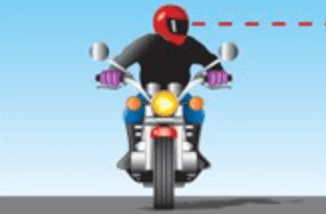
Use your signals to communicate. A driver behind you is more likely to understand your turn signal than your tail light. Use your turn signals even when what you plan to do is obvious. For example, if you use your signals on a freeway entrance ramp, it is more likely that vehicles on the freeway will see you and make room for you. Also, signal whenever you change lanes whether someone else is around or not. It is when you do not see the other vehicle that your signals are most important.
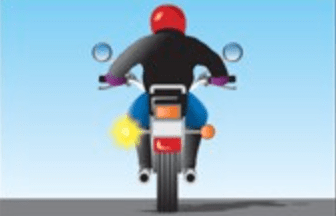
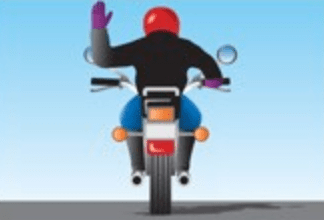
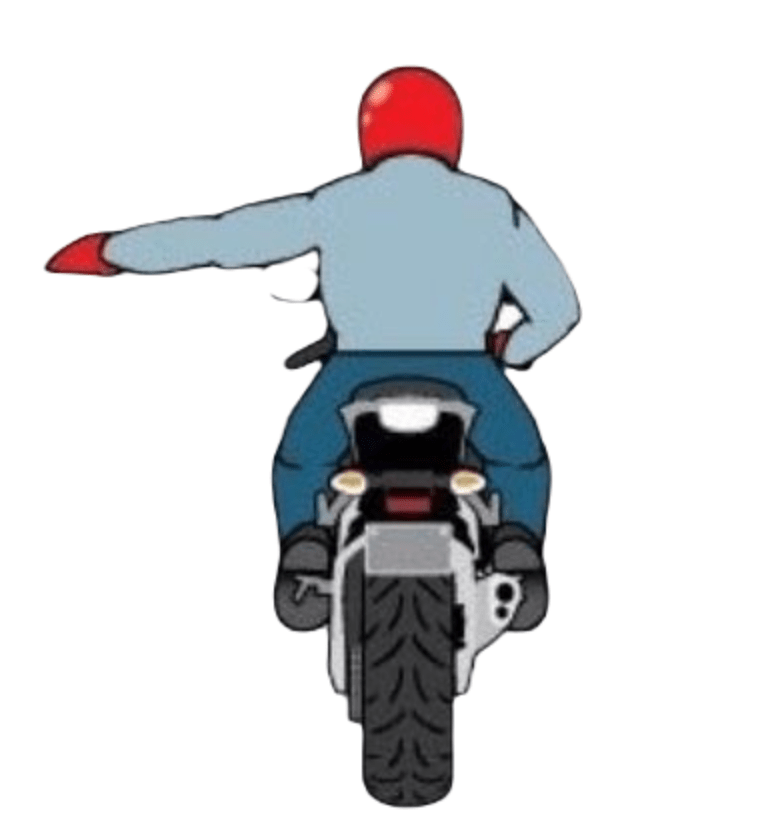
Remember to turn off your signal after you have completed your turn or lane change. It can be as dangerous to forget to turn a signal off as it is to forget to turn it on. A driver may think that you plan to turn or make a lane change. Check your instrument panel to see if you have left a signal on. If you have an older model vehicle that did not come with turn signals, use the standard hand and arm signals as shown in the diagrams here. This also applies if your turn signals or brake lights are not working, in which case you should proceed to take your vehicle off the road until repairs can be made. Manual hand and arm signals are less effective during poor light conditions and may not be visible to others. Exercise extra caution if your turn signals and brake lights are not working.
When watching for signals made by others, remember that cyclists may signal right turns by holding their right arm straight out.
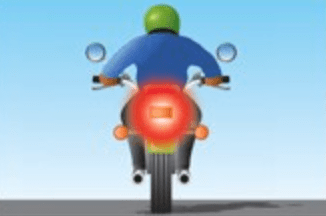
Tap the brake pedal lightly to flash your brake light before you slow down. This warns drivers behind you that you are going to slow down. This is especially important when you are being followed too closely, when you are making a tight turn off a high-speed road, or when you are slowing down or turning where others may not expect it. Also, keep your foot on the brake, day or night, when stopped for a stop sign or traffic signal.
Turn Left
Turn Right
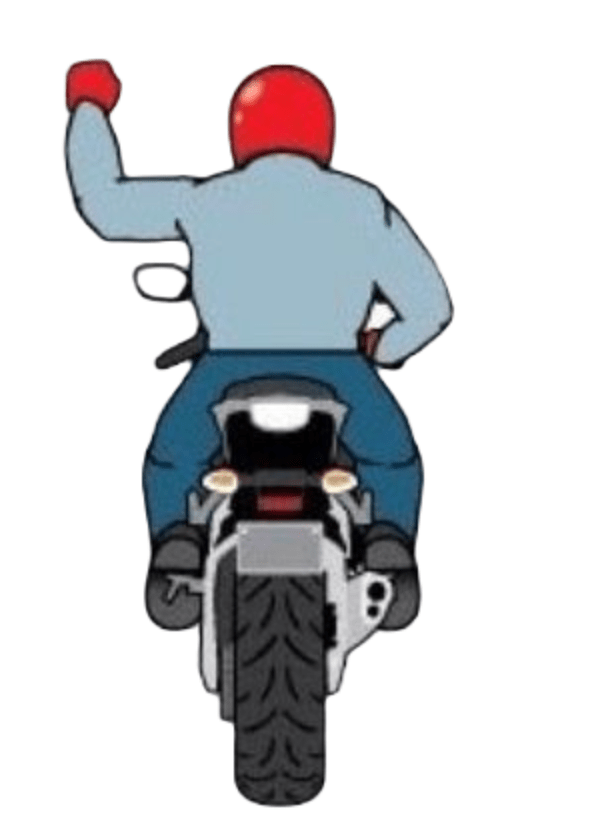
Stop
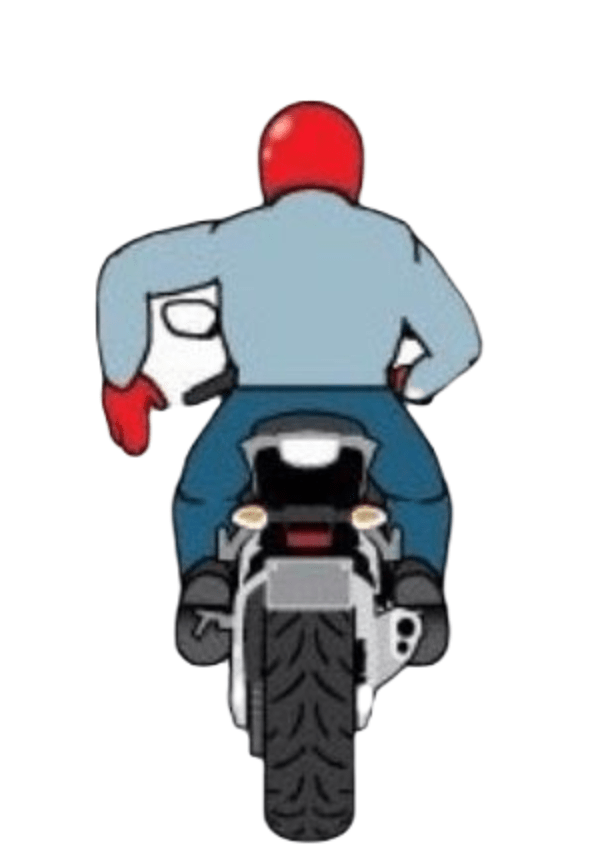
Summary
By the end of this section, you should know:
- How to use eye contact and your horn to communicate with other road users
- How to use signals and brake lights to communicate your intentions to other road users
Keeping a Cushion of Space Around you
The best protection you have as a motorcycle or moped driver is distance between you and other drivers. Distance gives you time to react to trouble and find some place to move if necessary.
Always leave a cushion of space around your vehicle to let other drivers see you and to avoid a collision. Keep alert for all other traffic, including vehicles in front, behind, coming toward you and approaching from the side, as well as those you are passing and any that are passing you.
It is important to remember that motorcycles and mopeds, because they weigh less than most other vehicles on the road, are able to stop and accelerate faster than other vehicles. Keep in mind when deciding how much space to leave around you that other drivers may need much more space to stop than you do.
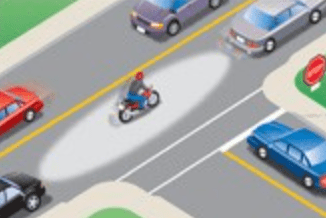
Distance in Front
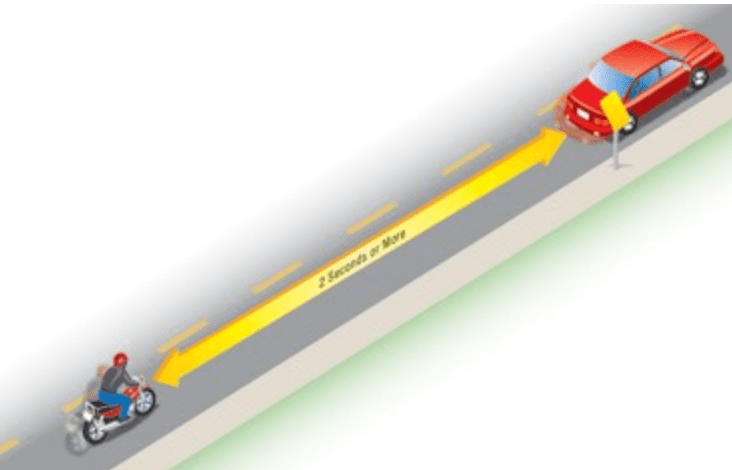
Always keep at least a two-second distance behind the vehicle in front of you. This gives you time to react if something happens ahead. It also gives you a better view of things in the road, such as potholes, slippery spots, chunks of tire tread or debris. If conditions are less than ideal, such as in bad weather, leave even more space. To give yourself at least a two-second space, follow these steps:
- Pick a marker on the road ahead, such as a road sign or hydro pole.
- When the rear of the vehicle ahead passes the marker, count “one thousand and one, one thousand and two.”
- When you reach the marker, stop counting. If you reach the marker before you count “one thousand and two,” you are following too closely.
When you stop behind another vehicle, leave enough space to pull out and pass without having to back up about one motorcycle length. If the vehicle in front is large, leave more space. Leaving this space protects you in three ways: it lets you pull around the vehicle in front if it stalls; it helps prevent you from being pushed into the vehicle ahead if you are hit from behind; and it reduces the risk of collision if the vehicle ahead rolls backward or backs up.
Distance to the Side
On a motorcycle or moped, you have the ability to change your position within the lane to increase your distance from other vehicles. You should do this as traffic conditions change.
Try to keep a space on both sides of your vehicle. Do not drive beside other vehicles if you can avoid it. A vehicle in the next lane could move into your lane without warning. Vehicles in the next lane also block your escape if you run into danger in your lane. Drop back or speed up until you find a place that is clear on both sides. Avoid driving in other drivers’ blind spots.
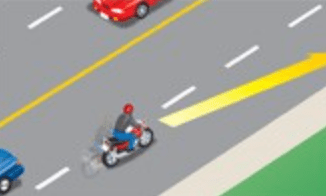
The following are some of the conditions that require changes in lane position:
- Passing vehicles: When you are being passed by an oncoming vehicle or from behind, move toward the centre of the lane. Avoid being closer to a passing vehicle than you have to be; a slight mistake by either driver could cause a sideswipe.
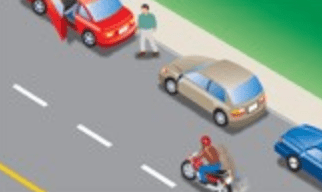
- Parked vehicles: By staying to the left side of the lane, you can avoid the dangers of opening doors, drivers getting out of vehicles or people stepping from between vehicles.
- Vehicles pulling out: When pulling out into traffic, other drivers often take a quick look behind them and fail to see a motorcycle or moped. Vehicles making U-turns are a particular danger. If you see a vehicle pulling out, approach with caution.
Distance Behind
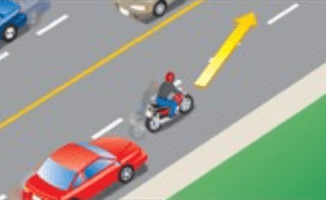
Many drivers complain about “tailgaters” — people who follow others too closely. If someone is following you too closely, change lanes and let the tailgater pass. If a driver still follows you too closely, increase the distance between you and the vehicle ahead. This gives you and the tailgater more time to react in an emergency. Then, when the way is clear to pass safely, slow down so the tailgater can pass.
Sharing the Load with Large Vehicles
It is very important to know how to safely share the road with large vehicles such as tractor-trailers and buses. Keep the following factors in mind:
Blind Spots
Large vehicles have large blind spots on both sides. Avoid following too closely behind a large vehicle. Not only does it block your vision, but the driver of the large vehicle will not be able to see you back there. If the vehicle has to stop suddenly, you might crash into it. Remember that, if you can’t see the driver’s face in his or her side-view mirror, the driver probably can’t see you.
Stopping Distance
Many drivers do not realize that large vehicles require a much longer distance to stop than smaller vehicles. When passing a large vehicle, do not cut in front too closely. Not only is it discourteous, it is dangerous because it reduces the space cushion the large vehicle needs in order to stop safely if the need arises. When you are passing a large vehicle, make allowances for this longer stopping distance.
Wide Turns
When making a right turn, a large vehicle may need to first swing wide to the left and then back around to the right in order to avoid hitting the right curb. If a large vehicle in front of you is making a right turn, do not move up into the space that opens up in the right lane; you are putting yourself into a very dangerous position. Once the front of the large vehicle has cleared the corner, the rest will move partially back into the right lane. If you are in that lane, your vehicle will be squeezed between the large vehicle and the curb. Instead, stay well back until the truck has completely cleared the lane. This situation can also occur on expressway off-ramps that have two left-turning lanes. Do not drive up into the left lane when a large vehicle is making a left turn in front of you. Stay well back until the truck has cleared the turn, or else you may get squeezed between the truck and the curb.
Rolling Back
Leave plenty of room when you are stopped behind a large vehicle. When the driver of a large vehicle releases the brakes after being stopped, the large vehicle may roll back.
Spray
In bad weather, large vehicles are capable of spraying up large amounts of mud, snow, and debris, which could hit your face shield and block your vision, or even worse, cause you to lose control of your vehicle. Stay well back from large vehicles in bad weather.
Turbulence
Passing a large vehicle on a motorcycle or moped is difficult and can be dangerous. Due to various factors such as air pressure and airflow, a large vehicle can create heavy turbulence that can seriously affect your ability to control your vehicle when you are passing the larger one. If you must pass a large vehicle, try to relax and work with the air turbulence. After you pass through the first blast of turbulent air coming off the back of the truck, you will feel a stream of air either pulling you toward the truck or pushing you away from it, depending on wind direction. Lean away from the truck if the wind is pulling you toward it, or lean toward the truck if you are being pushed away. More turbulence will be waiting for you coming off the front of the truck. Lean into this wind as you pass in front of the truck.
Sharing the Road with Municipal Buses
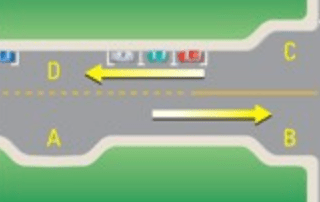
Many municipal roadways have special indented stopping areas for municipal buses, called bus bays, where passengers can get on and off in safety. There are three types of bus bays:
- Mid-block indented bay
- Indentations immediately before and after intersections
- Bus-stop areas between two designated parking areas
When a bus in a bus bay begins flashing its left-turn signals, indicating that it is ready to leave the bus bay, and you are approaching in the lane adjacent to the bus bay, you must allow the bus to re-enter traffic. Yielding the right-of-way to buses in this situation is the law.
- Mid-block indented bays
- An indentation before an intersection
- An indentation after an intersection
- Bus stops between legally parked cars
Summary
By the end of this section, you should know:
- The importance of maintaining space between yourself and other road users
- How to measure following distance while driving
- Situations where you can change your position within your driving lane to increase the distance between yourself and other road users
- How to deal with tailgaters
- Special considerations when sharing the road with larger vehicles
Positioning
Lane position
On a motorcycle or moped, you do not have the protection of a vehicle around you, so you have to make your own protection. To do this, you need to position your vehicle in the best possible spot on the road.
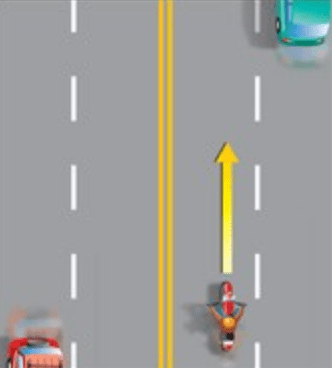
Depending on traffic and road conditions, the best position in the lane is usually a little to the left or right of the centre of the lane, in the track where the tires of a four-wheeled vehicle would travel. This spot is referred to as the left or right “tire track.” It is considered the best position for keeping a safe distance from other vehicles, for seeing and being seen, and for the smoothest road surface with the best traction. It is also called the “blocking position” because it blocks or discourages other drivers from trying to squeeze past you in the same lane.
Limited-Speed Motorcycles and Mopeds
If your vehicle is capable of maintaining the posted speed limit of the road, you should use the proper tire track position. However, if your vehicle cannot maintain the posted speed limit, you may drive as close as safely possible to the right-hand curb or edge of the roadway. You must allow faster vehicles to pass you when it is safe and practical to do so. Where it is dangerous to drive too close to the curb or edge of the roadway due to grates or other hazards, or if the lane is too narrow to safely allow vehicles to pass you, you may use a blocking position in the lane so that no one can pass you.
Wrong Position
The centre of the lane is not a good driving position because it is coated with oil from other vehicles and gets slippery when wet.
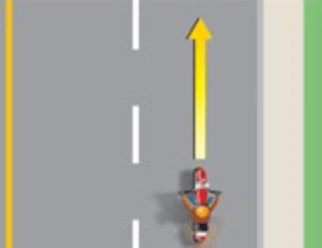
Curb lane
In the right lane of a two-lane road, you should be slightly to the left of the centre of the lane in the left tire track. This position provides good visibility and blocks other vehicles from pulling up beside you in the lane.
Passing Lane
In the passing lane, you should be slightly to the right of the centre of the lane in the right tire track. This provides good visibility and blocks other vehicles from driving beside you in the lane.
Centre Lane
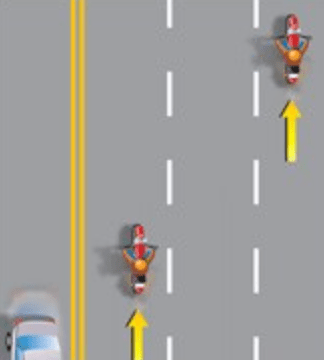
On a freeway with three or more lanes, do not drive in the centre lane, if possible, because you do not have a blocking position.
Right Turn — Same-Size Lane
Approaching an intersection where the curb lane remains the same size, stay in the normal blocking position (left tire track). Some motorcycle drivers angle their motorcycles across the lane (45 degrees) to create a larger blocking position and to make themselves more visible to drivers behind them. Make your turn and move to the correct lane position after completing the turn.
Right Turn — Wider Lane
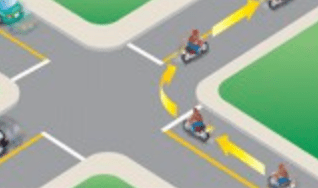
Making a right turn is more complicated when approaching an intersection where the lane opens up. Because the stop line is farther out, you must move over from your normal blocking position (left tire track) to prevent another vehicle from coming up on the inside on the wider part of the road. Check over your shoulder and move over to the right tire track. Again, you may want to angle your vehicle across the lane to make yourself more visible and to keep other vehicles from pulling up beside you. Make your right turn and then make another shoulder check if necessary and move back to the proper blocking position (left tire track).
Left Turn — from Curb Lane to Curb Lane
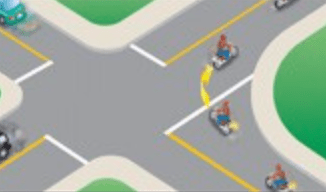
From the curb lane, make your turn, keeping your blocking position (left tire track) throughout the turn.
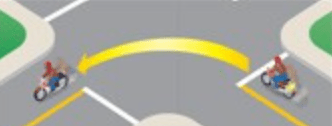
Left Turn — from Passing Lane to Passing Lane
From the passing lane, make your turn, keeping your blocking position (right tire track) throughout the turn.

Changing Lanes
Weaving in and out of heavy traffic is dangerous and is usually done by inexperienced or aggressive drivers. When you are travelling in heavy traffic, stay in the same lane as much as possible.
When you have to change lanes, check your mirrors to make sure there is no traffic overtaking you. If it is safe, signal, check your mirror again and then turn your head and check over your shoulder before changing lanes. Checking over your shoulder is the only sure way to see a vehicle behind you in the next lane. This is particularly important, because there is little chance a driver in the next lane can react quickly enough to avoid you once you have started to change lanes.
On a road with several lanes, check the far lanes as well as the one next to you. Another driver may be headed for the same space you are.
Lane Sharing
Unless your vehicle cannot maintain the posted speed limit of the road and you are driving close to right curb or edge of the roadway, you should not share your lane with other vehicles. The best way to avoid lane sharing is to keep your blocking position, especially in situations where other drivers might be tempted to squeeze by you. This is most likely to happen in the following situations:
- Heavy bumper-to-bumper traffic
- When you are preparing to turn at an intersection
- When you are entering an exit lane or leaving the freeway
- When another driver wants to pass you
Lane Splitting
In heavy traffic, some motorcycle and moped drivers try “lane splitting” by driving on the line between lanes of traffic. This is extremely dangerous. Do not do it. It puts you too close to other vehicles. Other drivers do not expect a vehicle to be in that space. Just a small movement, such as a vehicle starting to change lanes or a door opening, can cause a collision because there is no place else for you to go.
Passing on the Shoulder
The only time you may drive on the right shoulder of the road is to pass a vehicle turning left, and then only if the shoulder is paved. You may not pass on the left shoulder, whether it is paved or not.
Summary
By the end of this section, you should know:
- The concept of using tire track/block position to drive in the safest possible position on the road
- Various scenarios when you would use different lane positioning
- Which lane position you should use in various turns
- The danger of lane sharing, lane splitting and passing on the shoulder
 Apperture Labs