Abrasions
- Watch for the tattooing effect (embedding debris in the skin).
- Debridement should be done within 6-8 hours.
- Betadine is an option but must be thoroughly rinsed with normal saline (NS) or sterile water.
Amputations – Prioritize ABCs!
- Viability without cooling:
- Digits: Up to 12 hours.
- Other limbs: Up to 6 hours.
- With cooling:
- Digits: Can last 24 hours.
- Proximal to wrist: Up to 12 hours.
- Key considerations: Can the patient rehabilitate? (Decision between reattachment or full amputation.)
- Treatment: Splint, elevate, irrigate using only NS.
Avulsion Injuries
- Cannot approximate wound edges—requires a moist NS dressing.
- May need surgical intervention for repair.
Carpal Tunnel Syndrome – Median Nerve Involvement
- Tinel’s Sign: Tapping the wrist reproduces symptoms.
- Phalen’s Test: Pressing the backs of hands together in maximum wrist flexion elicits symptoms.
Compartment Syndrome
- Fascial layers do not stretch with swelling, leading to circulatory compromise.
- Can result in rhabdomyolysis.
- Fasciotomy is the last resort.
- Key symptom: Pain disproportionate to the injury.
Sprains (Ligament Injury)
(Tip: Both “sprain” and “ligament” have letters that extend below the baseline!)
- Grade 1: Stretching of ligament fibers.
- Grade 2: Partial tear, but the joint remains stable.
- Grade 3: Complete tear, resulting in joint instability.
Muscle Strain
- Injury to muscle fibers due to overstretching or excessive force.
Suture Removal Guidelines
- Joints: 14 days
- Trunk: 7 days
- Extremities: 8-10 days
- Face: 3-4 days
- Scalp: 5-8 days
- Staples are preferred in non-visible areas to minimize cosmetic concerns.
Volkmann’s Ischemic Contracture
- Irreversible flexion deformity of the hand and wrist, giving a claw-like appearance.
- Commonly linked to supracondylar humerus fractures due to compromised circulation.
Types of Fractures
Basic Classifications:
- Open (Compound): Bone breaks through the skin.
- Closed (Simple): Bone is fractured, but skin remains intact.
Specific Fracture Patterns:
- Greenstick: Incomplete break; one side of the bone bends.
- Transverse: Straight-line fracture across the bone.
- Spiral: Twists around the bone; often from rotational injuries.
- Oblique: Diagonal break across the bone.
- Compression: Bone is crushed, appearing wider or flatter.
- Comminuted: Bone shatters into three or more fragments.
- Segmental: Bone breaks in two places, leaving a detached “floating” section.
Notable Named Fractures:
- Monteggia Fracture: Proximal ulnar fracture with radial head dislocation.
- Boxer’s Fracture: Break at the neck of the 5th metacarpal.
- Colles’ Fracture: Distal radius fracture causing dinner fork or bayonet deformity.
- Navicular (Scaphoid) Fracture: Identified by snuffbox tenderness.
- Treatment: Thumb spica splint; may take 4-6 weeks to appear on X-ray.
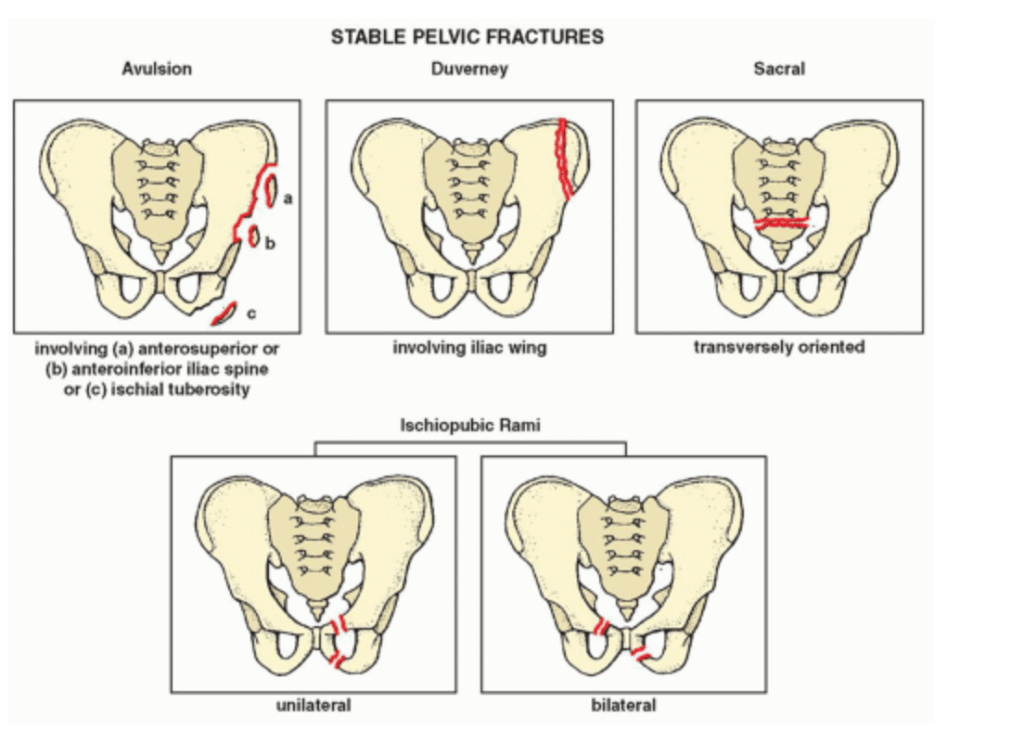
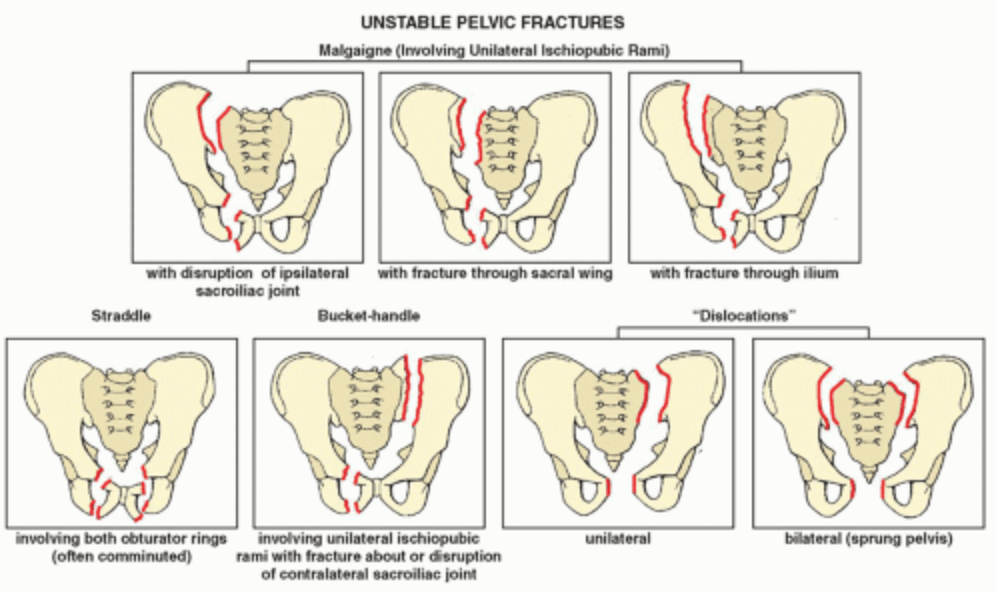
Pelvic fractures
Osteoarthritis (Degenerative Joint Disease)
- Affects large weight-bearing joints and hands.
- Morning stiffness is brief.
- Can be unilateral or bilateral.
- Bony nodules:
- Heberden’s nodes → Affects DIP (distal interphalangeal) joints.
- Bouchard’s nodes → Affects PIP (proximal interphalangeal) joints.
Management:
- Lifestyle Modifications:
- Exercise 3x per week (isometric, tai chi).
- Weight loss and smoking cessation.
- Pain Relief Options:
- Acetaminophen (Tylenol).
- NSAIDs (if no contraindications).
- Topical treatments: Diclofenac, capsaicin cream.
- Alternative therapies: Acupuncture.
Nursemaid’s Elbow (Radial Head Subluxation)
- Common in young children due to sudden pulling of the arm.
- The radial head slips under the annular ligament, causing pain and limited forearm supination.
- Frequently caused by pulling a child up by the arm (e.g., preventing a fall).
- Typically resolves easily with proper reduction.
 Apperture Labs