Backing Up
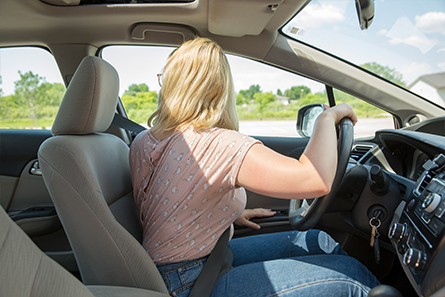
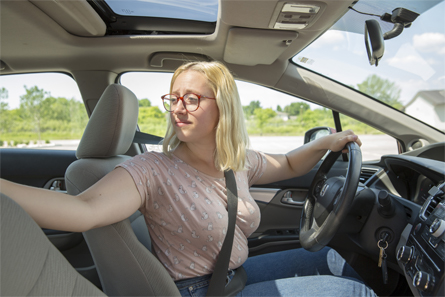
Before backing up, check for anyone or anything behind you, both by looking in your mirrors and over your shoulder. This includes checking carefully for children who may be too small to be in your direct line of vision. With your foot on the brake, put the vehicle in reverse. If you are reversing straight back or to the right, check your mirrors and look over your right shoulder. If reversing to the left, use your mirrors and look over your left shoulder. Take your foot off the brake and, if you’re turning as you reverse, ensure that you don’t strike anything to the sides.
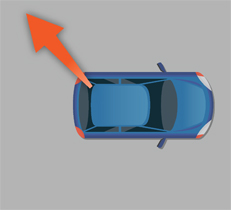
Look over your left shoulder for a clear view when reversing to the left.
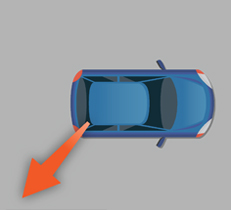
Look over your right shoulder when reversing straight or to the right.
Three-Point Turn
A three-point turn is when you:
- Pull over to the right side of the street, stop, check mirrors and shoulder check.
- Back up into an intersection or driveway. Check mirrors and shoulder check before backing up.
- Turn left and proceed forward in the direction you came from.
Traffic check
Before slowing down, check traffic in front and behind you. Check your blind spot before pulling over to the right side of the road to stop.
Signal
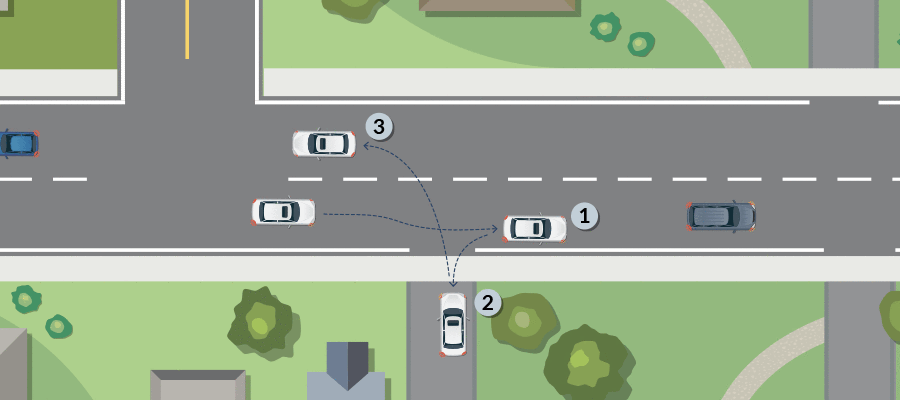
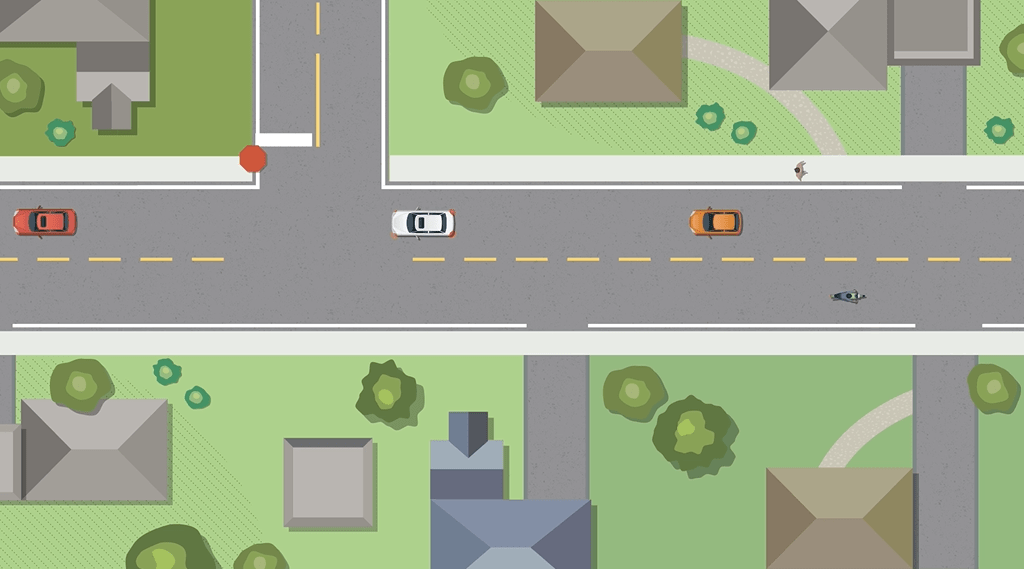
Turn on your right signal before slowing down unless there are vehicles waiting to enter the road from side roads or driveways between you and your stopping point (see diagram below). Wait until you have passed these entrances so that drivers will not think you are turning.
Speed
Gradually reduce speed. In a vehicle with a manual transmission, you may down shift into a lower gear as you slow down. Don’t coast with your foot on the clutch pedal.
Position
Stop so you are parallel to the curb and not more than 45 centimeters away (Position 1). Where there’s no curb stop as far as possible off the travelled part of the road. Don’t stop where you will block an entrance, an intersection or other traffic.
Traffic check
Check your mirrors and shoulder check to the right before starting the turn. Wait until the way is clear. Each time you stop while turning, check traffic in both directions.
Signal
Turn your right signal or four-way flasher on.
Turn around
With the steering wheel turned sharply right, reverse your vehicle slowly and smoothly, backing into the lane or driveway (Position 2). Back up far enough so you can have a clear view of the roadway and are behind the sidewalk and stop. Turn your left signal on, shift to a forward gear, turn your steering wheel to the left and make sure that you check in both directions. Then move your vehicle into the traffic lane (Position 3).
Speed
Return to normal traffic speed by accelerating smoothly to blend in with the traffic around you. In light traffic accelerate moderately. In heavier traffic you may have to accelerate more quickly. In a vehicle with a manual transmission, shift gears as you increase your speed.
Three-point Turn Around on a Dead End Street
Traffic check
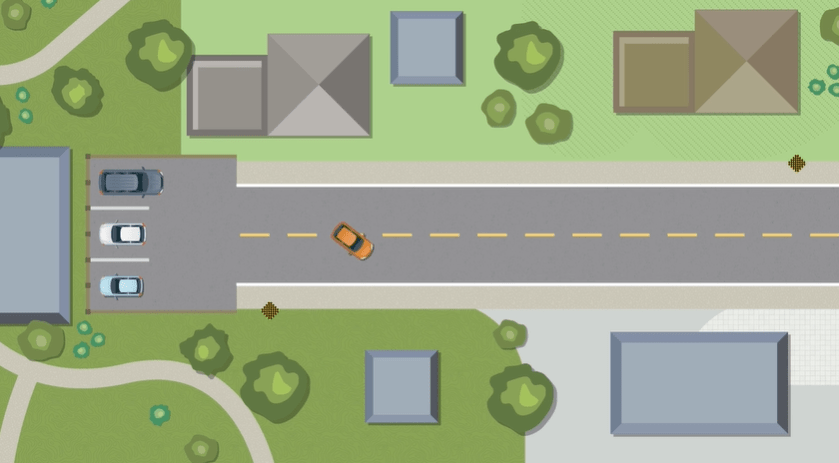
Before slowing down, check traffic in front and behind you. Check your blind spot before pulling over to the right side of the road to stop.
Signal
Turn on your right signal before slowing down.
Speed
Gradually reduce speed. In a vehicle with a manual transmission, you may down shift into a lower gear as you slow down. Don’t coast with your foot on the clutch pedal.
Position
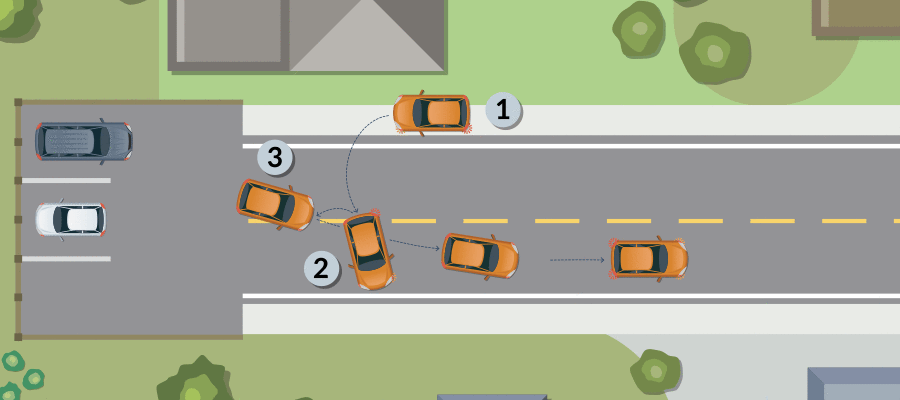
Stop so you are parallel to the curb and not more than 45 centimetres away. Where there’s no curb, stop as far as possible off the travelled part of the road. Don’t stop where you will block an entrance, an intersection or other traffic (Position 1).
Traffic check
Check your mirrors and shoulder check to the left just before starting the turn. Wait until the way is clear. Check traffic in both directions as you proceed to make the turn. Each time you stop while turning, check traffic in both directions.
Signal
Turn on your left signal before starting to turn.
Turn around
With the steering wheel turned sharply left, move slowly and smoothly across the road. When you have reached the far left side of the road, stop and put your vehicle in reverse. With the steering wheel turned sharply right, move in reverse so the vehicle is facing in the new direction (Position 2). Stop and shift into forward gear to drive ahead. Use the whole road to make your turn, reversing only once. Don’t reverse over the edge or shoulder of the road or onto the curb (Position 3).
Speed
Return to normal traffic speed by accelerating smoothly to blend in with the traffic around you. In light traffic accelerate moderately. In heavier traffic you may have to accelerate more quickly. In a vehicle with a manual transmission, shift gears as you increase your speed.
Parallel Parking
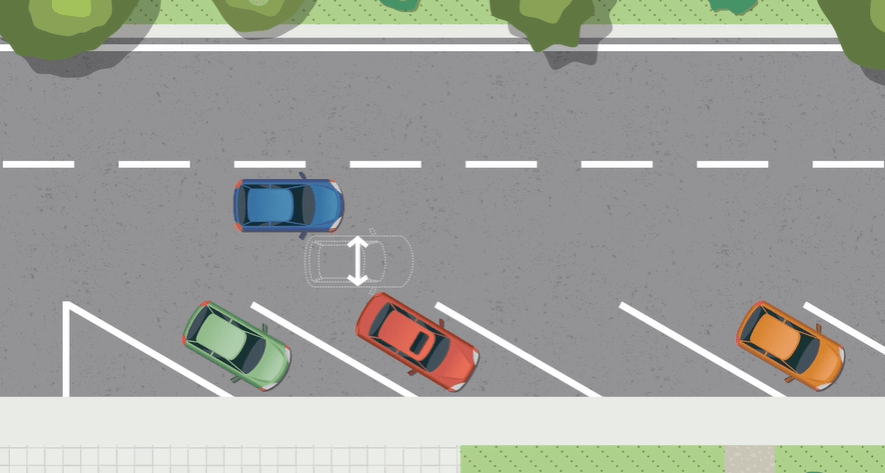
- Check your mirrors for traffic. Don’t stop suddenly if a vehicle is close behind you. Signal your stop by flashing your brake lights approximately three times or by using a hand signal and then turn on your right signal. Drive alongside Vehicle B about one metre away. Stop when your vehicle’s (Vehicle A) rear bumper is even with the rear bumper of Vehicle B.
- When you have checked your mirrors and blind spots and you are sure the way is clear, start backing into the space very slowly. As you reverse, you should steer sharply to the right until your vehicle is at a 45 degree angle from the curb. Watch for vehicles passing you. Stop when your steering wheel is in line with the rear bumper of Vehicle B.
- Straighten the wheels and continue to back into the space. The turn signal can be turned off. Stop when the right end of your front bumper is in line with and past the rear bumper of Vehicle B.
- Turn the steering wheel sharply to the left as you continue to back slowly. Make sure the front of your vehicle does not hit the parked vehicle ahead. Your right rear wheel should be close to the curb. Stop moving the vehicle
- Put the vehicle into forward gear. Turning the steering wheel to the right as you do so, drive slowly forward. This should bring your vehicle parallel to and not more than 45 centimetres away from the curb. Stop the vehicle when it’s centred between Vehicles B and C.
Backing Skill Test
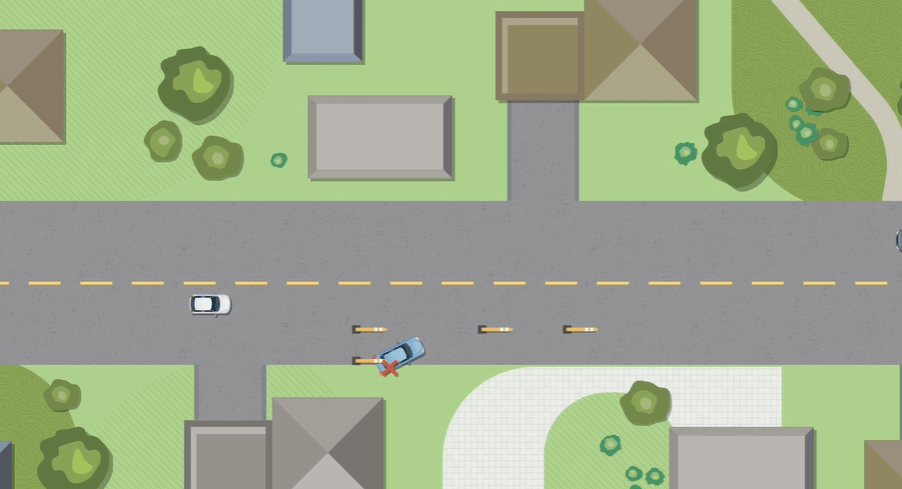
During the road test, you will be required to demonstrate your ability to back up your vehicle. This will be done by successfully backing a vehicle within a space measuring approximately 1.85 metres by 7.5 metres as outlined by testing poles.
During the road test you will be asked to stop before the backing area to be given an explanation of the test. You will have three attempts or four minutes, whichever comes first, to complete this portion of the test. Each attempt consists of three movements of the vehicle (backwards, forward and then backward again).
At this point the vehicle must be parked satisfactorily. In this portion of the road test, the following actions will result in an automatic failure:
- The vehicle touches one of the poles.
- You drive over the curb (although your tires can touch the curb).
- You drive between the poles that represent the front or the back of a vehicle.
- You commit a dangerous act such as backing up or moving forward while a vehicle is passing close by.
Angle Parking
This type of parking commonly occurs in parking lots, shopping centres and on very wide streets in some communities.
Steps in angle parking
- Signal your intention to park and slow down.
- Check for approaching traffic from the front and rear.
- Approach the stall approximately one vehicle width from the parked vehicles.
- When your vehicle’s front end is even with the rear of the stall you want to park in, begin steering sharply to the right while slowly driving towards the centre of the stall. Remember as you are turning into the stall to check that you will not hit the vehicle on either side of the stall.
- Once your vehicle is centred in the stall, straighten your wheels and continue driving forward until you are completely in the parking stall.
Although it’s easy to park, backing out from this position can be hazardous. Shoulder check sides and rear — don’t just rely on your rearview mirror. Make sure it’s clear behind and on both sides before backing up. If your vision is blocked, for example, by a truck parked beside you, move back cautiously and watch for pedestrians or vehicles that you may not have seen.
Reverse Angle Parking
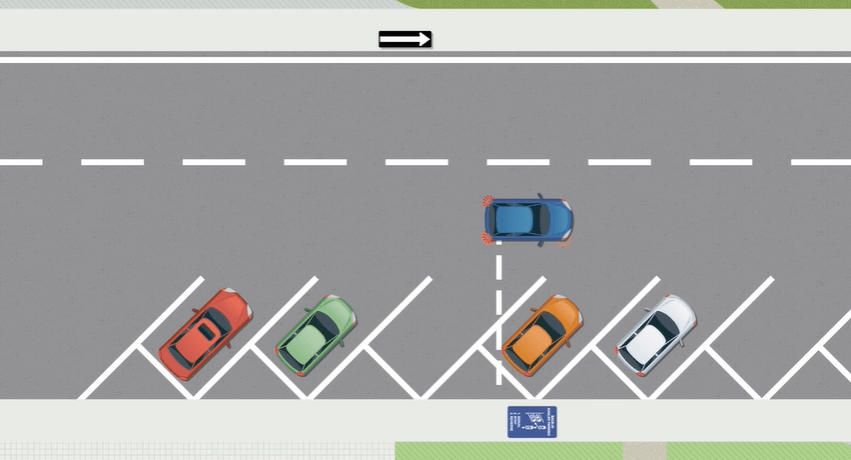
There is another type of angle parking that is becoming more common, it is called Reverse Angle Parking or Back-In Angled Parking. Reverse Angle Parking is great because it makes it much easier for drivers to see pedestrians, cyclists and other vehicles on the road. It also allows drivers to use more eye contact and nonverbal communication cues.
Steps in reverse angle parking
- First, look for the Back-In Angled Parking sign and find an open stall. Slow down and signal to let others know you are going to park. Approach the stall approximately one vehicle width from the parked vehicles.
- When your vehicle’s back bumper is in line with the parked car ahead of your stall’s driver side rear bumper, stop and put your vehicle into reverse. Begin steering sharply while slowly reversing towards the centre of the stall. Remember to use your mirrors and shoulder check either side as you are turning into the stall so you don’t hit the vehicles beside you.
- Once your vehicle is centered in the stall, straighten your wheels and continue reversing until you are completely in the parking stall. To exit the stall, signal, check for oncoming traffic and slowly start to pull out of the parking stall. Once it’s safe, turn the wheel and pull onto the roadway.
To exit the stall, signal, check for oncoming traffic and slowly start to pull out of the parking stall. Once it’s safe, turn the wheel and pull onto the roadway.
Parking on a Hill or Incline
Vehicles with automatic transmission should be placed in the Park position. Vehicles with manual transmission should be placed in reverse or low gear. In both cases, always set your parking brake firmly.
Uphill parking – turn the wheels away from the curb.
Downhill parking – turn the wheels toward the curb so the position of the wheel will help hold the car.
If there’s no curb, whether you are parking up or downhill, turn wheels slightly to the right so that if the car begins rolling, it will move off the roadway.
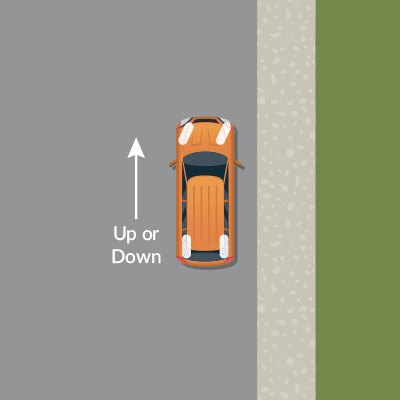
Uphill with curb. Turn wheels away from curb.
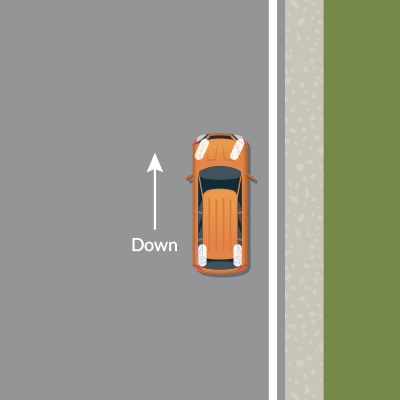
Downhill with curb. Turn wheels towards the curb.
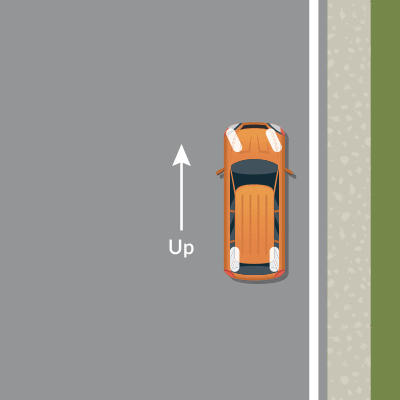
Without curb. Turn wheels to the right
Parking Pointers
- Always look for traffic including other vehicles or cyclists before opening a vehicle door.
- By law you may leave your vehicle unattended when the motor is running only for reasons such as warming the vehicle and defrosting the windshield. It’s recommended that you have a spare key and you lock your door if you leave the vehicle. Utility and delivery service vehicles are exempt from this law.
- When leaving from a parked position, signal and wait until it’s safe before pulling out.
Illegal Parking
It’s illegal to park:
- On a sidewalk
- Across the entrance to any driveway, back lane or intersection
- Within three metres from the point on the curb or edge of the roadway immediately opposite a fire hydrant
- On a crosswalk or within three metres of a crosswalk
- Within 15 metres of a pedestrian corridor
- Within nine metres of a stop sign or other traffic sign or signal posted at an intersection
- Within 30 metres of the nearest rail of a railway crossing, unless otherwise posted
- Within six metres of a driveway entrance to a fire station, unless otherwise posted
- On a roadway beside another vehicle that is already parked
- At a curve on the highway outside a city, town or village, when the vehicle cannot be clearly seen from at least 60 metres in each direction upon the highway
- In such a manner that it becomes a hazard or that is contrary to any section of The Highway Traffic Act or any municipal bylaw
 Apperture Labs