Speed
A safe speed allows you to stop safely in emergency situations. Unless otherwise posted, the maximum speed limit is 90 km/h in rural areas and 50 km/h in urban areas. Poor driving conditions will require you to drive more slowly. At no time should you exceed the posted maximum speed limit.
Driving safely can also mean not driving too slowly. You should not drive at such a slow speed that you hold back or block the normal and reasonable flow of traffic.
Following Safely
You are responsible for maintaining a safe following distance — one which provides you with sufficient time to stop in an emergency.
Use a four-second following distance when following under ideal driving conditions — allow more time under adverse conditions.
Calculating safe following distance:
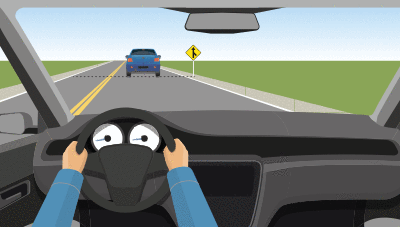
1. The rear of the vehicle ahead has just passed the sign you have decided to use as your marker. Begin counting.
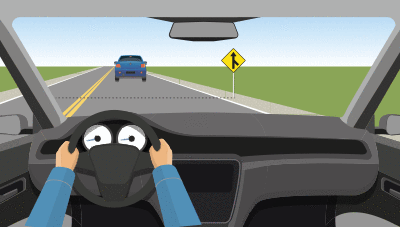
2. Count: One thousand and one, one thousand and two, one thousand and three.
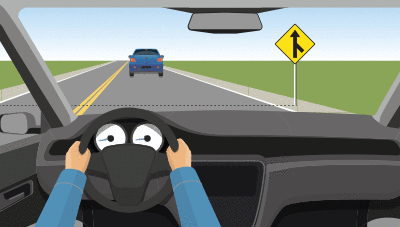
3. Count: One thousand and four (four seconds). If it takes less than four seconds for the front of your vehicle to reach the marker, you are too close. Four seconds is correct. The safety factor is even greater if it takes more than four seconds.
If you are being followed too closely, slow down gradually to give the driver behind you time to react. This can reduce your chances of being struck from behind should you need to stop.
Passing
Care must be taken when passing because it’s extremely difficult to judge the speed of approaching vehicles. You might think you have plenty of time and distance to pass, but don’t forget you are closing the gap between you and the approaching vehicle at twice your own rate of speed — and sometimes by more than that.
On highways, beware of vehicles parked on the opposite side, as they may suddenly pull out onto the highway. It’s illegal to exceed the speed limit when passing.
The basic steps for passing are:
- Check ahead for oncoming vehicles.
- Check your side and rearview mirrors for vehicles approaching from behind.
- Signal.
- Check the blind spot on your left for vehicles beside you.
- Check again that the road is clear before passing.
Once the vehicle you have passed is visible in your rearview mirror, check your blind spot on the right, signal to the right and return to the proper lane.
When being passed, slow down and move as close as possible to the right side of the road.
Drivers must be aware of wind turbulence caused by passing semi-trailer trucks or other large motor vehicles.
You must never pass:
- By driving off the road (e.g. on the shoulder)
- Where a vehicle is slowing or has stopped to yield the right-of-way to a pedestrian or other vehicle
- In a school area within 15 minutes of the opening or closing of morning and afternoon classes, or while children are near a school or playground
- On the left side of the road if it’s not sufficiently clear ahead
- Where highway construction is taking place
Passing on the right is permitted only:
- When overtaking a vehicle making a left turn
- On one-way streets
- On streets with marked lanes
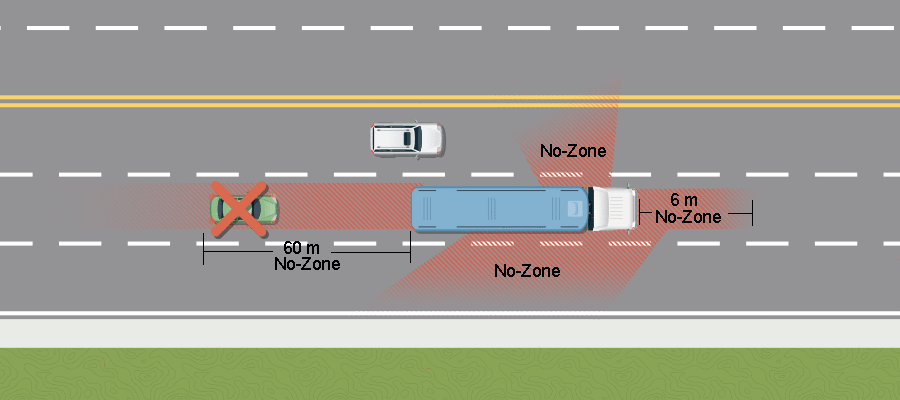
No-Zone Around Large Vehicles
Big trucks have big blind spots and to stay safe, you should avoid them. The No-Zone refers to blind spot areas around big trucks, where collisions are more likely to occur.
Rear
Trucks have deep rear blind spots. A truck driver can’t see you if you’re in this No-Zone — especially if you’re tailgating. If you can’t see the truck’s mirrors, the driver can’t see you. Stay well back of big trucks to avoid a rear-end collision.
Side
Trucks have large blind spots on both sides. If you stay in these blind spots, that can mean trouble if the truck driver decides to change lanes.
Front
Truck drivers sit up high, and the hood of the cab obscures part of the road ahead. When you pass a big truck, make sure you can see the entire truck cab in your rear-view mirror before pulling in front. When vehicles cut in too soon, then abruptly slow down, truck drivers are forced to react with little time or room to spare.
Backing
Never pass close behind a truck that is preparing to back up or is in the process of backing up. Most trailers are 2½ metres wide and completely hide objects behind them.
Wide Turns
Truck drivers must sometimes swing wide to the left in order to make a right turn. They can’t see cars directly behind or beside them. If you cut in between the truck and the right curb, you might cause a collision.
Entering and Leaving an Expressway
Entering
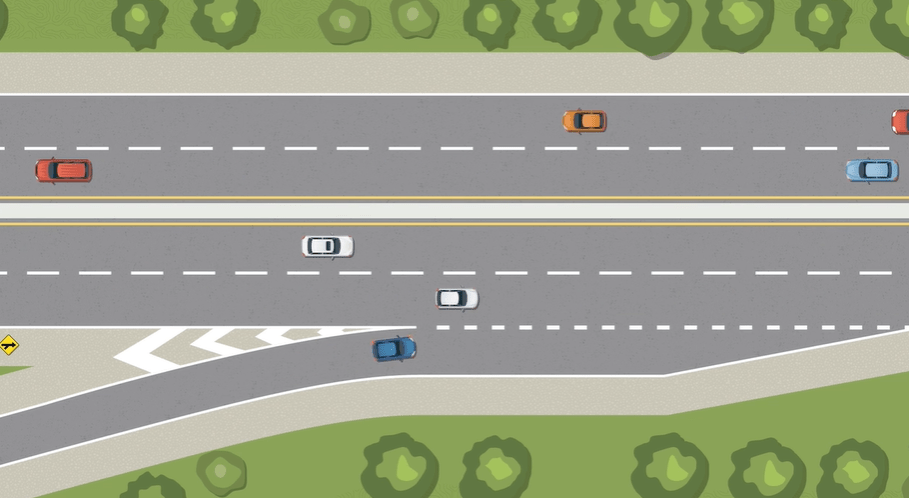
Rear-end collisions are the leading type of accidents at entrances to expressways. Not only do you face the possibility of being rear-ended by traffic behind you in the entrance lane or on the expressway, you might rear-end a vehicle while your attention is focused on traffic in the expressway. The following advice will help minimize the risk of rear-end collisions:
- As you enter the entrance lane, adjust your speed to match traffic and keep plenty of space between you and the vehicle ahead, so that you and the vehicle behind you will have more time and distance to stop in an emergency.
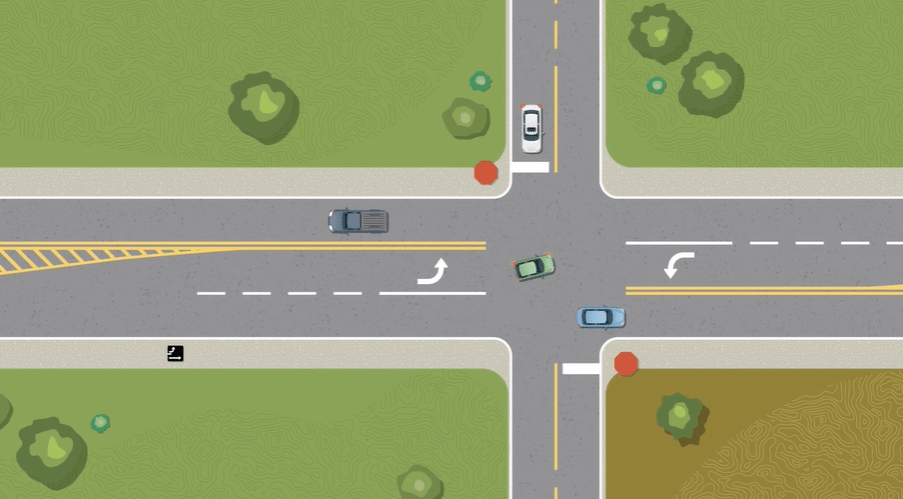
- Check expressway traffic to determine if it will be necessary for you to slow down or stop at the point immediately before the entrance of the merge lane. (See diagram.) Keep in mind that the decision could be made for you by the driver immediately ahead of you.
If you’re not entirely sure if you’ll have to slow down or stop, touch your brakes lightly to alert drivers behind that you may have to do so. The place to stop is just before the entrance of the merge lane. - Use the merge lane to match your speed with expressway traffic, so as to merge without having to stop. If you stop at the end of the entrance lane, you sharply increase the risk of being struck from behind.
Leaving
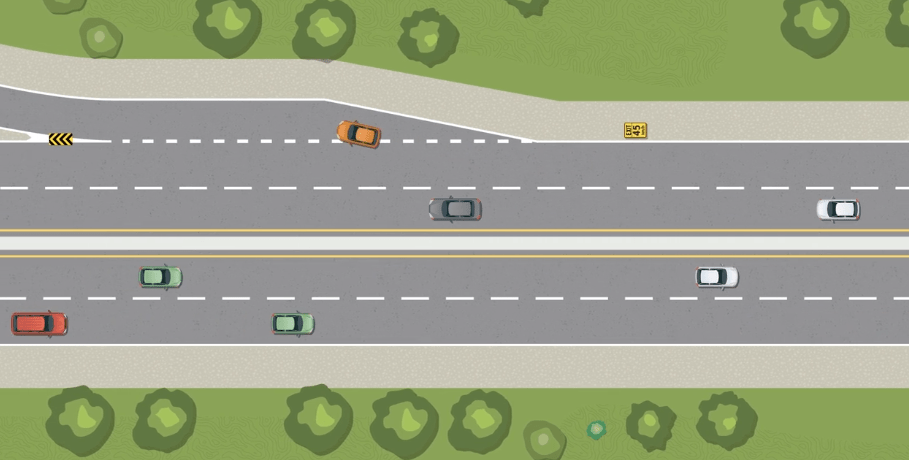
- Give yourself plenty of time to move over to the lane closest to the exit. (Follow the instructions given earlier for making lane changes.)
- Maintain your speed until you are completely in the exit ramp, and then slow down smoothly to whatever speed is posted or to the prevailing speed in the exit ramp (whichever is slower).
If you pass your exit on an expressway, never stop to back up. Continue on to the next exit.
Right-of-Way
Uncontrolled intersections
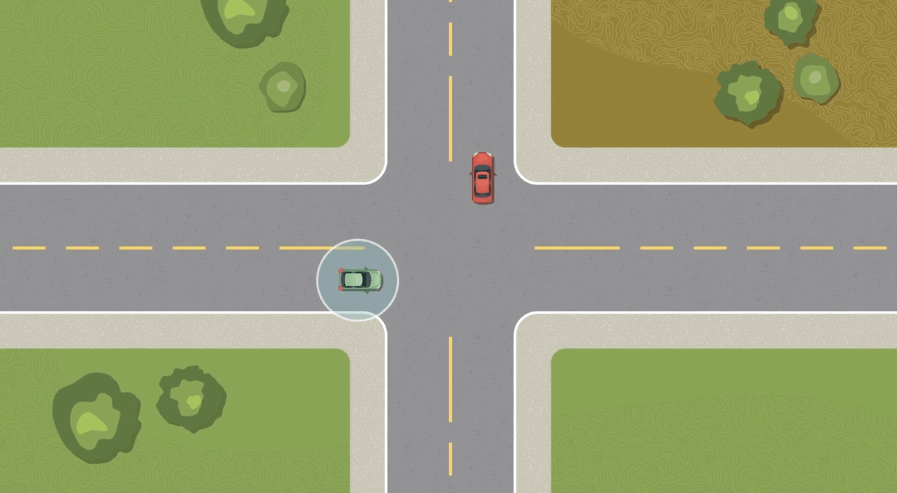
When two vehicles approach an intersection with no traffic signals or signs, both must slow down. The vehicle on the left must always yield the right-of-way to the vehicle on the right. Nevertheless, the driver with the “right-of-way” must still exercise proper care and attention to avoid a collision.
Private entrances to public thoroughfares
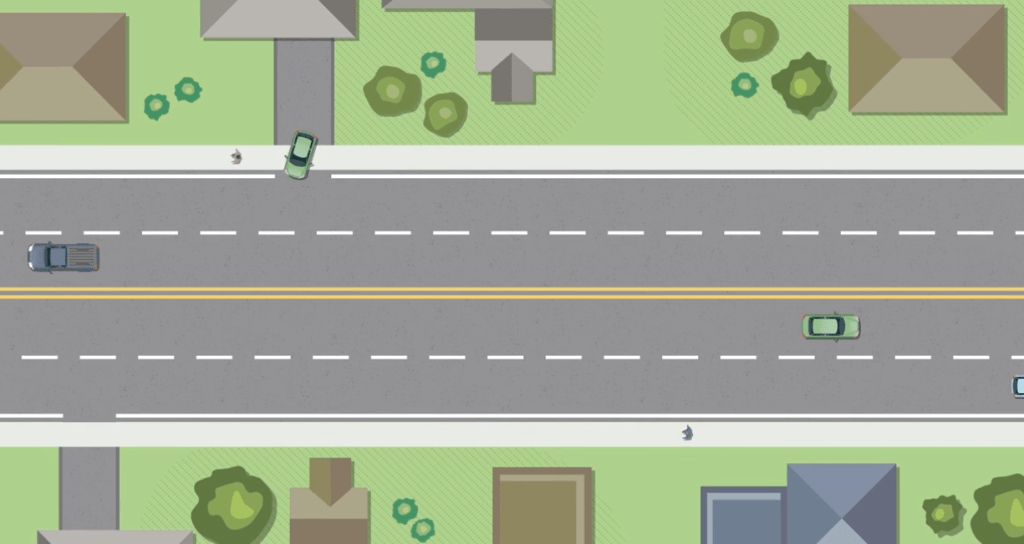
When entering a street, Provincial Road or Provincial Trunk Highway from a private road, lane, driveway or parking lot, you must stop before crossing the sidewalk and yield the right-of-way to all pedestrians and traffic. Proceed when safe.
Funeral processions
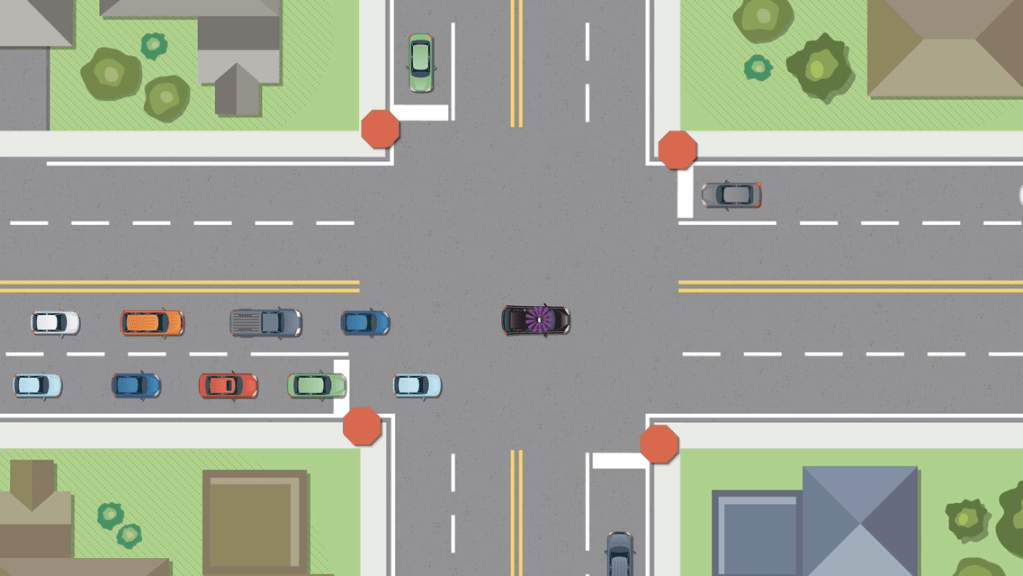
Drivers of vehicles in a funeral procession with lighted headlights and following a lead car may, if traffic conditions and local bylaws permit, go through a red light or stop sign with caution. The drivers of all other vehicles must yield the right-of-way to the procession.
The lead car in the funeral procession may be equipped with a flashing purple light.
Emergency Vehicles
Motorists can be fined under provisions of The Highway Traffic Act for failing to use caution when passing emergency or designated vehicles working at roadside. You must slow down to the following reduced maximum speeds, passing only when it’s safe to do so:
- 40 km/h on highways with posted maximum speed limits under 80 km/h
- 60 km/h on highways with posted maximum speed limits of 80 km/h or higher
If you are caught driving faster than the reduced speed limits, you could face a significant fine and move down the Driver Safety Rating scale.
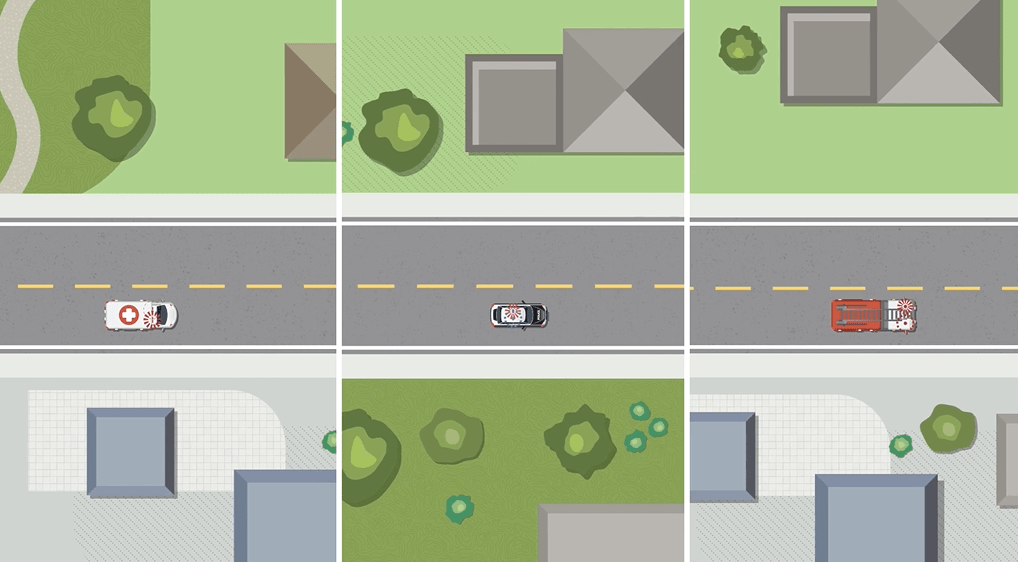
An emergency vehicle, when responding to an emergency call, will sound an alarm and use flashing lights. The alarm may be a horn, gong, bell or siren. The lights may consist of any of the following: a flashing red light, flashing red and blue lights or alternating flashing headlights.
When an emergency vehicle (ambulance, fire or police), sounding an alarm and flashing lights, is approaching from any direction you must yield right-of-way by:
- Immediately moving clear of an intersection if you are stopped for a red light or stop sign (If blocking the path of an emergency vehicle, you must proceed through a red light or stop sign with caution, to clear the way.)
- Driving as closely as possible to the right curb or edge of roadway
- Remaining stopped at the edge of the road until the emergency vehicles have passed
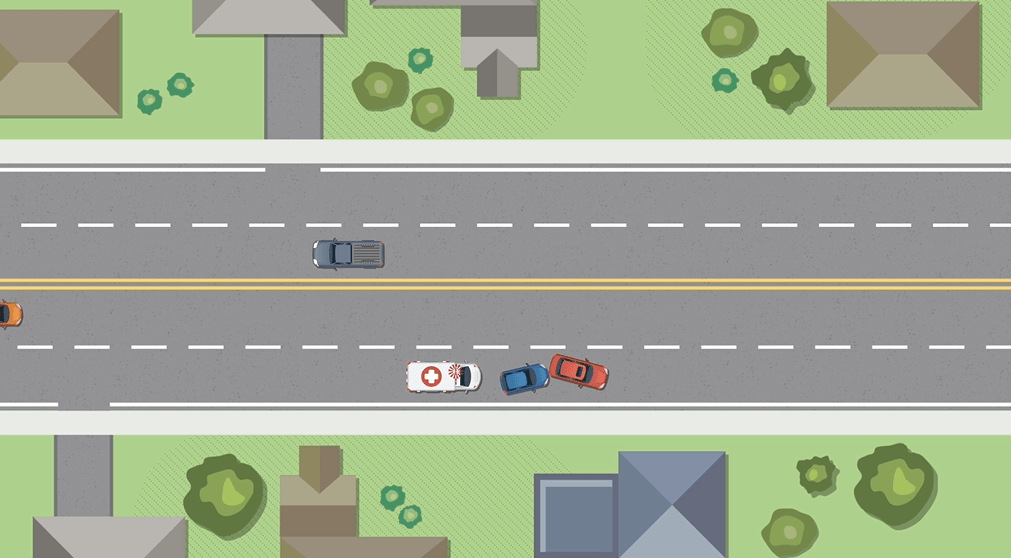
Note: On one-way streets, pull right or left to the nearest curb so as not to block the emergency vehicle.
Pull over and stop for emergency vehicles.
When passing a stopped emergency vehicle or other designated vehicle (tow truck or other roadside assistance vehicle, or vehicle used by government enforcement officers) that has its warning lights activated, slow down and proceed with caution, passing only if it’s safe to do so. When two or more lanes of traffic in the same direction are available, you must move to the lane farthest from the emergency or designated vehicle, provided it’s safe to do so. This applies to drivers on either side of an undivided highway.
School Buses
School buses make frequent stops as passengers enter and leave. Children getting on or off the bus may not be paying attention to the traffic around them. As a driver, it is your responsibility to pay close attention and keep children safe when you are near a school bus.
When a bus displays flashing overhead amber lights, it is about to stop to load or unload students. You must slow down and prepare to stop.
It is illegal to pass from either direction when the bus displays flashing red lights and the stop arm extends from the left side. You must stop at least five metres from the bus. You must remain stopped until the flashing overhead red lights are turned off and the stop arm is folded in.
You are not required to stop if travelling in the opposite direction on a divided roadway separated by a physical median or ditch. A double solid line is not considered a physical separation.
Illegally passing a school bus results in a large fine and moves you down the Driver Safety Rating scale. Be cautious around school buses, and always stop when a bus’ red lights are flashing.
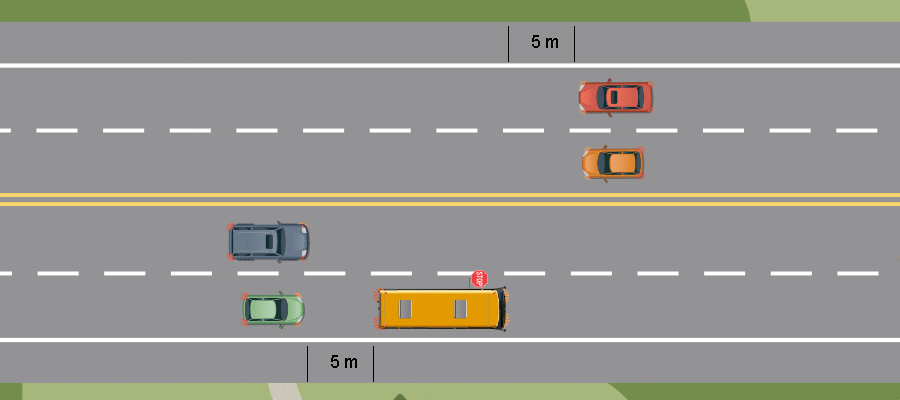
You must stop your vehicle not less than five metres from the bus when approaching in either direction.
Transit Buses
A number of collisions involving transit buses result from vehicles rear-ending the bus, either in the bus stop location or at intersections. Be aware of their travel and maintain a safe following/stopping distance.
Buses don’t necessarily stop at all bus stops. Some stops are designated for special routes such as express and sporting events. If a stop is coming up, don’t assume the bus is going to stop.
Transit buses display a decal on the rear of the buses requesting motorists to “Please Yield.” A bus operating on the street will be moving around parked vehicles or out of bus bays. If a transit bus is signaling its intention to change lanes to the left, a motorist can increase the safety of this manoeuvre by allowing sufficient time and space for the bus to enter the lane. At times, a bus may be required to change multiple lanes in order to move from a right hand curb lane to a left hand turn storage lane.
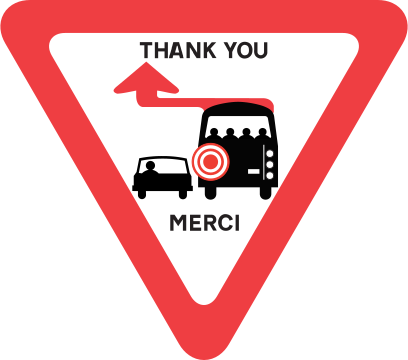
Buses are wider than most cars and light trucks, and consequently, they occupy more roadway space. Buses operate on a wide variety of street types, including residential streets and busy downtown streets. When exiting a parked vehicle, shoulder check before opening your door to avoid contacting a passing bus or other large vehicle.
Transit bus situation #1
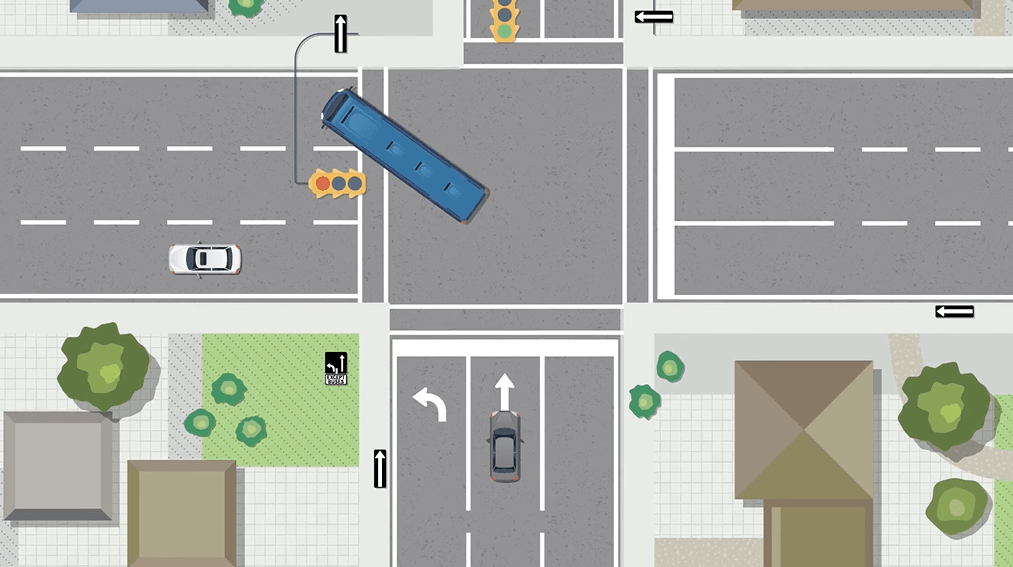
When making a right turn, it must be done in the extreme right lane. Making a right turn from the second lane in front of a transit bus not only places you at risk of being struck if the bus pulls away, but is also illegal. Pull behind and wait until the bus completes loading and unloading and pulls away from the stop or intersection.
If the bus has its hazard lights activated and is sitting a short distance from the intersection, communicate your intentions by signaling and tapping your horn prior to pulling around the front of the bus.
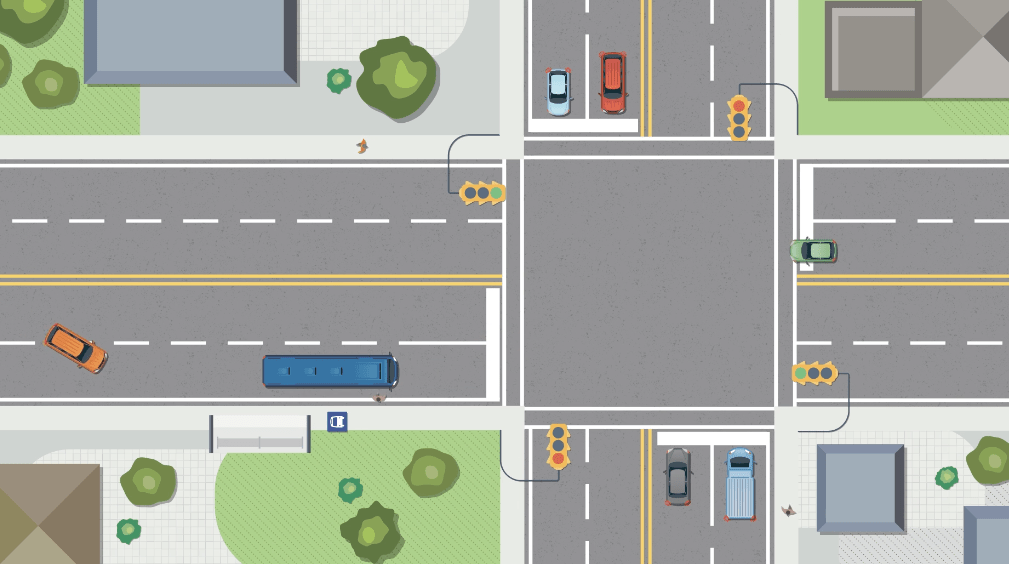
Transit bus situation #2
There are numerous locations where the stop line of an intersection is set back farther than normal from the crosswalk. This is to accommodate large vehicles such as trucks and transit buses to be able to physically negotiate the turn.
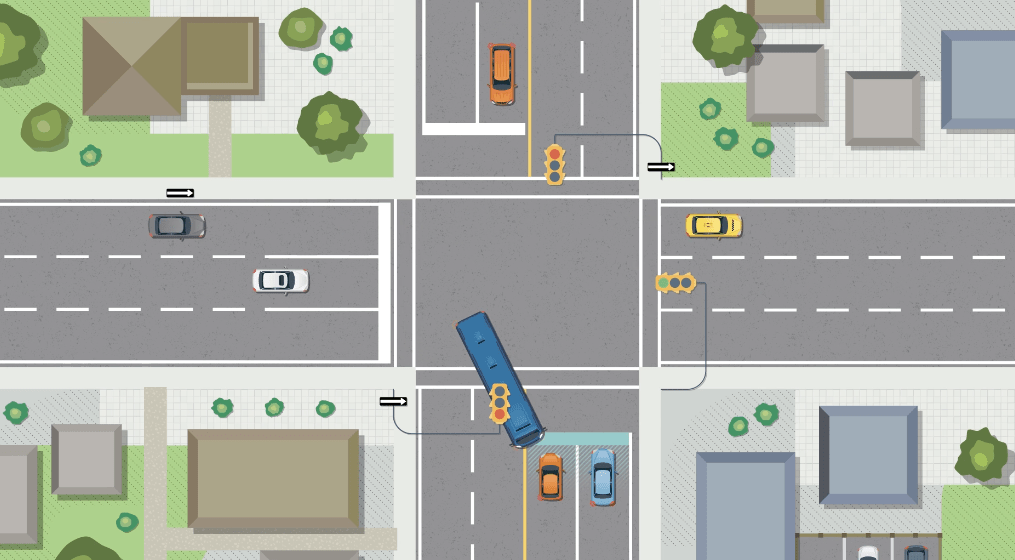
Transit bus situation #3
At many times, there may be passengers standing on transit buses.
Conducting a sudden, unexpected manoeuvre in front of a bus, such as a lane change or pulling out in front, may force the bus to stop or brake suddenly causing passengers on board the bus to fall down and possibly be injured.
Please drive cautiously around transit buses and be aware that they carry standing passengers.
Transit bus situation #4
The blind spot of a 12.2 metre transit bus is 4.3 metres on the right side and 1.5 metres on the left, as well as 12.2 metres to the rear.
If you are driving in this area, the bus operator may not see you.
Transit bus situation #5
Transit buses are given special turning privileges at certain identified intersections. Be aware of these locations and watch for buses turning with you.
Construction Zones
Passing vehicles can pose a serious threat to the safety of construction workers on or near the roadway.
When driving through construction zones, slow down, watch for workers and drive with caution, as lanes may be closed and traffic may be redirected. Keep enough space between you and the vehicle ahead of you and be ready to make a sudden stop.
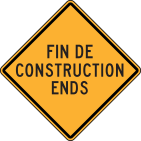
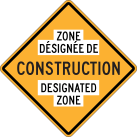
Construction zones will be marked by traffic control devices, including pylons or signage, at their beginning and end. A flagperson may also be in the construction zone to help direct the flow of traffic. You must obey the directions of the flagperson, including slowing down or stopping.
In a designated construction zone, identified at the start and the end by a special sign, the set fines for speeding over the posted speed limit will be doubled, regardless of whether workers or equipment are present, and regardless of whether the speed limit has been reduced.
Failing to use caution or exceeding the maximum speed limit while driving through a construction zone can result in severe consequences under The Highway Traffic Act. In addition to a significant fine, you may also move down the Driver Safety Rating scale, which affects how much you pay for your driver’s licence and vehicle registration, and receive possible driver improvement action up to and including driver’s licence suspension.

The Zipper Merge
When a lane on a highway is temporary closed due to construction and traffic is backed up, drivers may see road signs asking them to merge in a specific fashion known as the zipper merge (or late merge). In certain situations, this makes the traffic flow more efficiently for drivers in both lanes. A zipper merge has drivers use both lanes until reaching a defined merge point. Drivers then take turns merging into the open lane in a zipper like fashion.
Remember, drivers who are changing lanes must signal, while drivers who are remaining in the through lane must let in one vehicle.
VIDEO
Railway Crossings
The signs below indicate a railway crossing ahead. Slow down, check to the right and left along the angle of the track shown in the sign, and proceed only when safe.
The actual crossing is marked by a railway crossing sign.
When approaching railway crossings, check both ways for trains and remember that they always have the right-of-way.
When stopping at a crossing, keep at least five metres away from the nearest rail in a restricted speed area and at least 15 metres away in a non-restricted speed area. A restricted speed area means any area within Winnipeg, an urban municipality, a local urban district under the Municipal Act or any other area, highway or portion of highway designated by regulation.
If you see a train approaching, be prepared to stop. Motorists can seriously misjudge the speed of trains, believing they’re travelling much slower than they actually are or incorrectly assuming that trains must slow down at railway crossings.
Since most railway crossings don’t have electronic signals warning you when to stop, the most important rule to recognize is that trains automatically have the right-of-way at all railway crossings. In other words, at railway crossings, the safety of you and your passengers depends entirely on you, the driver.
Other safety pointers include:
- When there’s more than one set of tracks, don’t start across when the train passes. Make sure there isn’t another train coming on the other track.
- Half of all night rail/highway crossing collisions involve vehicles hitting trains. To avoid that, slow down when you see the advance warning sign so that you can stop in time if you have to.
- Never move onto the track unless you’re sure there’s plenty of room on the other side. If traffic is backed up so that you can’t get across the tracks, stop and wait at least five metres from the crossing, until the traffic jam clears and it’s safe to cross.
- Some vehicles may stop at all crossings. These may include regular buses, school buses and vehicles carrying hazardous materials. If you’re following such a vehicle, be prepared to stop.

Railway Crossing Ahead

Railway Crossing
It’s illegal to:
- Cross a railway crossing when warning signals are on (except as explained below)
- Shift gears when crossing railway tracks
- Drive a vehicle through, around or under a crossing gate or barrier that is closed or being opened or closed
- Drive a vehicle onto a railway crossing unless there’s sufficient space at the other side of the crossing to accommodate your vehicle without obstructing the passage of trains
- Park within 30 metres of the nearest rail of a railway crossing unless otherwise posted
Drivers may cross a railway crossing when the warning lights are flashing if:
- The vehicle is brought to a complete stop prior to crossing
- The crossing is not protected by gates or barriers
- The crossing is within a restricted speed area
- The train is stopped or is a safe distance away
- The crossing may be done safely
For railway crossing procedures, drivers of for-hire vehicles, school buses and vehicles capable of transporting flammable liquid or gas should consult the Professional Driver’s Handbook.
If there’s any doubt, stop and wait for the train to cross or for the warning lights to stop flashing.
 Apperture Labs