Ice, Sleet or Snow
You are responsible for keeping full control of your vehicle at all times, even under poor driving conditions.
- Start out slowly and gently test steering and braking conditions.
- Reduce your speed to suit ice and snow conditions, and remember that even snow tires can slide on ice or packed snow.
- If your vehicle does not have anti-lock brakes, apply steady brake pressure without locking the wheels and losing steering control. This is sometimes referred to as threshold braking. If your vehicle does have anti-lock brakes, apply full brake pressure and hold. You will still have some steering control. Check your owner’s manual for the best advice to follow for your specific braking system.
- Increase the distance between you and the vehicle ahead of you according to road conditions. Remember that in winter your vehicle requires a greater stopping distance.
- Be alert to pedestrians at all times as well as slippery patches, bridges (which may have slippery surfaces), blind intersections, snow plows, graders, etc.
- Keep windows and windshields clear of ice and snow, and make sure your defroster and windshield wipers are working properly
- Keep your lights on.
Daytime Use of Headlights
Using headlights during the day can significantly reduce the chances of a collision because your vehicle is easier to see.
Reduced Visibility
By law, while driving a vehicle, you are required to switch on headlights a half hour before sunset until a half hour after sunrise and when visibility is reduced to 60 metres.
Other recommended practices include:
- Sharply reducing your normal driving speed
- Turning your headlights on low beam to reduce the glaring reflection from dense fog or snow (Fog lamps are even better.)
- Reducing your speed further on seeing headlights or taillights (The headlights may be on a vehicle being driven down the centre of the road, and the taillights may be a vehicle stopped on the road or just barely moving.)
- If driving at a greatly reduced speed, turning your hazard/emergency flashing lights on (This will make you more visible and warn other drivers that you are travelling at a reduced rate of speed.)
- Being prepared for emergency stops (If the visibility becomes so poor that you can barely see, cautiously pull off the pavement and stop. Wait until visibility improves.)
Night Driving
One of the major reasons why driving at night is more dangerous than driving during the day is that you cannot see as far. Never drive so fast that you can’t stop within the distance you can see in front of you with your lights. That means driving slower than usual, since under normal conditions you can see only 30 metres ahead on low beam and 110 metres ahead on high beam.
To reduce glare, don’t look directly at the headlights of oncoming traffic; instead, look to the right edge of the roadway. To cut glare from the rear, adjust your mirror or use a day-night mirror. Reduce your speed until your eyes have recovered from the glare.
Some additional pointers to minimize the hazards of night driving include:
- Ensuring your low beams reveal objects at least 30 metres ahead without blinding oncoming drivers
- Dimming your lights at least 450 metres from oncoming vehicles, and 60 metres when following vehicles
- Keeping headlights clean
- Keeping the interior lights off so that your eyes will remain adapted to the dark
- Watching for pedestrians and vehicles stopped at the edge of the road
- If you must stop, pulling off onto the shoulder and using your emergency flashing lights or other approved warning devices such as flares
- Watching for highway signs — they’re more difficult to see and read at night
- Keeping both the inside and outside of the windshield clean
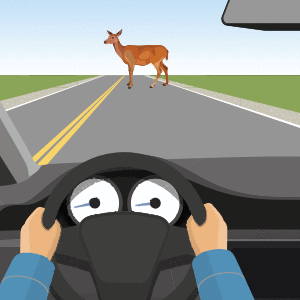
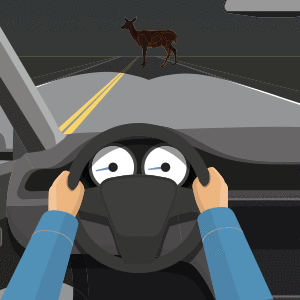
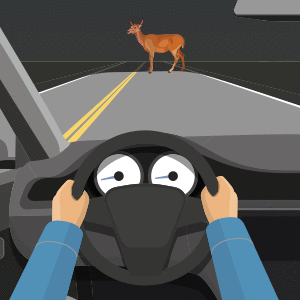
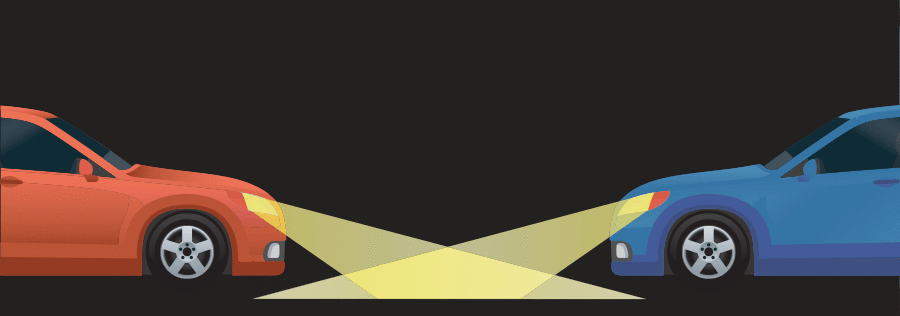
Always use low beams when approaching other vehicles. High beams will blind the other driver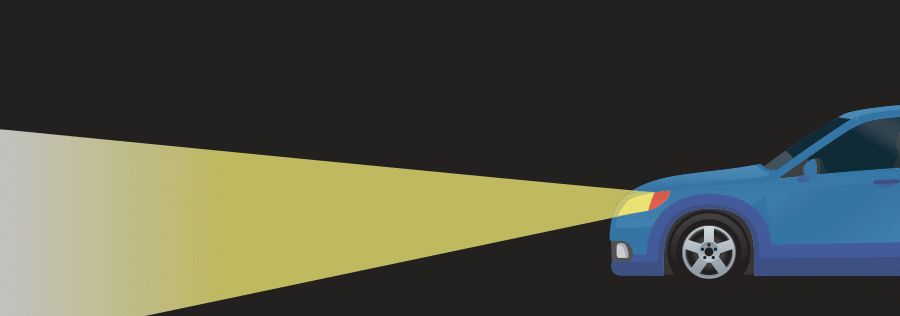
Use high beams only when driving in open country without other vehicles near.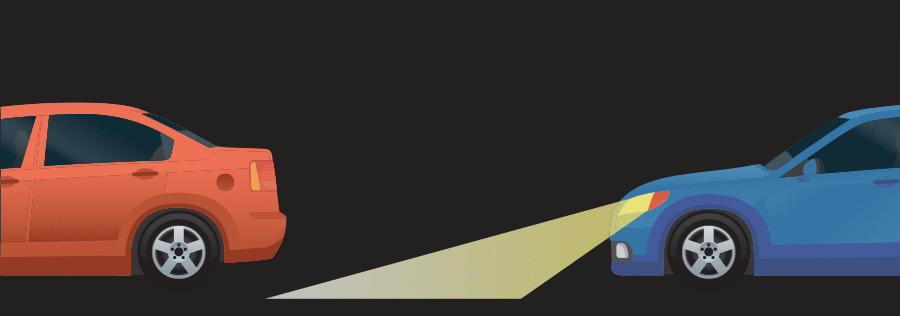
Use low beams when driving by street light, in fog and when following another vehicle closely.
Gravel Road Driving
Gravel roads present special driving challenges as evidenced by the high number of rollover accidents. Following are some safety tips to minimize the safety hazards when operating a vehicle on gravel roads:
- When driving onto a gravel surface, slow down and drive carefully.
- As a driver you should always drive at a speed that will allow you to stop safely for any hazard.
- On gravel, sudden changes in direction such as a swerve to avoid an object or animal on the road, can be dangerous.
- Stopping or speeding up too quickly can result in loss of control.
- Know your braking system (refer to your owner’s manual):
- If your vehicle has anti-lock brakes, you should be able to apply full brake pressure and still have steering control.
- If your vehicle does not have anti-lock brakes, apply steady brake pressure without locking the wheels and losing steering control. This is sometimes referred to as threshold braking.
- Remember that stopping distances are increased because your tires have reduced traction to the road surface (loose gravel surface).
- Following distance is very important. You should stay a minimum of six seconds behind other vehicles. This distance should be increased when road conditions are less than ideal (washboard, potholes and loose gravel). This will reduce the danger from clouds of dust obscuring vision and flying rocks damaging head lights and windshields.
- Rollovers are of particular concern in rural driving, whether on gravel or pavement. It’s very easy for a distracted driver to allow the tires on one side of the vehicle to wander off the road while travelling at higher speeds. Many drivers will try to get back on track by quickly turning the steering wheel and jamming on the brakes. This can cause the vehicle to start into a skid, where it may tip and rollover several times before stopping.
- To avoid a rollover take your foot off the gas and steer the vehicle so it follows the edge of the roadway, slowly turn the steering wheel to gradually guide the vehicle back onto the road.
Winter Road Driving
The winter road systems in Manitoba are basic access routes to remote northern communities and have no alignment standards. There are no posted speed limit signs and the recommended speed limit for vehicles with a maximum gross vehicle weight of seven tonnes or greater is 15 km/h on all ice roads. Winter roads are constructed on the natural terrain of the land and ice. They cross muskeg, rock ridges, streams, rivers and lakes. The road surface can get worse quickly due to changes in the weather. The chance of a collision increases if you don’t drive according to the road conditions.
Here are some safety tips and information to help reduce the hazards when operating a vehicle on winter roads:
- Travel is not approved until a section officially opens. No regular inspection or maintenance is provided along the route before opening or after closing, increasing the potential risk to drivers. (A 24-hour voice report for winter road information to access remote isolated northern Manitoba communities is available by calling Highway Information Services at 204–945–3704 or toll-free 1–877–627–6237.)
- The road surface is packed snow or ice and the stopping distance of all vehicles is longer than on land roads. As a driver, you should be travelling at a speed that will allow you to safely slow down or stop if you come upon a hazard or approaching vehicle.
- Winter roads are primarily used by heavy truck traffic delivering fuel, freight, groceries, machinery and building products. The contractor’s maintenance equipment is slow moving and can pose hazards on blind corners. The season may be shortened due to weather conditions and the traffic volumes may increase. Night travel is recommended for better visibility of traffic.
- Ice road failures, sudden storms, ground drifting and whiteout conditions preventing travel can occur in subzero temperatures. Wilderness survival training and ice road driving courses are recommended.
- Passing or meeting other vehicles should be done with great care because swirling snow can reduce visibility
- The results of an unexpected delay, breakdown or collision when travelling in an isolated area can be life threatening if you are not prepared. It may take a long time for help to arrive if there’s trouble. Proper clothing, personal medication, fuel to reach your destination, vehicle and survival equipment, cellular or satellite phone and/or Citizen Band communication are recommended for every vehicle travelling on the winter road system.
- Always let someone at your destination know when you expect to arrive prior to starting your trip.
- Environmental guidelines require road users to be responsible for their own abandoned vehicle and garbage removal.
Hills
Slow down at the top of a hill to make up for the increased braking distance required on the down slope. Before starting down a steep hill, shift to a lower gear to let your engine assist you as a braking force. Never coast down hills in neutral or with the clutch disengaged because you’ll be relying too much on your brakes and they may not hold.
Don’t pass near the crest of a hill because your sight distance ends at the hilltop.
It may be irritating to follow slow-moving vehicles up a hill but because your sight distance is limited, you should remain patient and follow all the way over the crest before passing. Observe the pavement markings and road signs.
Farm Equipment on Roads
When outside of cities, drivers need to be watching for farm equipment that might be moving between fields. Many farm implements are very large and oddly shaped, and farm tractors, combines and other equipment move very slowly, with a maximum speed of 40 km/h. Drivers need to be aware that at highway speeds, you will approach a piece of farm equipment faster than expected. As well, farm implements can sometimes take up more than half of the road width, or if they’re crossing a bridge, can take up the full width of the bridge. The most important thing to remember when approaching farm equipment on the road is to slow down well ahead of time, and to look closely at the implement when passing or meeting it to make sure you know how wide and how long it is.
Remember a valid Class 5 Intermediate Stage licence or higher is required to operate heavy and agricultural equipment on provincial highways and roads in urban areas. These types of vehicles include tractors, self-propelled farm equipment such as combines, and heavy equipment such as front-end loaders, cranes, forklifts and graders. Provincial highways and urban roads don’t include rural municipal roads, service roads or winter roads controlled or maintained by a local government such as a rural municipality.
Animals on the Road
In Manitoba, there are approximately 10,000 animal-vehicle collisions, per year. While most of these collisions tend to occur in rural areas, it’s important to be aware and cautious in urban areas as well.
A large number of animal collisions involve deer. Deer are particularly active in the fall with peak danger times from sunset to midnight and just after sunrise.
Avoid or minimize the impact of a collision with an animal by doing the following:
Be alert
Watch for wildlife warning signs, scan the road from side to side and watch for shining eyes. Use high beams when possible and remember – deer travel in groups. If you see one, others are likely nearby.
Slow down
Reducing your speed during peak hours will give you more time and distance to react to wildlife and stop if you have to.
Stay in control
If an animal crosses your path, brake firmly. Avoid swerving, as that may cause a worse collision. Dim your lights so the animal does not freeze and sound the horn with one long blast to try to scare it off the road.
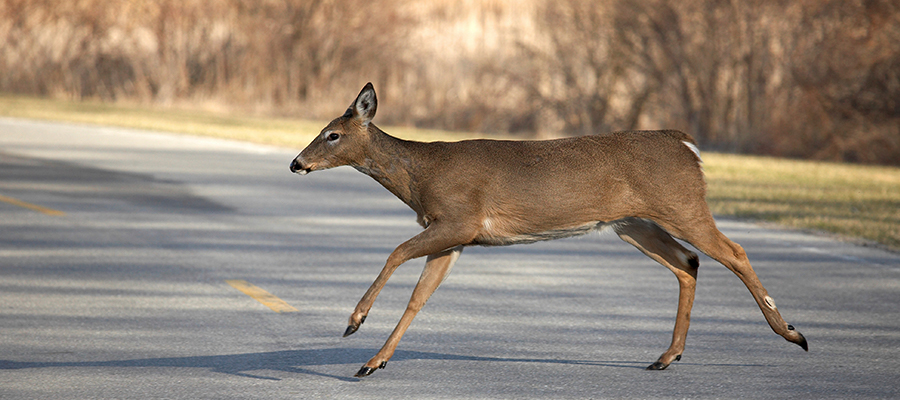
If a collision with a very large animal (such as a moose) is unavoidable, get below the windshield to avoid a catastrophic injury.
If you do hit an animal, move your vehicle safely off the road. Once you’re parked, call the local road authority. It’s very important that you don’t approach the animal, as it could try to escape and hurt you or itself.
When driving near horses, pass slow and wide
A horse rider or carriage driver has the right to travel on the roadway. Be mindful that when approaching horses, sudden moves or noises could frighten them and endanger everyone on the road. Don’t sound your horn and be ready to stop if the rider indicates for you to do so. When you’re ready to pass, slow down and leave plenty of distance between you and the horse. Only resume speed once you are well past the rider.
Pilot Vehicles
Pilot vehicles are used to warn drivers they’re approaching an oversize vehicle or load.
When an oversize or overload permit requires a pilot vehicle for escort purposes, the pilot vehicle shall be equipped with a yellow flashing light and shall display an illuminated “WIDE LOAD” or “D” sign.
When escorting an oversize vehicle or load:
- On a two-lane or four-lane highway — The pilot vehicle shall precede and follow the oversize vehicle or load at a distance of not less than 100 metres and not more than 500 metres.
- On a four-lane divided highway — The pilot vehicle shall follow the oversize vehicle or load at a distance of not less than 100 metres and not more than 500 metres.
Drivers should be aware that the oversize vehicle or load may pose a threat to normal traffic patterns, particularly when passing the oversize vehicle or load on a two-way highway.
 Apperture Labs