Starting Out
Steering — Hand Position
Most vehicles are equipped with power steering and adjustable steering wheels that make operating the vehicle easier and more comfortable for the driver. It’s recommended that the steering wheel be held with your hands at the 9 o’clock and 3 o’clock positions. This will allow for good control and, in the event of a collision and the vehicle is equipped with an airbag, it will inflate without injuring or being obstructed by the driver’s arms. The driver of a vehicle should never turn the steering wheel with one hand (palming the wheel) or with one finger as they may not have full control of the vehicle.
Accelerator
To set a vehicle in motion, you have to accelerate smoothly and gradually to avoid jerking the vehicle. The driver’s foot should lie flat on the accelerator with the heel on the floor. For optimal engine performance, the driver should avoid abruptly applying and releasing the accelerator.
Drivers should accelerate slowly and steadily when starting from a stop. By doing this, drivers have more control over the vehicle. If the vehicle is over-accelerated, particularly on poor or slippery road surfaces, the wheels can lose traction, which could cause loss of control.
Automatic transmission
Many vehicles have transmissions that change gears automatically in response to speed and acceleration, by means of mechanical, electrical or hydraulic controls.
Drivers of such vehicles can also shift down to a lower gear for increased braking power when descending a hill. Downshifting prevents the transmission from automatically changing into a higher gear, keeping the vehicle speed slower. This can be very helpful in keeping the vehicle’s brakes cooler as they will not have to be used as often when descending a steep hill.
This is an example of how the gears on an automatic transmission could be used:
- P (park): for starting the engine, stopping for an extended length of time and parking
- N (neutral): for starting the engine, disengages the engine from the drive wheels
- R (reverse): for backing up (bring the vehicle to a complete stop before changing from a forward gear to reverse and vice versa)
- D (drive) or 2–5: for normal forward driving conditions
- 2–3/2–4 lower gears for driving with heavy loads
- 2: for driving on slippery surfaces or up or down steep inclines
- 1: for driving very slowly when off the highway
Manual (standard) transmission
Shifting gears in a vehicle equipped with a manual transmission is a skill which requires considerable practice. The driver operates a clutch pedal with the left foot while manually selecting the desired gear range by moving a gear shift lever with the right hand.
The clutch is used to make, or break, the connection between the vehicle’s engine and its transmission. When the pedal is up, the connection is engaged and the power of the engine can then be transmitted to the drive wheels of the vehicle.
When the clutch pedal is pressed down, the connection is disengaged which prevents the transfer of engine power. It’s while the connection is disengaged that the driver will change gears.
As the driver begins to let up on the clutch pedal, the re-establishment of the connection will be felt before the pedal is fully released. The point where this first occurs is called the “friction point.”
It’s at this friction point that the driver must coordinate the further release of the clutch pedal with the use of the gas pedal to achieve a smooth shift and prevent engine stalling.
Shifting patterns vary as do the number of available gears. Your owner’s manual will describe the shifting pattern for your vehicle.
With the ignition switch in the off position, you can practice moving the gear shift lever into its various positions until you’re sure of the locations and can find each gear without looking.
When starting the engine of a vehicle equipped with a manual transmission, your selector lever should be in the neutral position and your clutch pedal should be fully depressed.
When driving manual-transmission vehicles, it’s important to select the proper gear so your engine neither lugs (moves the vehicle in rough, bumpy fashion) nor races (revs the engine but does not move the car effectively). If the engine begins lugging, you must shift to a lower gear. If it starts to race, a higher gear range must be selected. Your owner’s manual will provide you with the approximate speeds at which you should shift.
Once you have the vehicle in motion and have completed shifting gears, be sure to remove your foot from the clutch pedal. Leaving your foot on the clutch pedal unnecessarily is called “riding the clutch” and can cause excessive clutch wear.
When you’re required to brake or come to a stop, you should avoid depressing the clutch too soon to avoid coasting to your stop.
When turning corners, be sure that your vehicle is in the proper gear for the speed at which you’re turning.
Clutch
The clutch makes it possible to disengage the transmission and the engine. By pressing the clutch pedal, the connection is broken between these two components, allowing the driver to change gears. The clutch pedal must be pressed with the left foot and held to move the gear lever. Avoid releasing the clutch too quickly. This can damage components leaving the vehicle inoperable. Also, don‘t let the clutch out too slowly or release it only enough to hold the vehicle from rolling on a hill when stopped. This will cause the clutch to heat excessively and wear out prematurely.
Starting
Before starting out from a parked position on a street, the driver must first turn on the signal furthest from the curb or use the appropriate hand signal and then shoulder check before moving. This warns drivers about to turn into that lane that the parked car intends to move from a parked position. These cars have sometimes been struck by other cars whose drivers were surprised by the parked car suddenly moving.
Lane Changing
Before changing lanes, check your rearview mirror for traffic and signal your intention to move to the right or left. Check blind spots by shoulder checking before changing lanes. Move into another lane only when safe. When changing across multiple lanes, it’s acceptable to make one shoulder check and signal to change over a number of lanes at one time, as long as the movement can be completed safely. If you must use mirrors only to check to the side and rear (unable to shoulder check), you can only change one lane at a time.
Remember:
- Never change lanes at intersections.
- Signals and checks are required before moving away from a straight line such as when maneuvering past parked vehicles.
Blind Spots
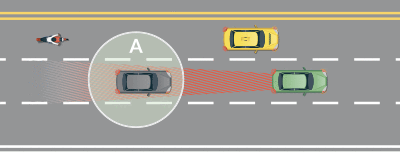
1. With the inside rearview mirror:
You can see A. You can’t see B or C.
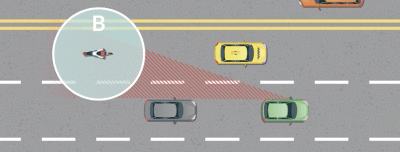
2. With the sideview mirror:
You can see B. You can’t see A or C.
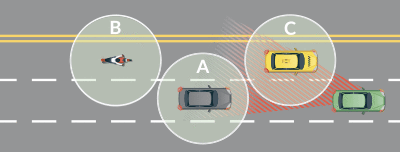
3. With both mirrors and a shoulder check:
You can see A, B and C.
Hand Signals
If your vehicle signals don’t work, use these hand signals:
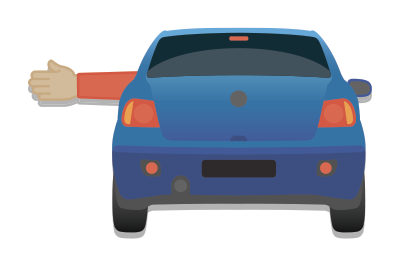
Left Turn: left arm extended straight out
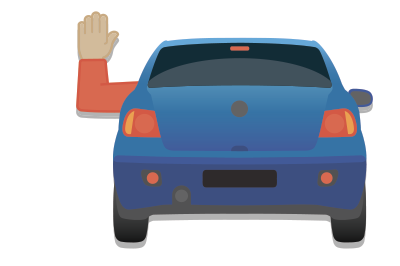
Right Turn: left arm out and bent upwards
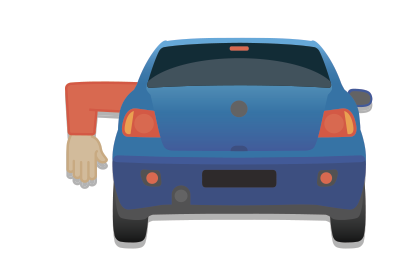
Stop: left arm extended out and bent downwards
Curves
- Slow down before entering a curve and avoid braking in the curve.
- If you do enter a curve too fast, don’t jam on the brakes. Instead, apply them carefully to keep control.
- When entering a left-hand curve, steer toward, but not over, the centre of the road.
- When entering a right-hand curve, steer toward the right side of the road.
- Beware of drivers who may have strayed into part of your lane.
- Decide well in advance where you are going to turn and move into the appropriate lane, following the correct lane-change rules.
- Once you are in the proper lane, signal at least 30 metres before the turn. Outside cities, towns or villages, signal at least 150 metres before turning.
- For cars with manual transmissions, shift to the proper gear before turning.
General Rules of Turning
General rules of turning
- Decide well in advance where you are going to turn and move into the appropriate lane, following the correct lane-change rules.
- Once you are in the proper lane, signal at least 30 metres before the turn. Outside cities, towns or villages, signal at least 150 metres before turning.
- For cars with manual transmissions, shift to the proper gear before turning.
Right Turns
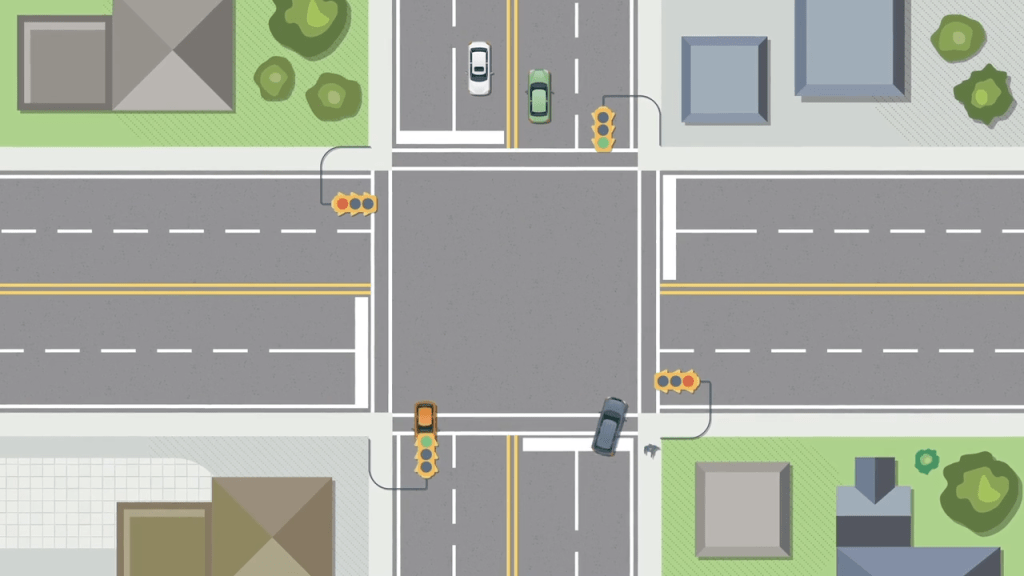
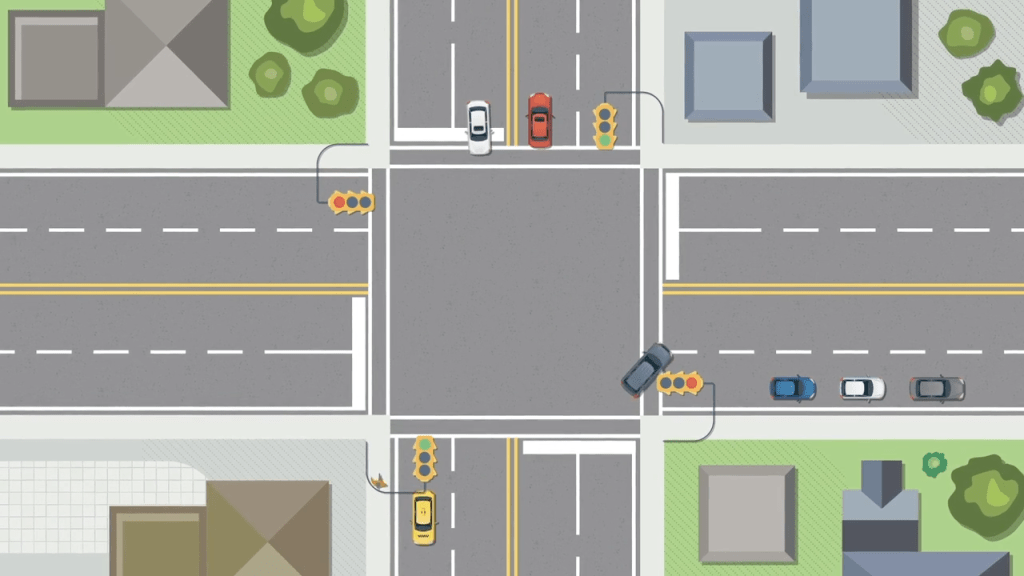
Right turns must be made from the right lane nearest the curb into the right lane nearest the curb of the other road, unless it’s blocked within 30 metres of the intersection. In that case, you can turn into the next lane nearest the right if no other traffic is approaching in that lane, such as a vehicle coming from the opposite direction also turning onto that street. Before making a right turn, watch and yield the right-of-way to pedestrians crossing the street.
Making right turns correctly
Right turns without parked cars:
Right turns with parked cars:
Making right turns in towns and villages
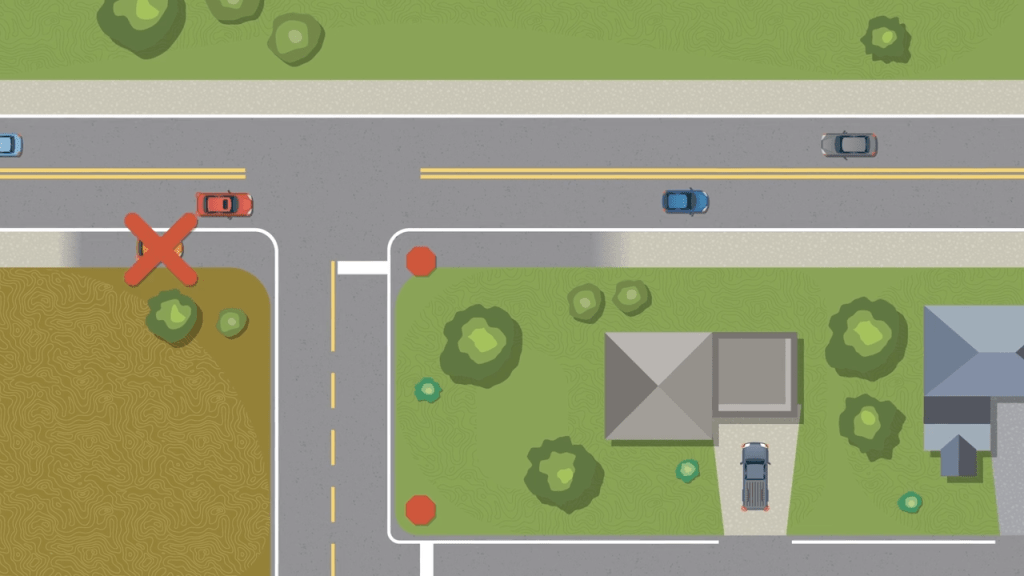
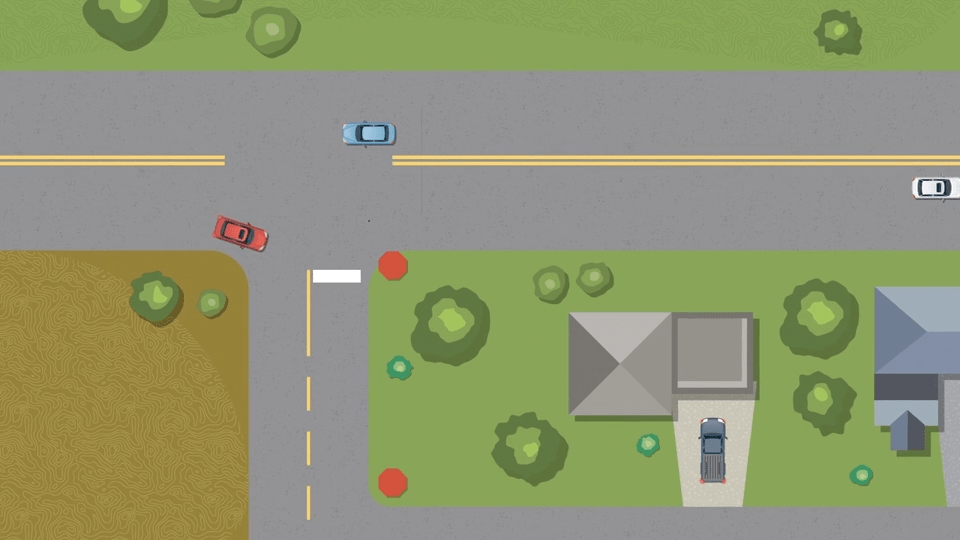
Some communities have a white line on the right side of the road. The area to the right of this line is the shoulder of the road. Stay to the left of the white line to make your turn (refer to Figure A). Extra caution should be taken when turning right as there may be someone driving illegally on the shoulder. On wide roads without white lines on the right side, keep well over to the right if you are turning right (refer to Figure B).
Making right turns on highways in high-speed areas
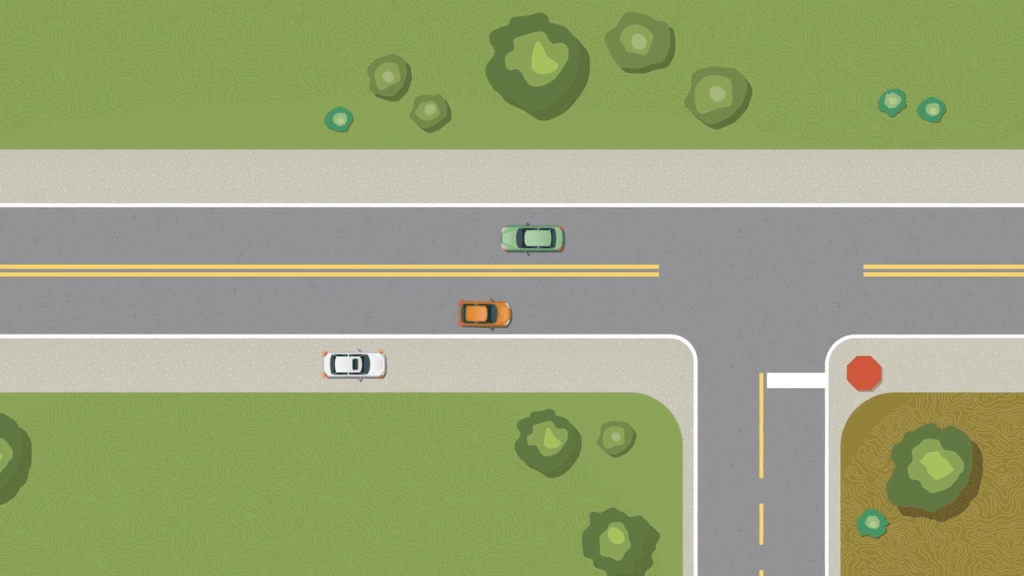
On highways outside towns and villages, solid white pavement markings identify the edge of the road, and the area to the right of this line is identified as the shoulder. The shoulder may be gravel or pavement. Don’t drive on shoulders as they’re intended as a safe place for stopped or disabled vehicles. A careful driver, however, should make a reasonable effort to get off the travel lanes as quickly as possible when turning right while being followed by high-speed through vehicles.
Left Turns
Left turns are more dangerous than right turns because of oncoming traffic. Different types of streets require different left turn procedures. Only make a left turn when it’s legal and safe.
When approaching the intersection, check for signs that may prohibit or restrict turns. Before making a left turn, enter the proper lane well before the intersection.
When approaching the intersection, signal for the turn and watch for:
- pedestrians at the crosswalk
- traffic coming from your left and right
- any vehicles established in or blocking the intersection
- traffic approaching from the opposite direction
Never enter any intersection:
- if it’s not safe to do so
- if you will not be able to clear the intersection because traffic is backed up in the lane you wish to enter
- if the intersection is blocked
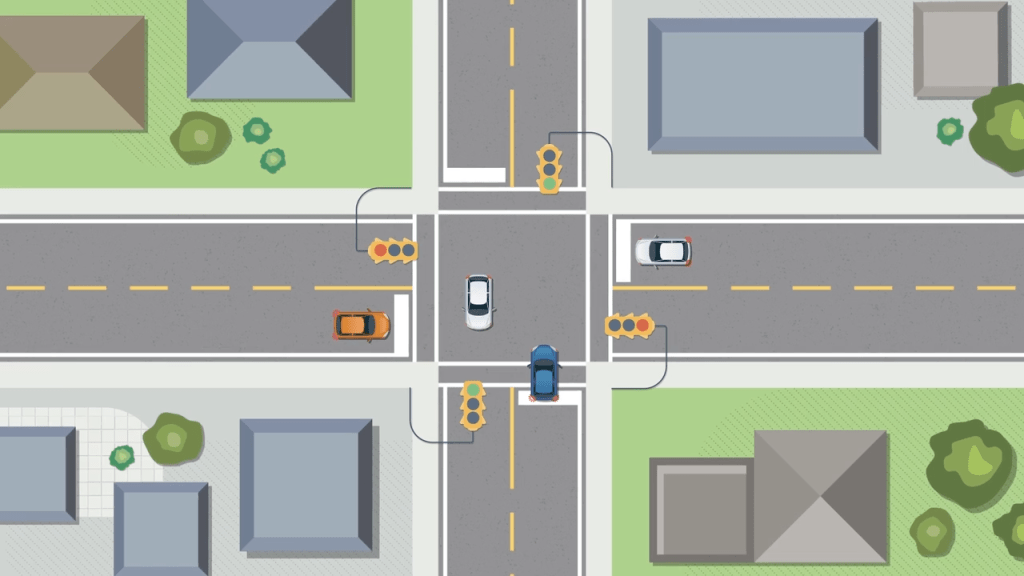
Making left turns on a green light
If you have stopped at a red light, when the light turns green, you must move into the intersection if it’s safe. Before moving ahead, you must check:
- for pedestrians crossing in front of you
- for traffic coming from left and right (watch for vehicles attempting to race the amber light)
If you are approaching an intersection and the light is green, you must check:
- to make sure the intersection is clear
- that it’s safe for you to enter
- that the light is still green
When it’s safe, move ahead to just before the centre of the intersection and just to the right of the directional oncoming line.
Once established in the intersection, you may clear the intersection when it’s safe and if:
- there’s no pedestrian traffic crossing the lanes you wish to turn into
- there’s a break in traffic big enough to complete your turn safely without interfering with oncoming vehicles
- no other vehicles are approaching
If the light turns yellow or red while you are established in the intersection, watch for traffic slowing down to stop and complete your turn when it’s safe. Always be alert to drivers attempting to race an amber light. (If you are not already established in the intersection, you must not attempt the left turn when the light changes from green.)
Making left turns from two-way onto another two-way street
- Well ahead of the turn, look for any following vehicles, signal and move close to the centre line.
- Slow down and look both ways before starting turn.
- Enter the intersection to the right of the directional dividing line.
- Make your turn to the left of the centre of the intersection.
- If turning onto a four-lane highway outside a city, town or village, move to the right after completing the turn, if traffic permits.
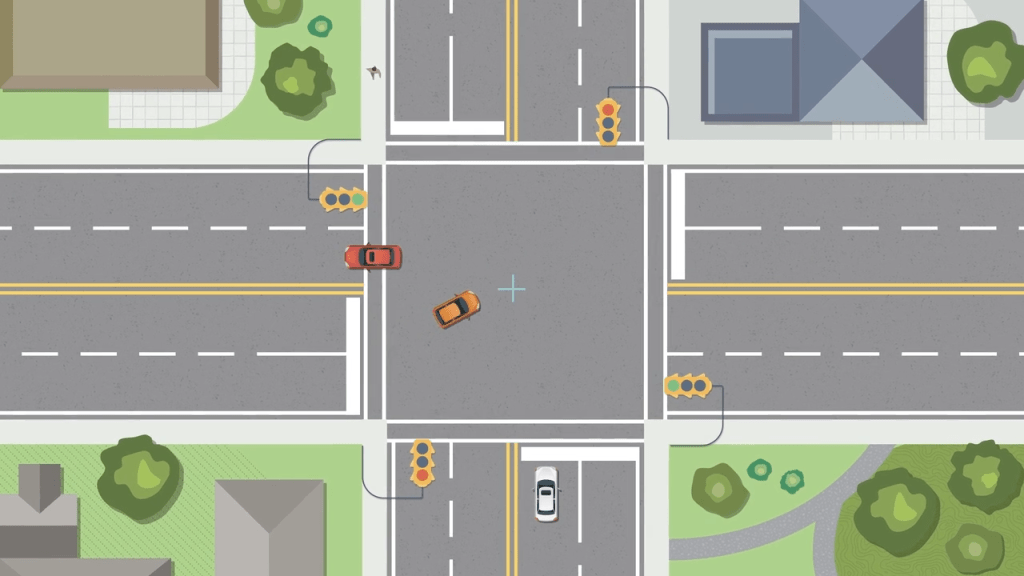
Making left turns when two lanes can turn
Complete this turn the same as any other turn except when two lanes are allowed to turn left at the same time. The vehicle closest to the median must complete the turn and stay in the lane closest to the median on the street being turned onto. The vehicle second from the median must turn into the second lane from the median on the street being turned onto. When turning with vehicles beside you that are also turning, watch for vehicles that may not stay in their own lane and be prepared to avoid them.
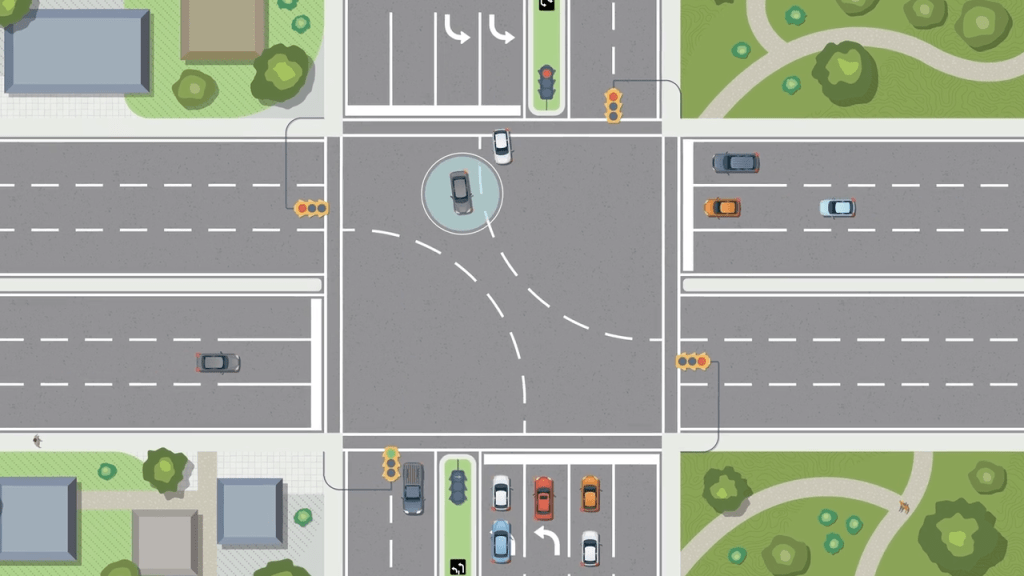
Making left turns from a street with a stop sign onto a street with a boulevard
- Make a complete stop.
- Check traffic and when there’s no traffic coming from the left or traffic turning in front of you and it’s safe, proceed. If traffic is approaching from the right establish your vehicle in the intersection.
- Complete your turn when it’s safe, to the left of the centre of the intersection in the boulevard area.
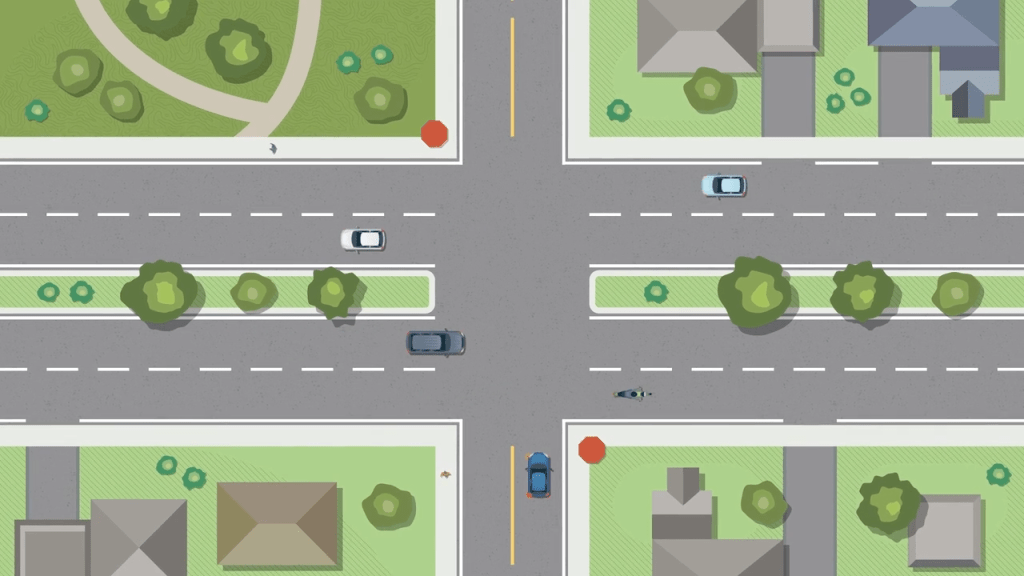
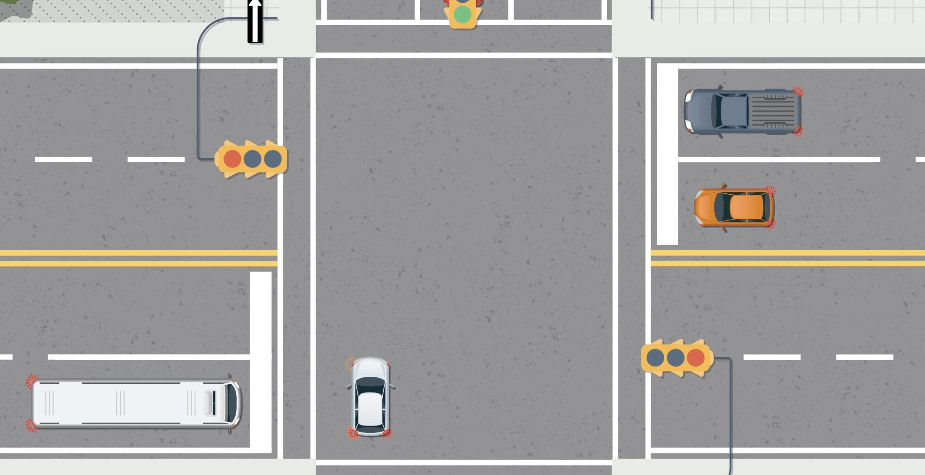
Making left turns from one-way onto another one-way street
- To make a left turn, the driver should, when safe, move into the left lane closest to the left curb.
- Slow down and begin your left turn after checking for traffic.
- Turn into the lane closest to the left curb unless blocked within 30 metres of the intersection.
- Unless otherwise indicated, you may turn left from a one-way street to a one-way street on a red traffic light, after stopping and yielding the right-of-way to pedestrians and other traffic.
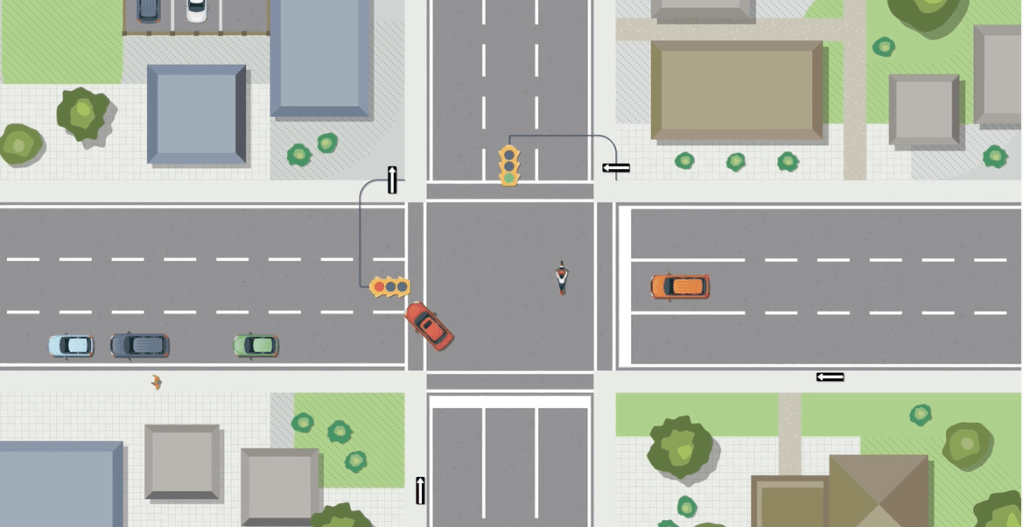
Making left turns from one-way onto two-way street
- Signal well ahead of the turn and, when safe, move into the left lane closest to the left curb.
- Slow down and begin the left turn from a point as close as possible to the left curb or edge of the roadway.
- When entering the two-way street, turn into the lane immediately to the right of the centre line.
Making left turns from two-way onto one-way street
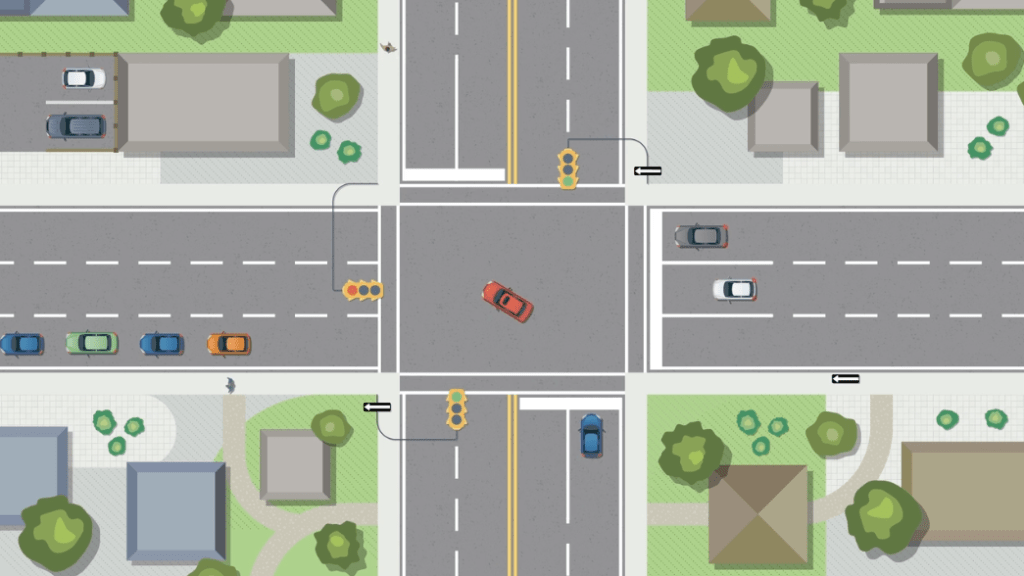
- Signal and, when safe, move into the lane next to the centre line in preparation for the turn.
- Slow down before entering the intersection, check for traffic ahead and to the right and, when safe, begin the turn.
- Turn from the lane next to the centre line into the lane nearest the left curb unless it’s blocked within 30 metres of the intersection.
Making left turns onto driveways and lanes
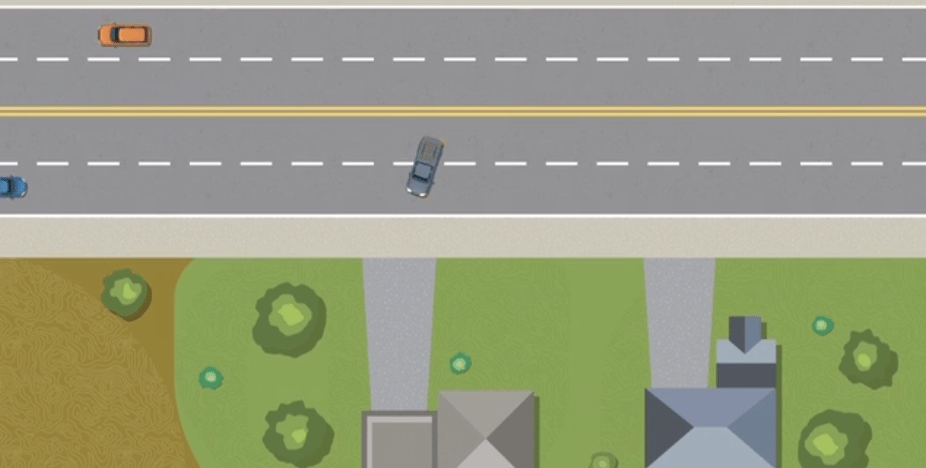
To make a left turn onto a driveway or back lane, signal and move into the proper lane before turning left.
U-turns
Although under certain situations it’s legal to make a U-turn, we advise against it unless it’s at an intersection controlled by a U-turn traffic signal. Instead, in cities, you should go around the block to change directions.
In rural areas, continue ahead until you can turn onto a side road from which you can then make a regular turn onto the highway in the desired direction. With the higher speeds prevailing on highways, it’s extremely dangerous to make a U-turn.
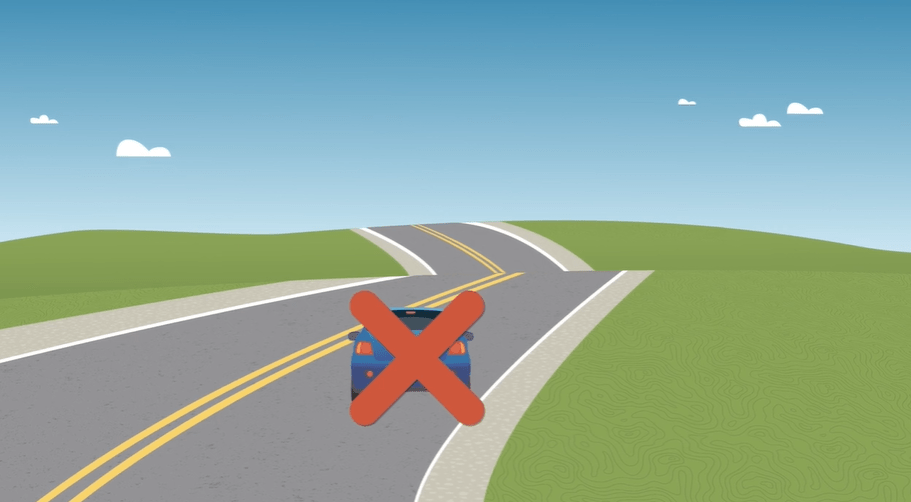
U-turns are prohibited at:
- curves
- approaches to or near the crest of a hill where there’s not at least 150 metres of clear view of oncoming traffic
- places where a sign prohibits U-turn
Roundabouts
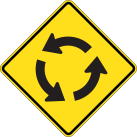
When approaching a roundabout you will see a roundabout sign.
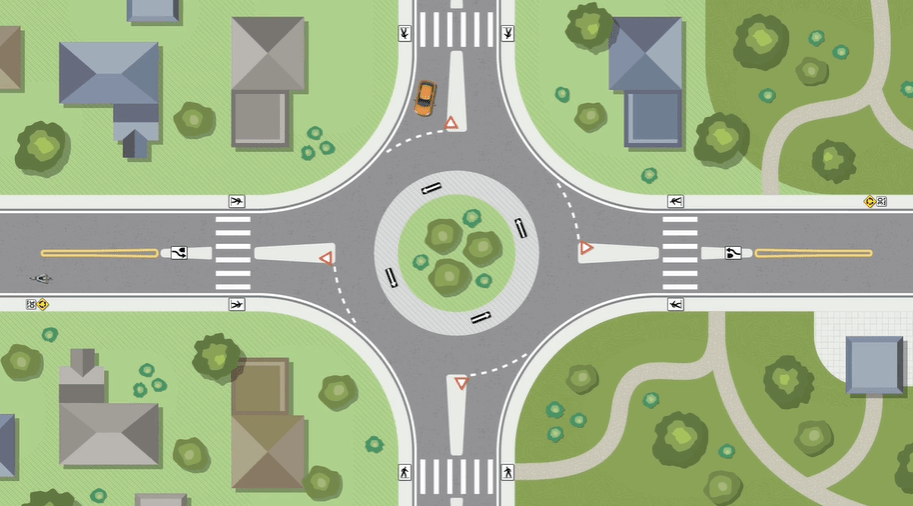
Reduce your speed to the posted speed limit or slower and be prepared to yield to pedestrians, cyclists and vehicles in the roundabout. When no traffic is approaching from the left you may proceed into the roundabout. If two vehicles arrive at the same time, the vehicle on the right should enter the roundabout first. When on the roundabout, you have the right-of-way over vehicles entering. Continue until you reach the street you wish to exit on, signaling your intention to exit in advance. As you exit, watch for pedestrians within the pedestrian corridor and yield the right-of-way to pedestrians and cyclists.
 Apperture Labs