Circle Check — Exterior of Vehicle
As a driver, you are responsible for ensuring that your vehicle is safe to drive. Vehicles should be thoroughly checked at least twice a year. A police officer can order you to have defective equipment repaired immediately. If you fail to comply, your vehicle registration may be suspended until a qualified mechanic certifies the defects have been repaired.
Is your vehicle safe to drive? Check:
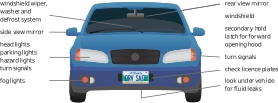
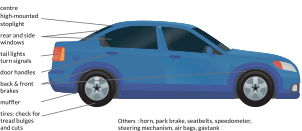
Required Equipment
The following equipment must be in safe working condition:
Brakes
Brakes must be able to stop passenger vehicles travelling at 30 km/h within 7.6 metres. Other motor vehicles, such as trucks and vans under 4,540 kg, must be able to stop within nine metres. All brakes should be periodically checked and, if necessary, adjusted.
Lights
All motor vehicles, except motorcycles, must have:
- Two to four headlights, including a high beam and low beam on each side, in good working order (Vehicles must also have a high-beam indicator light. When operating your vehicle, headlights must be switched on a half hour before sunset until a half hour after sunrise and when visibility is reduced to 60 metres. A recommended safe driving practice is to drive with headlights on all the time.)
- Functional daytime running lights, if manufactured on or after Dec. 1, 1989 (For motorcycles and mopeds, model year 1975 or later, a headlamp must be on at all times when being operated.)
- Turn signals — amber or white lights at the front, red or amber lights at the rear (Motorcycles of the model or make of the year 1974 or earlier and mopeds are not required to be equipped with signal lights. Trailers require signal lights on the rear only.)
- At least two rear red lights or, for vehicles dated 1967 or earlier, at least one rear red light
- One functional centre high-mounted stop light, in addition to the regular stop lights, if it’s a passenger car manufactured after 1986
- One white light for the rear number plate
- At least one red light on the rear plus a stop light, if a trailer is attached (Towed vehicles with a width exceeding 2.05 metres, except passenger cars, must have clearance lights and reflectors at the front and rear.)
- A red flag clearly visible at the end of a load during daylight and a red light or reflector at the end of a load at night, if the load extends one metre or more past the rear of the vehicle
Tires
To maximize the safety and life of your tires:
- Use tires of the same construction and size. Your owner’s manual should inform you which is best for your vehicle.
- Using an accurate tire pressure gauge, check the air pressure of your tires at least once a month and after long trips. The best time to inflate tires is when they’re cool.
- Check your owner’s manual to determine if and when you should rotate tires.
- Always replace tires when the tread is less than 1.6 millimetres. After replacing tires, have the wheels balanced.
- Studded tires are illegal between April 30 and Oct. 1.
Remember: A tire with deep cuts, cracks, blisters or bulges is dangerous and should be replaced.
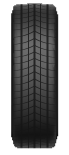
exposes the wear indicators between two or more adjacent grooves. Replace the tire when the wear indicators become visible.
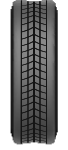
will cause a tire to wear out at the edges first. This tire’s smooth edges may causes kids on wet curves and must be replaced.
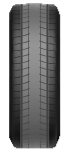
causes the tire to wear out in the centre first. This tire is dangerously worn and must be replaced.
Mirrors
All motor vehicles must be equipped with a mirror, providing a clear rear view. Vehicles such as vans, buses, trucks, campers, cars pulling trailers and other vehicles must have outside mirrors on the right and left sides. Extended mirrors must be removed when a trailer is not being towed.
Horn
All motor vehicles must have a horn that can be heard for at least 60 metres. A horn should be sounded only when necessary.
Windshield and windows
There must be a clear view from the front windshield, side and rear windows. From Nov. 1 to March 31 inclusive, your vehicle must be capable of keeping the windshield, the rear window and the windows at both sides free from frost
Windshield wipers and washers
Front windows must have windshield wipers in good working condition and every motor vehicle dating from 1971 (except motorcycles or mopeds) must have a functioning windshield washer with the fluid container topped up as necessary.
Speedometer and odometer
A motor vehicle must have a speedometer and odometer in good working order. It’s illegal to alter the distance shown on an odometer.
Muffler
All motor vehicles must have a muffler capable of preventing excessive noise. A leaky muffler can cause carbon monoxide poisoning. It’s illegal to use a muffler cut-out, straight exhaust, gutted muffler, hollywood muffler, bypass or any device that reduces the effectiveness of a noise muffler.
Bumper
Every passenger car must have a bumper at the front and rear
Suspension
It’s illegal to raise or lower the original suspension of a passenger car.
Other Equipment
Oil pressure gauge
This gauge shows if there’s sufficient oil pressure to motor parts where it’s needed.
Temperature gauge
This gauge shows the temperature of the engine. Don’t operate the vehicle if this gauge shows a high temperature.
Ammeter/voltmeter
This gauge shows when the battery is being charged or discharged.
Fuel gauge
This gauge identifies the amount of fuel left in the fuel tank.
Warning light
Most vehicles are equipped with warning lights to notify the driver of problems with certain operating systems on the vehicle. If a light is illuminated, consult your vehicle operating manual.
Airbags
Airbags are built into steering wheels, dashboards and in the sides of some vehicles. They launch automatically when there’s a very fast deceleration such as a crash. They give drivers and passengers extra protection, especially during head on and side impact crashes.
Seatbelts
All drivers and passengers must wear the complete seatbelt assembly, where a seatbelt assembly is provided, unless exempted by law.
Ensure the seatbelt is worn properly:
- It must be snug over the shoulder and across the hips.
- The seatbelt fabric must be flat and not twisted.
- The seatbelt must be kept over the shoulder and not under the arm as this could cause serious injury in a collision.
Infant and Child Car Seats
Rear-facing infant car seats
Use a rear-facing seat from birth until your baby reaches the maximum weight and height limits listed in the car seat manual. Some car seats are made for children up to 20 kg (45 lb.).
Rear-facing seats offer the best protection because they distribute the impact of a collision along the back of the car seat, which protects your baby’s fragile head and neck.
Installation
- The safest position for a car seat is the vehicle’s rear middle seat. If you have more than one child, place the youngest in the middle as their smaller bodies are not strong enough to withstand the impact of a crash.
- Use a seatbelt or Universal Anchorage System (UAS) to install the seat. Don’t use both.
- Check the tension where the UAS or seatbelt is routed through the car seat. You should not be able to move it more than one inch in any direction.
- At least 80 per cent of the infant car seat must be in contact with the vehicle seat.
- Check the level indicators to ensure the infant car seat is at a 45 degree angle
Check the fit
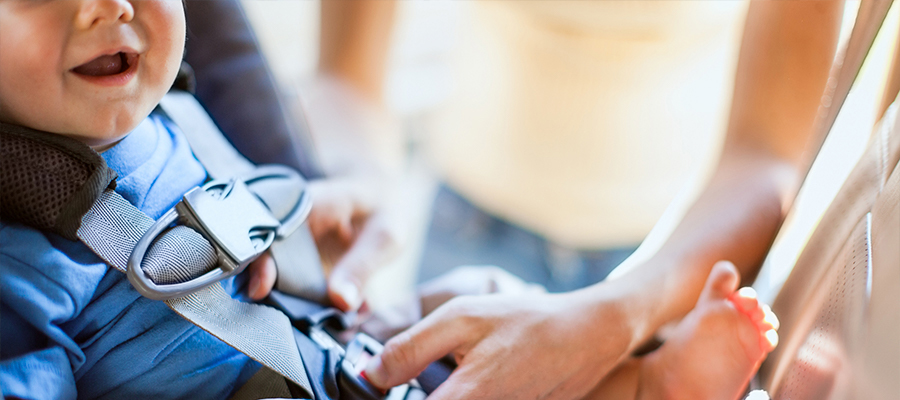
✔ The harness straps should be in the slot that is level with or below your child’s shoulders and fit snugly so you can fit only one finger between your baby’s collarbone and the straps. The straps should lay flat.
✔ The straps should be at or below the shoulders to prevent your baby from sliding out of the car seat.
✔ The chest clip should be at armpit level.
Forward-facing child car seats
Once your child reaches the weight and height limits of their rear-facing seat, they can move into a forward-facing seat. Look for a forward-facing seat that will meet the weight and height requirements of your child for as long as possible. Some seats are made for children up to 30 kg (65 lb.).
The harness straps in a forward-facing seat are designed so the impact is taken where your child’s body is strongest — the shoulders and chest, and then directed down to the hips.
Installation
- The safest position for a car seat is the vehicle’s rear middle seat. If you have more than one child, place the youngest in the middle, as their smaller bodies are not strong enough to withstand the impact of a crash.
- The tether strap must always be used to secure the top of the car seat to the vehicle.
- Use a seatbelt or UAS to install the seat. Don’t use both.
- Check the tension where the seatbelt or UAS is routed through the car seat. You should not be able to move the car seat more than one inch in any direction.
Check the fit
✔ The harness straps should be in the slot that is level with or above your child’s shoulders and fit snugly so that you can fit only one finger between your child’s chest and the straps. The straps should lay flat.
✔ The middle of your child’s ears should not come past the top of the seat.
✔ The chest clip should be at armpit level.
Booster seats
Once your child reaches the weight and height limits of their forward-facing seat, they can move into a booster seat. Because weight limits can vary among forward-facing seats (some can accommodate children up to 30 kg or 65 lb.), please check the manual for the weight limits of your specific car seat.
Provincial law requires children to remain in booster seats until they’re at least 145 cm (4’9″), 36 kg (80 lb.) or nine years old.
Without a booster seat, a seatbelt rides too high on a child’s stomach and neck and can cause serious injuries. Research shows that booster seats protect children from serious injury by more than 45 per cent.
How to choose a booster seat
If your vehicle does not have a head rest, choose either:
- A high-back booster seat that provides head and neck support. Some models convert from a forward-facing seat with a harness to a high-back booster seat.
- An adjustable booster seat that provides adjustable head and neck support as your child grows
If your vehicle has a head rest, choose a backless booster seat, an adjustable booster seat or a backless booster seat that has a seat base and arm rests.
Installation
- The safest position for a car seat is the vehicle’s rear middle seat. If you have more than one child, place the youngest in the middle, as their smaller bodies are not strong enough to withstand the impact of a crash.
- Keep an empty booster seat buckled up to prevent it from moving and hitting you in a sudden stop or crash.
Check the fit
✔ The shoulder strap should fit over the shoulder and across your child’s chest.
✔ The lap belt should sit snug on their hips.
✔ The middle of your child’s ears should not come past the top of the vehicle’s head restraint. The head restraint ensures your child has adequate head and neck protection in a collision.
✔ The bend of your child’s knees should be in line with the vehicle seat.
✔ Never use just a lap belt to secure a child in a booster seat. Always use a shoulder and lap belt.
✔ Never allow your child to place the shoulder belt under their arm or behind their back as this can cause serious injury.
Seatbelts
For your child’s safety, provincial law requires children to remain in booster seats until they’re at least 145 cm (4’9″), 36 kg (80 lb.) or nine years old.
It’s important not to rush to using a seatbelt alone because it’s not designed for a child — the shoulder strap rides too high and could cause serious injuries.
Check the fit
✔ Sitting up straight, the seatbelt should fit across your child’s shoulder and chest and sit low across the hips.
✔ The middle of your child’s ears should not come past the top of the vehicle’s head restraint. Adjust the head restraint to ensure your child has adequate head and neck protection in a collision.
✔ The bend of your child’s knees should be in line with the vehicle seat.
✔ Never allow your child to place the shoulder belt under their arm or behind their back as this can cause serious injury.
The chances of being fatally injured in a collision can be decreased by as much as 70 per cent if you wear a seatbelt. Shoulder belts further increase your safety.
Environmental Consequences of Driving
If you keep a vehicle well tuned and maintained, it will help control the emission of pollutants. However, even the best maintained vehicles will continue to emit gases such as carbon dioxide, carbon monoxide, nitrogen oxides and sulphur dioxide, and volatile organic compounds.
These gases adversely affect our health and are significant enough to affect the environment.
The following are some things drivers can do to reduce these effects:
- Keep your vehicle well tuned and maintained and tires properly inflated. Check pollution controls regularly.
- Drive only when you must and consider walking when relatively short distances are involved.
- Don’t let your engine idle while your car is parked.
- Before buying or leasing a vehicle, check its fuel efficiency. The less fuel a vehicle burns, the less pollution it creates and the more money you save at the gas pump.
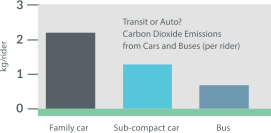
Consider taking the bus as much as possible. Cars produce 50 per cent of the carbon dioxide emitted by vehicles. The carbon dioxide per rider produced by the average family car is almost four times that produced per rider by a half-empty bus.
Fuel Efficient Driving Techniques
Safety should be your number one concern every time you get behind the wheel of a vehicle. The good news is that practicing defensive driving techniques not only improves road safety, it also reduces fuel consumption and cuts exhaust emissions that contribute to climate change and urban smog. Depending on your driving habits and how often you drive, these basic techniques and useful tips could save you hundreds of dollars a year in fuel and maintenance costs:
- It’s both safer and more fuel-efficient to maintain a steady speed on the road. Speed up smoothly when passing or merging with faster traffic and avoid hard braking. European tests have shown that aggressive driving — frequent, rapid speeding up and hard braking — can increase fuel consumption by up to 25 per cent.
- Never drive faster than the posted speed limit. Increasing your highway cruising speed from 100 km/h to 120 km/h will increase fuel consumption by up to 20 per cent.
- Plan your trips to combine errands and to avoid traffic jams, steep hills, road construction, etc. Combining a number of short trips into one longer one allows your engine and drivetrain to reach peak operating temperature, which is not possible on trips of less than five kms. Avoiding trouble spots shortens your travel time and reduces unnecessary idling.
- If you are driving a vehicle with a manual transmission, learn how to use it properly for maximum fuel savings. A tachometer can help you shift the transmission at the most fuel efficient engine speeds (the owner’s manual will indicate these speeds).
- If you have cruise control, use it for highway driving to maintain a constant safe speed and save fuel. The exception is on hilly terrain, where it’s a good idea to allow the vehicle’s speed to drop slightly going uphill and then let gravity help you build up speed again (to a safe level) going down the other side. Avoid using cruise control while driving on slippery or winter roads.
- In summer, minimize your use of air conditioning. Operating an air conditioner in hot weather can increase fuel consumption by more than 20 per cent in city driving. A more fuel-efficient option for staying cool is to open a window. However, at highway speeds, use your car’s flow-through ventilation — open windows and sunroofs increase aerodynamic drag, which makes the engine work harder and consume more fuel. If you must use your vehicle’s air conditioning, avoid running it continuously. Shut it off after the interior is cool or set the controls to a comfort level that allows the system to cycle.
- Check tire pressure at least once a month when the tires are cold (i.e. the vehicle had been parked for at least three hours or had not been driven more than two kms). If you have to drive more than two km to add air, check the tires before you leave and then add the amount of air that is missing from this reading. Inflate the tires to the recommended pressure, usually indicated on the car door, glove compartment or in the owner’s manual. With proper tire inflation, your car will burn less fuel and be safer to drive. Operating a vehicle with just one tire under inflated by 56 kilopascals (eight pounds per square inch) can reduce the life of the tire by 15,000 km and can increase the vehicle’s fuel consumption by four per cent (Transport Canada).
- Use an engine block heater in the winter to warm the engine coolant as this makes cold starts easier on your engine and electrical (battery, starter, etc.) components. To prevent freezing of your engine coolant, it should be rated for -35°C or colder or as recommended by the manufacturer. In addition, it will assist in the vehicle’s engine oil to get to the moving parts quicker to reduce premature wear. Use a timer to switch the block heater on four hours before you plan to drive. Proper use of a block heater can improve your vehicle’s overall fuel economy by as much as 10 percent. Don’t leave your block heater on overnight or your energy saving will disappear in a higher electricity bill.
- Follow the vehicle manufacturer’s recommended operating procedures and maintenance schedule in your owner’s manual. Regular maintenance such as oil and filter changes will not only prevent early breakdown of your vehicle’s parts, it will also keep them operating at their most fuel-efficient level. A clogged air filter can increase fuel consumption by up to 10 per cent. Regular maintenance will keep your vehicle operating safely, save you money and help the environment.
- Remote car starters are handy on cold winter mornings, but don’t start your car too soon. In most driving conditions, engines need to warm up for only 30 seconds, even on cold mornings. Also, allowing your car to idle too long wastes gas and produces unnecessary exhaust emissions.
- Idling for more than 10 seconds, except in traffic, wastes more fuel than stopping your engine and restarting it again. At the end of the day, stopping unnecessary idling will benefit the environment and save you money.
 Apperture Labs