Motorcycles represent less than 1 in 50 of all licensed vehicles in Ireland, but motorcycle users account for 1 in 8 road deaths. In a crash, motorcycle and moped users have less protection than drivers or passengers in vehicles.
This section is aimed at motorcyclists, including those who use mopeds, and describes how you can keep yourself safe on the road. Trained motorcyclists around the world prove every day that biking can be a fun, safe and satisfying activity if you have appropriate skills, the right attitude to safety and the benefit of education and training.
Licence
You musthold a current driving licence or learner permit for a motorcycle or moped. See section 1 for information on licences and permits and the categories of vehicle they cover.
As a motorcyclist on a learner permit you mustdisplay an ‘L’ on a yellow fluorescent tabard to give greater awareness to other road users that you are a learner and that additional care may be required. The ‘L’ must conform in size and colour to the normal ‘L’ plate.
If you have recently obtained your first driving licence (full driving licence) you will be classified as a ‘Novice’ driver and mustdisplay N plates on a yellow fluorescent tabard. This tabard must be worn over your clothes and the plates shouldbe clearly visible on the front and rear of your body.
Insurance and Tax
You must display a current motor tax disc and have insurance cover before you can take your motorcycle or moped on a public road.
All new first time learner permit holders for motorcycles must undertake Initial Basic Training (IBT) with an approved IBT instructor, before they can ride a motorcycle unsupervised.
What is IBT?
InitiaI Basic Training (IBT) is a training course that teaches basic riding skills to learner motorcyclists. In its basic form, IBT is a 16-hour course broken into 4 modules focusing on theory and practical skills, to be taken in sequence.
When you have completed each IBT Module on your IBT course, your instructor will record the details of your training in your logbook and, once all modules have been completed, issue you with a Certificate of Satisfactory Completion.
You must keep your Certificate with your learner’s permit and carry it with you whenever you are riding on the public road or in a public place, as you may be asked to produce it by a Garda.
You can then apply for your practical driving test.
Carrying passengers
You must not carry a passenger if you hold a learner permit as this is illegal. If you wish to carry a passenger, make sure your full licence and your insurance policy allows you to do so. The rider must make certain the passenger is wearing a properly fitted crash helmet. The rider should make certain the passenger wears appropriate PPE (Personal Protection Equipment, that is, motorcycle jacket, trousers, gloves and boots – all properly fitting). A rider must not carry more than one pillion passenger, who must sit on a proper seat. They must face forward and be capable of resting both both feet on the footrests. Riders must not carry a pillion passenger unless their motorcycle is designed to do so.
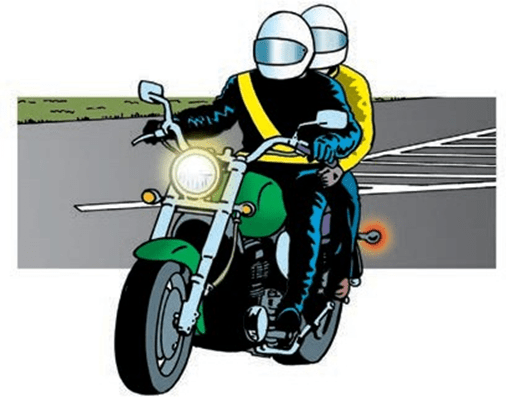
Daylight riding
- Make yourself as visible as possible from the side, as well as the front and rear.
- Wear a white helmet and fluorescent clothing or strips.
- Use dipped headlights. Even in good daylight, they may make you more visible.
Night-time riding
Wear reflective clothing or strips to improve your chance of being seen in the dark. These reflect light from the headlamps of other vehicles, making you more visible from a long distance.
Lights
You must have on your motorcycle or moped:
- A white or yellow head lamp;
- A red rear lamp;
- A red rear reflector; and
- A number plate light on the back.
To be seen at all times, bear the points below in mind:
- Use your dipped headlights at all times.
- Use headlights at night and during the day when visibility is seriously reduced.
- Slow down, and if necessary stop, if you are dazzled by oncoming headlights.
- Use full headlights when appropriate to do so.
- Use your hazard warning lights when your motorcycle or moped is stopped in a dangerous place.
- Make sure all sidelights and rear number plate lights are lit at night.
Personal protective equipment
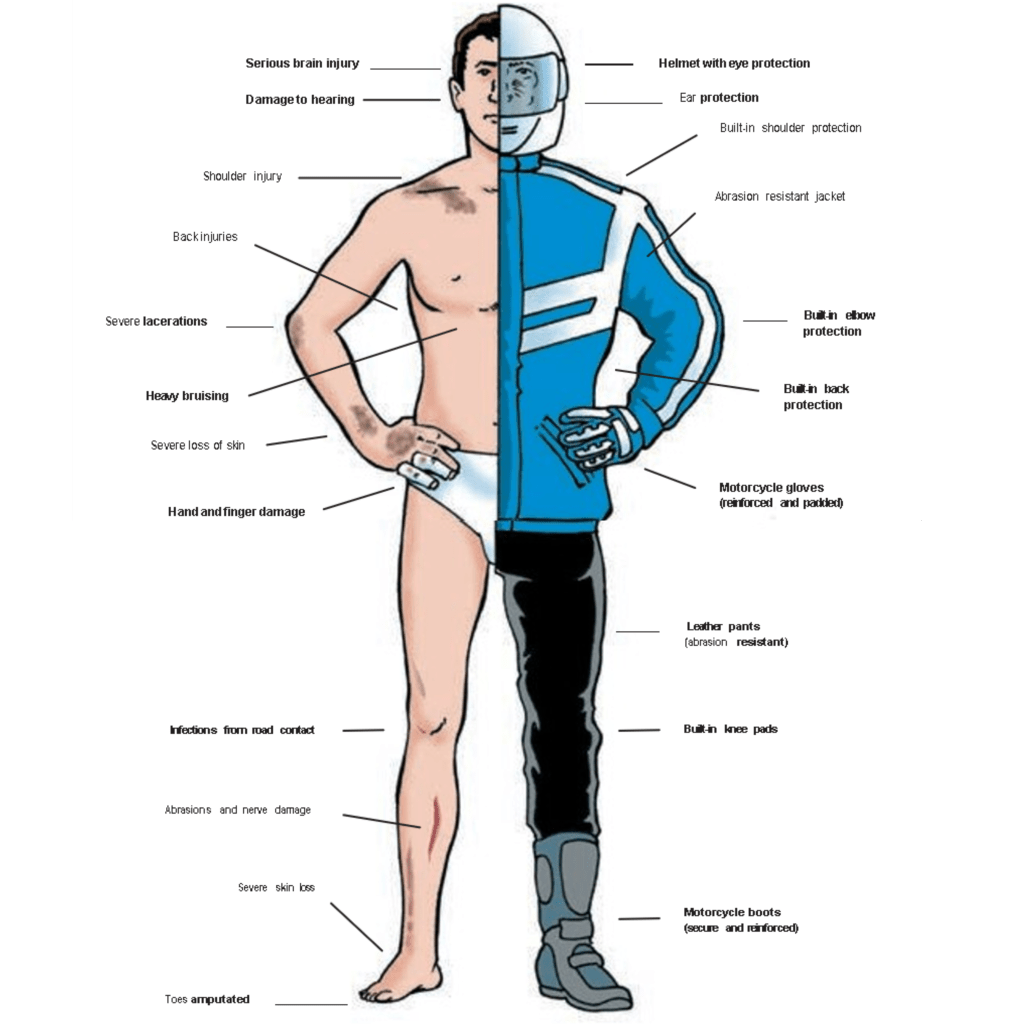
Wear appropriate clothing and a secure helmet every time you get on your bike.
Protective clothes
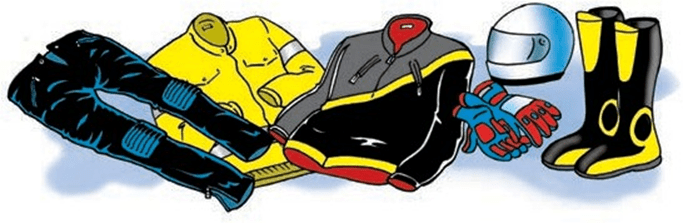
- Jackets and trousers should give you enough protection from impact, abrasion, cold and weather conditions.
- Use body armour on exposed areas such as the back, knees, elbows, shoulders, hips and shins. This should be adjustable so it fits snugly and does not move in a crash.
- You should wear a good reflective jacket, to make you more visible on the road.
- Wear protective gloves, and footwear that comes above the ankle at least.
Remember: It is a fixed charge offence of €80 to use a motorcycle without wearing a helmet or to permit a passenger to ride on a motorcycle without wearing a helmet.
Helmets
- Buy from reputable dealers. Try several different sizes and makes. Make sure the dealer knows how to assess fit.
- Never buy or use second-hand helmets.
- Never lend your helmet to someone else.
- If your helmet is damaged, replace it.
- Read the manual for your helmet and follow the care instructions.
- Clean your visor gently with warm soapy water.
- Use a helmet with a clear visor. If you use a dark visor, it will be almost impossible for you to see oil on a wet road.
- Replace the visor if it is scratched.
- Make sure your helmet is securely fastened. An unsecured helmet is illegal and useless in a crash.
- Do your research before you buy. Ensure all equipment meets EU standards.
NOTE: The strap retention system
Different makes and types of helmet come with different ‘strap retention systems’, e.g. D-rings, clip and buckle, quick-release, etc. Whichever type of helmet is chosen, it is essential to ensure that the retention straps fitted to the shell of the helmet have some type of restriction system to prevent the strap pulling through the buckle, e.g. ‘a stitched folded ridge across the end of the strap’. The danger in not having such a restriction system on the straps is that, in the unfortunate event of an accident or collision, the helmet may offer little or no protection as the strap could potentially pull through the buckle, releasing the helmet from the rider’s head, resulting in death or serious injury.
Eye and ear protection
- Use ear protection on long journeys.
- If you wear an open-face helmet (one without a chin bar), make sure you wear eye protection.
- When riding a motorcycle, do not use a personal entertainment system.
Personal protective equipment
Riding a motorcycle
As a motorcyclist you must obey the law governing traffic. You need to develop:
- A high level of attention;
- An awareness of likely hazards;
- Good anticipation; and
- Excellent observational skills.
You also need to make the most of the advantages of height, positioning, flexibility and manoeuvrability a motorcycle provides. The ability to sense danger in a situation develops only with experience, so you should always ride within your abilities.
Always make sure that the road space you intend to enter is completely safe, and be aware that others may be looking at larger objects and not the narrow profile of the motorcycle. Gravel chips, sand, pools of water and rough surfaces can seriously destabilise motorcycles and can be a cause of crashes. Reduce speed before hazards such as these, and continue riding with extreme caution.
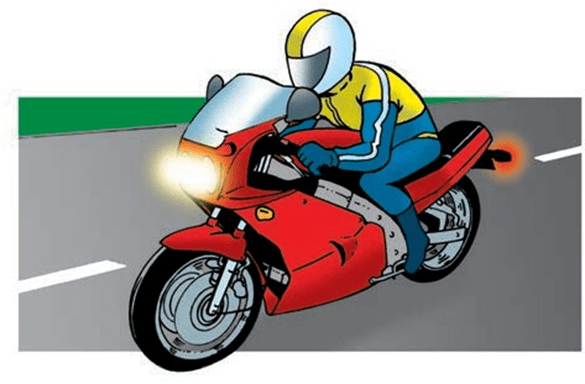
Follow the rules below.
- Avoid riding between traffic lanes.
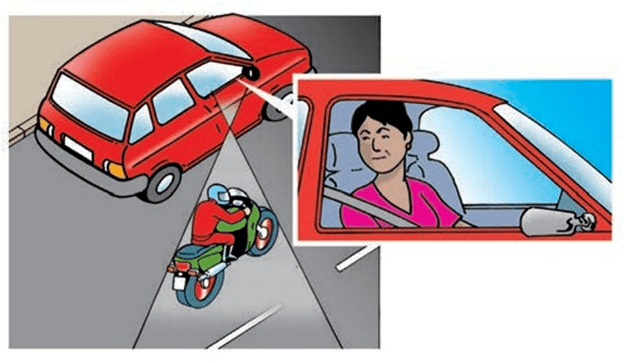
- Keep well clear of other vehicles when passing them. Remember that drivers might not always see you in their ‘blind spots’.
- If your machine is fitted with indicators and a brake light, use them. However, if other road users cannot see these signals, or if you think they might not be working, you should give clear hand signals as well. See section 7 on hand signals.
- Use rear-view mirrors if your motorcycle or moped is fitted with them. Remember, though, not to rely on your mirrors when moving off, changing lane, turning right and overtaking. You should also look over your shoulders and check any ‘blind spots’.
Your motorcycle tyres must have a tread depth of at least 1 mm, but you should replace them before they become this worn.
Tactics for surviving as a motorcyclist
- Watch your surroundings.
- Watching your surroundings means watching:
- Into the far, middle and near distance; and
- Behind you, using your mirrors and checking over your shoulders, before changing position or turning.
- Watching your surroundings means watching:
- Keep your distance.
- Use the ‘two second rule’. In wet or icy conditions, always leave a bigger gap.
- Be seen.
- Make sure your position is correct. Use dipped headlights and wear high visibility clothing (such as a neon vest and ‘Sam Browne’ reflective belt).
- Do not surprise others.
- Never do anything on the road that could cause another road user to slow down, brake or swerve or that could startle pedestrians.
- Think like other road users.
- Anticipate how other road users might react.
- Read the road.
- In other words, ride to current road, weather and traffic conditions.
- Adopt the right speed for the conditions.
- Never let others dictate your pace.
- Never ride your bike after consuming alcohol or drugs.
- Trust your machine by maintaining it properly.
- Follow the acronym POWDERS and check petrol, oil, water, damage,
electrics, rubber (tyres) and security.
- Follow the acronym POWDERS and check petrol, oil, water, damage,
 Apperture Labs